




Advertisement


ANALYSIS: How Global Crisis Drive Prices in Nigeria
By Lawal Dahiru Mamman,
“Every bullet, every bomb, every shell that hits a target in Ukraine, hits our pockets and our economies in Africa.” That was how Ghana’s President Nana Akufo-Addo captured the Russia-Ukraine crisis in 2022, and in October 2026 the same sentence explains why a crisis in faraway lands affects us in Nigeria despite our enormous resources.
Last month, the Chairperson of the African Union Commission, Mahmoud Ali Youssouf, warned that continued escalation of the Middle East conflict worsens global instability, with serious implications for energy markets, food security and economic resilience, particularly in Africa where economic pressures remain acute.
Ethiopia’s Prime Minister, Abiy Ahmed, echoed the same sentiment days later, saying decisions taken far beyond Africa’s borders increasingly affect the lives of its citizens.
Nigeria stands as the clearest case study of how pandemic scars, energy shocks, currency fragility and domestic policy choices compound into prolonged hardship for citizens who move from pillar to post daily in search of a livelihood.
From Pandemic to Global Shock
After the global disruptions caused by the COVID-19 pandemic in 2020, what began as a post-COVID recovery mismatch evolved into a multi-year squeeze on households worldwide. Supply chain disruptions, lockdown-driven demand shifts and fiscal stimulus fuelled early price pressures.
Russia’s 2022 invasion of Ukraine then supercharged energy and food markets. According to the Council on Foreign Relations Global Inflation Tracker, which draws on International Monetary Fund (IMF) data, median global inflation climbed from around 1.9 per cent in late 2020 to 8.7 per cent by the third quarter of 2022.
Data from the United Nations (UN) Food and Agriculture Organisation’s May 2026 update shows global food Consumer Price Index (CPI) inflation peaked at near 13 per cent in 2023 before easing, while general inflation rose from 1.6 per cent in 2021 to 8.6 per cent in 2022.
The impact was unequal. Analysis from the World Bank’s Global Database of Inflation shows developing economies saw cumulative price increases of roughly 35 per cent between 2020 and 2024, versus about 20 per cent in advanced economies. Low-income households bore the brunt because necessities form a larger share of their spending.
Energy was the trigger. The political fallout was immediate. An analysis of ACLED data by researchers reported by POLITICO and the Friedrich-Ebert-Stiftung found more than 12,500 protests related to food, energy and the cost of living erupted across 148 countries between late 2021 and late 2022.
October 2026: The Crisis Returns to Europe
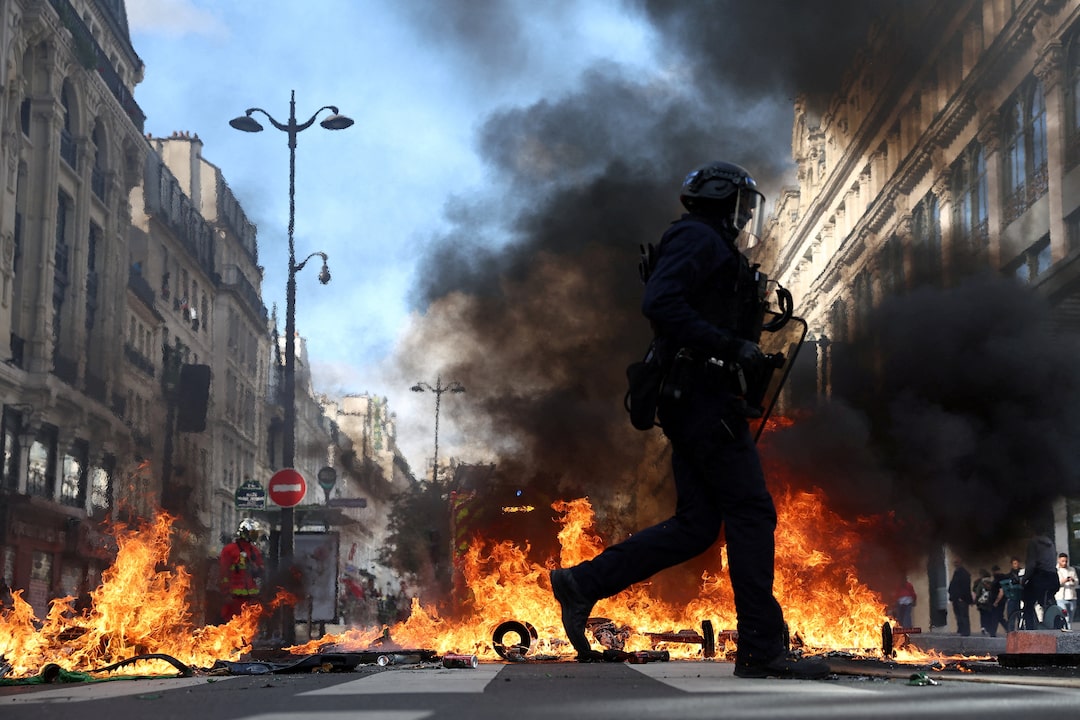
Recent events are indicators that those pressures have not receded. In mid-October 2026, a fresh wave of unrest swept Europe. Contemporaneous reporting by Al Jazeera, The Guardian, Euronews and POLITICO on 17 to 19 October showed hundreds of thousands took to the streets in separate but thematically linked demonstrations against the rising cost of living in Belgium, France, Italy and Portugal.
France saw one of its most turbulent protest days in decades, with figures from the French Interior Ministry, reported by the Associated Press, putting participation at more than 550,000 with around 1,200 arrests.
In Portugal, Al Jazeera reported tens of thousands marched in Lisbon against high living costs and a housing crisis where European Commission data shows house prices have more than doubled since 2017.
In all these events, a key amplifying factor identified in energy market reporting was the ongoing US-Israel-Iran conflict. Escalation involving Iran disrupted energy flows through the Strait of Hormuz, driving oil and diesel prices higher at various points in 2026.
Transmission to Nigeria
The link to Nigeria is direct. When escalation involving Iran threatens shipping through the Strait of Hormuz, through which about a fifth of global oil supply passes, global crude and diesel prices rise.
Nigeria, despite being an oil producer, imports a significant portion of refined products and its domestic pump price is now fully market-determined. The Dangote Refinery and other budding modular refineries may change this story entirely, but only time will reveal.
Higher global crude raises the landing cost of petrol and diesel, higher diesel raises haulage and transport costs from farm to market, and higher transport costs raise food prices.
At the same time, a stronger dollar driven by global risk aversion puts further pressure on the naira, making all imports more expensive and feeding directly into headline inflation.
The Nigeria Situation
Nigeria entered this period already strained. COVID-19 delivered a sharp recession, and the oil price collapse cut foreign exchange inflows, as documented in successive World Bank Nigeria Development Updates.
The decisive local inflection came in mid-2023 when President Bola Ahmed Tinubu’s administration removed the long-standing petrol subsidy and moved to unify the exchange rate. As UN Economic Commission for Africa Executive Secretary, Claver Gatete, observed, Africa has faced too many external shocks not of its making, but some shocks were domestic policy corrections long overdue.
Fiscal savings from subsidy removal reached multi-trillion-naira levels between mid-2023 and end-2025, according to government and multilateral estimates. Macro indicators are gradually improving with reserves rising and Gross Domestic Product (GDP) strengthening.
The short-term human cost was severe as figures from the National Bureau of Statistics (NBS) retail price data show petrol prices jumped from roughly N185–N240 per litre in May 2023 to peaks well above N1,000 and in some periods towards N1,300–N1,600.
Again, data from the Central Bank of Nigeria (CBN) and market trackers like FocusEconomics shows the naira depreciated sharply from around N460–N500 per dollar towards N1,300–N1,700 ranges at peaks.
According to the National Bureau of Statistics CPI report for December 2024, headline inflation climbed to a multi-decade high near 34.8 per cent. By September 2026, NBS releases showed it had moderated to around 14.63 per cent headline and about 19.6 per cent food, with some month-on-month relief.
Poverty deepened. The World Bank’s Nigeria Development Update of April 2026 and its Poverty and Equity Briefs estimate the national poverty rate rose from around 56 per cent in 2023 towards 61–63 per cent in 2024–2025/26, meaning roughly 139–140 million people.
Closing the Gap
The reforms were not irrational. Pre-2023 subsidy and foreign exchange policies were fiscally unsustainable. But sequencing and buffering mattered.
The global cost-of-living episode continues to flare with new geopolitical triggers, as the recent European demonstrations and Iran-related energy pressures illustrate.
For Nigeria the task is converting macro stabilisation into household relief without reversing hard-won corrections. That means accelerating agricultural productivity and rural security, expanding well-targeted transfers, and fostering non-oil foreign exchange earnings.
Speaking at his re-election campaign flag-off in Kaduna on 24 October 2026, President Tinubu defended his approach to governance, “What is past is past. Fuel subsidy is in our past, no more corruption, no more falsification of invoices, no more lies, no more smuggling of fuel.”
Whatever his believe, it is worth mentioning that for households measuring success in the price of rice, garri and a litre of fuel, the past is still present. Closing that gap between stabilisation and lived welfare remains Nigeria’s central challenge.