







The Mormon Church Is Suing One of Its Most Vocal Critics. The Reason Why Seems Silly. It’s Not.
The podcast Mormon Stories is in trouble for, among other alleged infringements, using the color blue.

Sign up for the Slatest to get the most insightful analysis, criticism, and advice out there, delivered to your inbox daily.
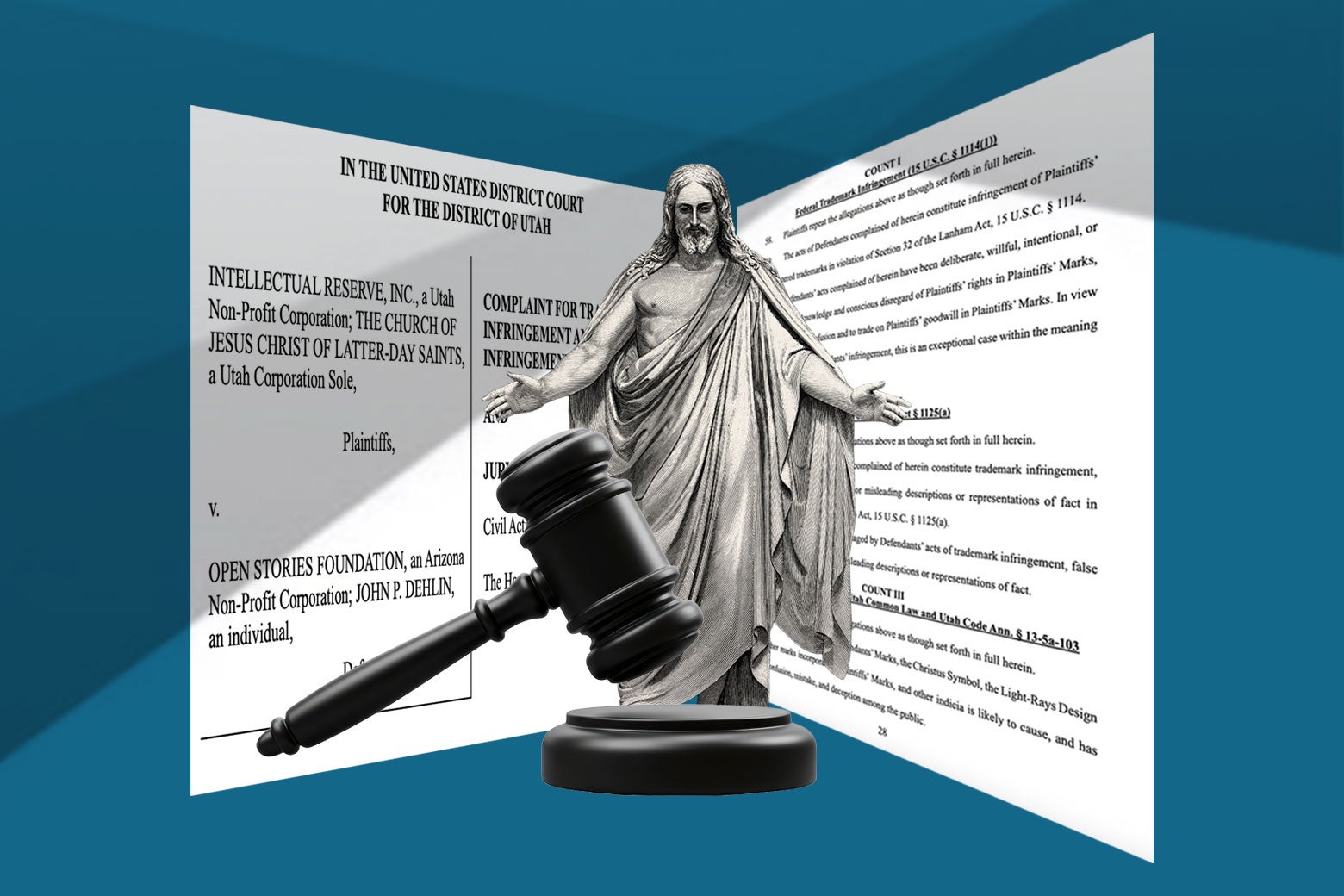
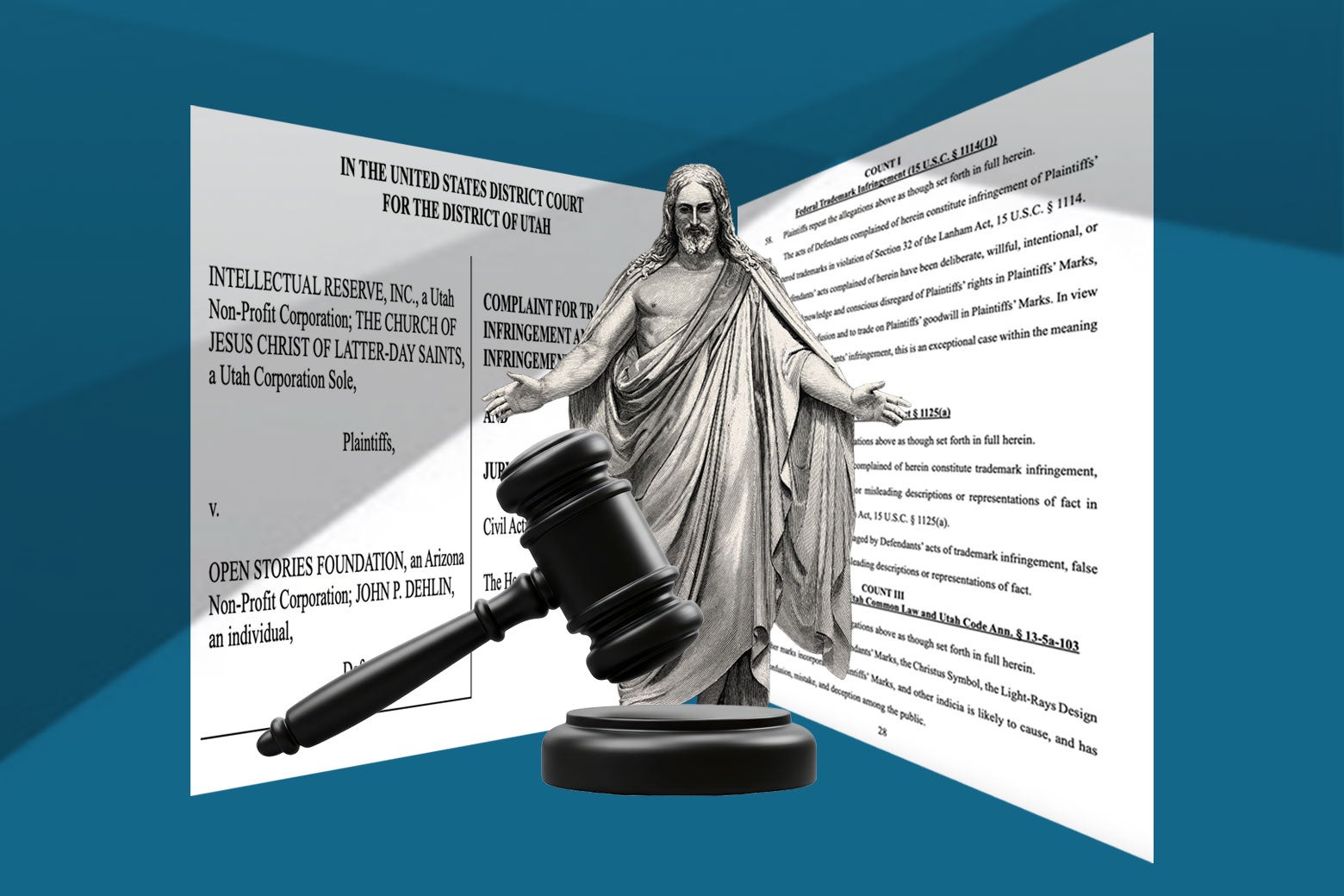
The color blue. Images accented by light rays. A sketch of Bertel Thorvaldsen’s marble Christus statue. These are images and designs trademarked by the Church of Jesus Christ of Latter-day Saints to distinguish its educational, broadcasting, and religious services and products. Now it’s suing over them.
On April 17, the church filed a lawsuit against the makers of Mormon Stories, a popular ex-Mormon podcast, alleging that they had used church trademarks and copyright materials with the intention of confusing individuals and causing them to “access Defendants’ content mistakenly believing it comes from or is affiliated with or endorsed by the Church.” Some of the contested imagery is highly specific, including the Christus rendering and copyright photographs; some of it is much broader, like “blue” and “all colors and orientations of the Light-Rays Design mark.” The lawsuit also contests the podcast’s use of the word Mormon itself, which the LDS church has trademarked in reference to specific groups and products, like the Book of Mormon, the Mormon Channel, and the Mormon Tabernacle Choir.
The suit accuses podcaster John Dehlin of intentionally deceiving members of the church for his own benefit. The costs of defending himself against the lawsuit are sure to place enormous pressure on Dehlin and the Open Stories Foundation, the nonprofit he started to support the podcast. The filing marks a shift in how the church has dealt with its critics, attempting to both discredit him and substantially alter how he defines and promotes his platform.
In the days since the lawsuit became public, the ex-Mormon community has rallied around Dehlin, donating to a legal fund, championing his cause as a matter of free speech, and accusing the church of attempting to silence a critic. The suit could also have unintended impacts on the church—a Streisand effect that creates more awareness of and conversation about a man it has excommunicated and whose claims it has advised its members to ignore. Already, the drama is helping popularize the podcast: The response to the lawsuit Dehlin posted to his YouTube channel garnered 135,000 views in a week, several times the typical number of views for his most recent videos.
The questions the lawsuit raises run much deeper than the matters of trademark and copyright. For decades, the church has tried to play it cool when it comes to critique and parody. It famously bought ad space in the play programs for the Book of Mormon musical, contending, “The book is always better.” As critiques and exposés have blossomed amid popular culture’s fascination with high-demand religions and cults, it has become more proactive. The church took legal action to prevent Real Housewives of Salt Lake City star Heather Gay from registering the title of her memoir, Bad Mormon, as a trademark. It has issued press statements against Hulu’s dramatization of Jon Krakauer’s Under the Banner of Heaven and the reality show The Secret Lives of Mormon Wives, as well as A24’s Heretic. Now the church is bearing down its legal weight on one of its most prolific critics. At stake is not just the Mormon Stories name and logo, but a whole universe of content, criticism, and conversation springing up to dissect and challenge a centrally controlled and deeply wealthy institution.
John Dehlin launched the Mormon Stories podcast in 2005, when he was still an active, attending member of the Church of Jesus Christ of Latter-day Saints in Logan, Utah. At the time, he was studying for a Ph.D. in psychology and had become alarmed by the mental health of the church’s gay members, many of whom were depressed or contemplating suicide. He says he was also concerned by the church’s tactics during his own experience serving a mission, and notes that he wanted to give members an opportunity to participate in the church with “informed consent.” After he became a more vocal critic of the church’s policies toward LGBTQ+ members and stated that he no longer believed in the major tenets of the faith, local leaders moved to excommunicate him in 2015.
The excommunication made the church’s position on Dehlin clear. What it didn’t do was dissuade his audience. With over 2,000 episodes in its library, Mormon Stories is now the most prolific and longest-running in a burgeoning industry of ex-Mormon podcasts, books, and documentaries deconstructing the faith. The podcast’s signature episodes are long-form interviews (most between two and five hours) with people from across a range of Mormon experiences, from those of “pioneer stock,” whose heritage goes back to the days of Joseph Smith, to converts to the church in Slovenia, Italy, and India. The majority of interviewees chart their course from true believers devoted to the church to skeptics to ex-Mormons, reflecting on the good and the bad of their journeys.
Since Dehlin detailed his excommunication on the podcast, it has also become a platform for deep reporting about contemporary scandals in the Mormon community and the church. The podcast first broke the story that controversial anti-sex-trafficking organization Operation Underground Railroad’s former CEO Tim Ballard had been excommunicated following a dispute in which the LDS church said he had used the church’s name for his own personal benefit. (Ballard eventually confirmed the excommunication himself.) The podcast has interviewed multiple parties connected to the infamous Ruby Franke and Jodi Hildebrandt child-abuse cases, as well as a Mormon bishop who says the church’s legal firm advised him not to contact law enforcement after he became aware that one of his parishioners was abusing a teenager.
Guests on the podcast and commenters on the Mormon Stories YouTube pages often thank Dehlin for Mormon Stories and cite it as an important resource in their “faith journey.” Dehlin also occasionally interviews guests who remain believing members, though he says his being labeled an apostate has made it risky for them to come on the show.
In a statement released on its website, the church claims that the lawsuit has nothing to do with the podcast’s critical content, insisting that it wishes only to address the alleged confusion the podcast’s branding has created over its relationship to the church. “To address that,” the statement reads, “the Church proposed a simple solution: a brief disclaimer that the podcast is not affiliated with or endorsed by The Church of Jesus Christ of Latter-day Saints.”
In a podcast episode Dehlin recorded last week, he says he made several modifications requested by the church during mediation, including changing his logo to orange; removing light rays, the Christus, and copyright images; and adding a statement on his platforms to clarify that the podcast is not affiliated with the church. He notes in the same episode that the church’s attorneys demanded far more than a disclaimer. “They asked us in mediation to change the words on our logo and the name that we put on our logo,” he said. “We were not going to agree to what they wanted, which was to take the word Mormon out of our logo. They wanted us to change the name on our logo to Ex-Mormon Stories With Dr. John Dehlin or Post-Mormon Stories With Dr. John Dehlin.” Dehlin claims that the church’s attorneys also asked them to sign declarations that they would not use the term Mormon in any future projects and would never file for trademarks for the name Mormon Stories. Slate reached out to the church attorneys for comment on Dehlin’s allegations but did not hear back by press time.
The lawsuit over Mormon Stories comes eight years after the church officially distanced itself from the word Mormon and requested that the news media and members call it either the Church of Jesus Christ or its full title, the Church of Jesus Christ of Latter-day Saints. Then–Church President and Prophet Russell M. Nelson claimed that to refer to the church without using Christ’s name was “a victory for Satan.” Even the widely known and trademarked Mormon Tabernacle Choir was renamed the Tabernacle Choir at Temple Square. Some, like fellow ex-Mormon podcaster Alyssa Grenfell, have argued that because of this shift from Mormon, the name Mormon Stories is even less likely to confuse believing members of the church today than in the past 21 years of its existence.
The lawsuit quotes Mormon Stories commenters who say they felt misled by its name, though most of the included comments emphasize that any confusion about the podcast’s affiliation was indeed momentary. “I stumbled upon the Mormon Stories podcast, thinking it was church-affiliated. It was quickly evident how anti it was,” reads one comment quoted in the suit. (Anti is Mormon shorthand for “anti-Mormon,” or people and organizations believed to be hostile to the church.)
The podcast episodes’ titles alone likely help alleviate misconceptions about Mormon Stories’ affiliation with the church: “How an Ex-Christian Atheist Experiences Mormonism,” “Joseph Smith Crowned King of the World?,” and “Graduated BYU and Resigned Immediately” are episodes from the past few weeks.
Other examples the lawsuit cites appear to be less brand confusion and more genuine questions seeking to understand Dehlin and the podcast’s stance. “Hi I’m confused r u for or against the mormon church,” writes one commenter. Another comment, presumably regarding the multi-episode Mormon Stories interviews of former associates of the controversial Utah-born, non-Mormon self-proclaimed spiritual healer Teal Swan, asks, “I’ve been watching the videos to do with Teal by this channel … but I don’t understand; is this channel run by Mormons? Or ex Mormons? Or people who are Mormons but against radical Mormons? Or they don’t like Mormons? I don’t mean to sound rude if it does, I just don’t understand.”
Some of this bafflement might stem from the nuance with which Dehlin approaches these subjects. Even as a former Mormon and an outspoken critic of many aspects of church policies and doctrine, Dehlin often acts as a devil’s advocate, encouraging even fervently ex-Mormon interviewees to list the good things from Mormonism they’ve taken with them. He frequently argues to guests that being raised Mormon was good for him and that he sees benefits in it for individuals struggling to find community or a sense of purpose and meaning. A recent interview with Kenyan convert Joe Ngatia concluded with Ngatia and Dehlin agreeing that the church is doing more good than harm by proselytizing in Africa.
People who have not previously been exposed to viewpoints on Mormonism from outside the church may be disoriented when they stumble into these discussions. They may assume that “Mormon stories” will always affirm Mormonism. That they don’t does not make them, factually, any less Mormon stories. That, legal scholars say, makes the church’s insistence on a name change one of the weaker aspects of the complaint.
“Dehlin seems like he ought to be able to use the term Mormon,” said Jake Linford, an attorney and professor at the Florida State University College of Law who also happens to be a member of the Church of Jesus Christ of Latter-day Saints. A judge’s prohibiting Dehlin from using the term “strikes me as way too far,” said Linford.
Harvard Law School professor Rebecca Tushnet, who studies trademark law and the First Amendment, agreed that the name Mormon Stories is likely allowable under fair use because it is descriptive of the content of the podcast. “Mormon Stories seems to truthfully describe the contents of the show, even if there’s momentary confusion,” said Tushnet.
Church leaders have apparently been quite concerned about the influence of platforms like Dehlin’s, urging members to steel themselves against critics and nonbelievers. Nelson warned church members in a 2023 speech: “The Apostle Paul prophesied that ‘in the latter times some shall depart from the faith, giving heed to seducing spirits, and doctrines of devils.’ There is no end to the adversary’s deceptions. Please be prepared. Never take counsel from those who do not believe.” Slides purportedly leaked from a 2015 internal meeting of church leadership show Dehlin’s name on a slide titled “Issues and Ideas Leading People Away From the Gospel.” Dehlin is listed alongside “Pornography,” “False Prophets,” and “Ordain Women,” the Mormon feminist group.
So although the church contends that this lawsuit isn’t about Dehlin’s viewpoint, it’s hard to ignore the timing, as Dehlin’s and other ex-Mormons’ influence grows and the church faces an unprecedented decline in growth in the United States. Tushnet said, “It’s hard to make predictions in this area, but if the court perceives this as an attempt to suppress criticism, it may not accept allegations about confusion and may find the images used to be fair.”
What’s at stake here cannot be settled via a press statement or a lawsuit over titles and marks. The church is confronting a world in which its perspective is no longer the only one members will be exposed to when they go out to seek information about Mormonism.
As the church’s complaint makes clear, too many members have been led to believe that there are only two types of Mormon stories in the world, Mormon stories and anti-Mormon stories. But the world of Mormonism is far bigger and more complicated than that. That creates a messiness of ideas that a disclaimer, a new logo, and even a name change can’t clean up.
Get the best of news and politics
Sign up for Slate’s evening newsletter.


