

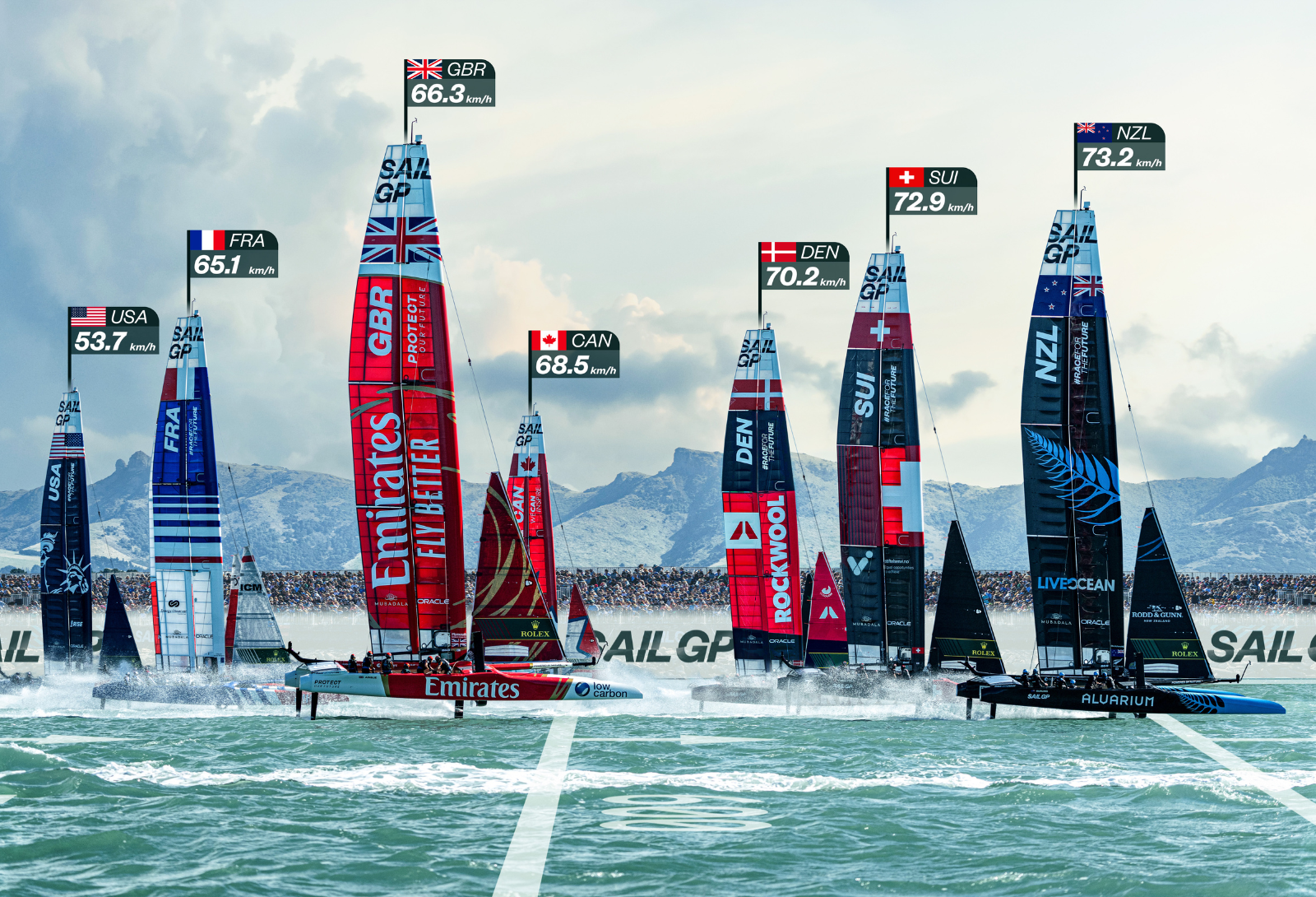
How do you create an intimate fan experience for an event that takes place miles away from shore? Artificial intelligence. High-speed catamaran racing series SailGP is doing just that, providing fans with a deeper understanding of the sport and enhancing the entertainment factor.
SailGP is the winner of Newsweek’s AI Impact award in the category of Best Outcomes, Sports Broadcasting/Streaming for redefining data-led sports storytelling through AI to bring sailing to new fans.
Each year, the Rolex SailGP Championship features 12 national teams battling for a title, sailing identical 50-foot catamarans at speeds well over 60 miles per hour. Racers from Great Britain, Switzerland and Australia, among others, race on waterfronts in New York City, Sydney, Auckland, Dubai and beyond.
SailGP has taken a fan-first approach to the events, catering to both those in the grandstands and those watching at home. Broadcasts reach more than 200 million TVs across 212 countries and territories.
During a race, SailGP uses Oracle Cloud Insights to process 56 billion points of data via 125 sensors on each boat. That data is received via a private 5G network using RF mesh. The result is a product called LiveLine, an augmented reality (AR) overlay tool that helps existing and new fans better understand the on-screen action of the races.
“The use of AI almost feels like a natural progression, given that we’re a sport that’s heavily based on on data,” Melissa Lawton, chief content officer at SailGP, told Newsweek. “And because we’re such a data rich sport, we can do a lot with that.”

Newsweek Illustration
No matter where the race is happening, LiveLine is produced from SailGP’s offices in London. New graphics opportunities that push the boundaries of fan interactions are delivered to television screens.
AI helps make that happen. Using AI image detection, the boat cameras detect human shapes, strides and biometrics to generate AR identifier graphics for athletes as they move around the boat. This helps viewers at home identify the individuals, who generally all look nearly identical to the naked eye with matching wetsuits, goggles and helmets.
“The athletes go from side to side. And one of our really big issues was, as this camera is following athletes going from side to side, [viewers] couldn’t really detect who the athletes were. And for a new viewer, everyone looks the same,” Lawton said.
“Using AI image detection to figure out the height of the athlete, the weight, their stride, length, their positioning, through that same sort of algorithm to then automatically pop the athlete’s name above the head in a moving graphic. That graphic that sort of moves with them in augmented reality, in our augmented reality suite of graphics. This is revolution.”
Using AI predictions, SailGP can display to viewers which boat has the right of way while showing explainer graphics on the screen.
SailGP was recognized as Best Outcomes, Sports Broadcasting/Streaming in the Sports category. There were more than a dozen, including ones focused on sustainability, health care and customer service. The 38 total winners were selected by a panel of AI and subject matter experts.
Additionally, AI-powered race marks, developed in partnership with ePropulsion, use GPS, negating the need to anchor each mark to the sea bed, avoiding damaging the local environment. These marks have AI-operated cameras that use Oracle’s anomaly detection software to predict which boats are most likely to experience an issue, crash or near miss.
Lawton said: “If the boats look like they’re about to collide, or in a position where they could be on a trajectory to collide immediately, or if something’s not working optimally on the boat, it sends a signal directly to our data analysts and the team to give them a warning.
“This anomaly detection is actually a medical tool that vendors of Oracle use to find medical issues within the human body. They can sort of say, ‘this is an unusual cell,’ or deep detection of a medical issue can be found by using literally data and analytics through AI.”
Buoys equipped with cameras are able to capture footage that is traditionally unavailable. “They are in the middle of the racecourse in, I would say, an area that would be too dangerous for a human to be positioned…That gives us really cool shots that we can post either immediately to social [media] and really fun and weird shots that we can send straight out that our fans love.

SailGP
“It gives us another angle on crashes that we wouldn’t have just through our broadcast available camera… I would say it’s a camera that’s always knowing where the excitement might be happening, and therefore is more efficient for us,” Lawton said.
Efficiencies have been achieved in procuring and producing video, as well as gathering and understanding data, but that doesn’t mean SailGP is eliminating positions within the company. Instead, they’re growing their team, capitalizing on priorities and opportunities as it builds its audience.
“In live sports, the faster we can get content out, the faster we can get relevant content out, the more consistently we can get it out, the better it is for our overall viewership and numbers down the line,” Lawton said.
To see the full list of AI Impact winners, visit the official page for Newsweek’s AI Impact Awards.
Newsweek will continue the conversation on meaningful AI innovations at our AI Impact Summit from June 23 to 25 in Sonoma, California. Click here for more information and to register for the event.
