




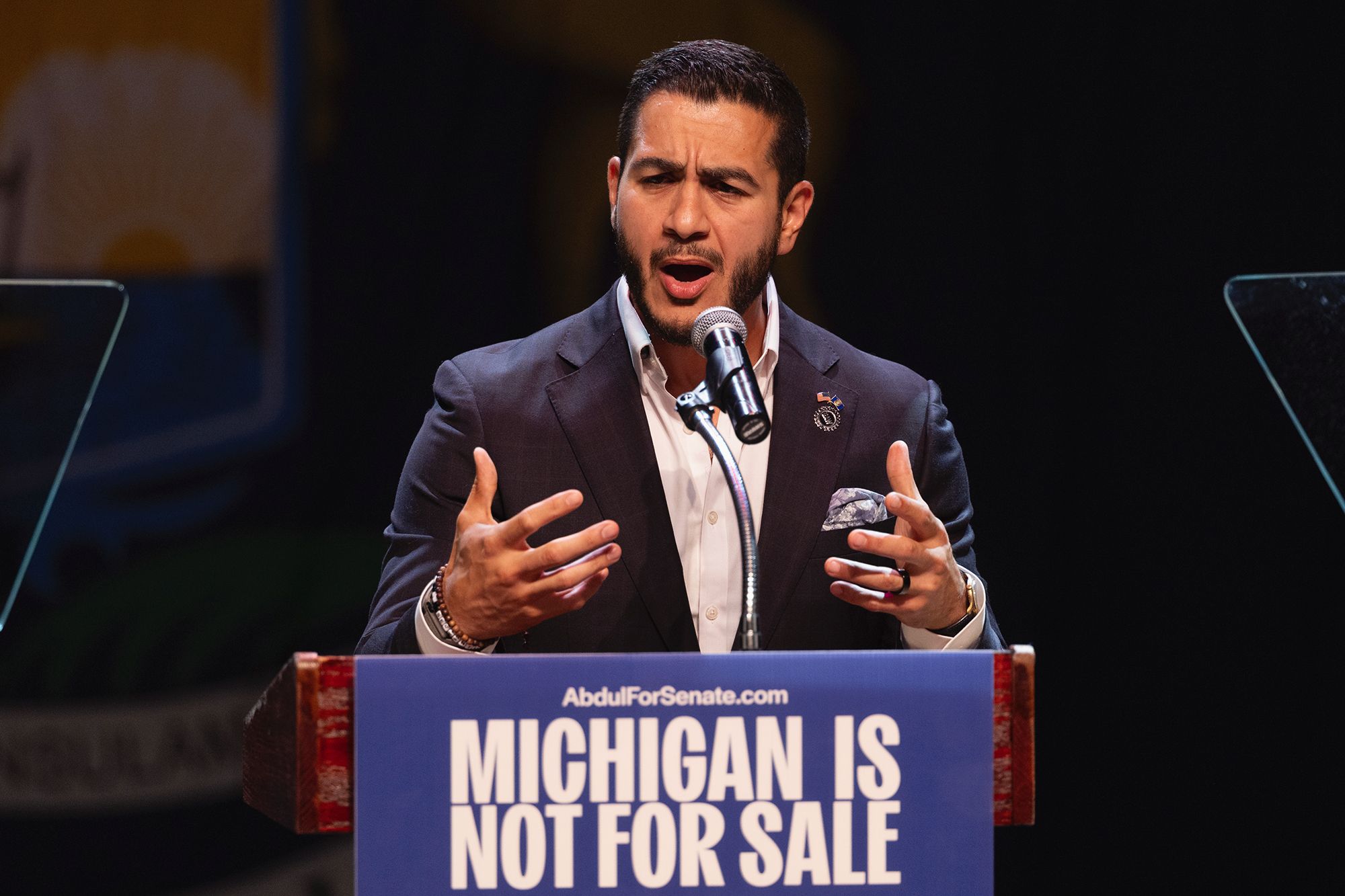
Once upon a time, the money cannon meant something. In the Citizens United era, outside groups have carpetbagged around the country, flooding their preferred candidates with millions of dollars and blanketing the airwaves with ads, often enough ensuring victory.
But in the bloody battle between two Democrats vying for a Senate seat in Michigan, big-dollar politics met defeat. Outside groups spent more than $63 million supporting Haley Stevens, a candidate backed by the establishment, dwarfing the amount spent on her opponent, a brash progressive named Abdul El-Sayed with a war chest some nine times smaller.
In this primary, outside spending became a campaign issue. El-Sayed, a former public health official and a Rhodes scholar, told voters he would take on big money in politics and regularly singled out the involvement of the American Israel Public Affairs Committee. The advocacy group’s main super PAC spent a record $31.7 million to help elect Stevens, who calls herself a “proud pro-Israel Democrat,” and defeat El-Sayed, who counts among Israel’s most vocal critics and calls the war in Gaza a genocide. It was the most expensive Democratic primary ever.
This progressive victory in a purple state, as narrow as it was, proved that major spending doesn’t ensure victory. But it also raises the question of how toxic AIPAC has become among Democratic-primary voters. On Election Day, if you flipped on cable news, you were greeted by a steady stream of voters telling campaign reporters that AIPAC was the reason they were supporting El-Sayed.
“One could argue that AIPAC’s $32 million didn’t just fail to help Stevens,” said Pod Save America host and former Obama speechwriter Jon Favreau, “but served as the most effective line of attack for her opponent.”
The group, which has grown increasingly active in primary campaigns over the years, embodies two issues that have motivated Democratic-primary voters: a growing distaste for money in politics and a turn against Israel. El-Sayed hammered both of those themes, rarely missing an opportunity to connect them. At his rallies, the faithful often recited a pecuniary incantation: “Money out of politics! Money in your pockets!”
AIPAC was first launched in the 1950s as a bipartisan lobbying organization seeking stronger ties between the United States and Israel. It organized trips for American politicians to visit Israel and endorsed candidates who supported the country. It didn’t offer direct financial support for candidates until 2021, when it launched a super PAC that backed candidates supportive of Israel and targeted its critics, particularly in Democratic primaries. As Americans have soured on the Israeli government, much of that anger has been directed at AIPAC.
“AIPAC’s numbers have dropped like a rock among Democrats in just the last two years,” CNN data analyst Harry Enten tells Vanity Fair. “The percentage of Democrats who say AIPAC backing a candidate makes them less likely to vote for them has gone from just about a third a few years ago to more than half now.” Israel, Enten adds, is “a four-letter word in Democratic primaries right now.” Approval for the country among Americans, he points out, “has dropped 50-plus points from where it once was (depending on when you compare the current moment to).”
There are ample signs that AIPAC itself understands this. The super PAC that handled much of its spending in the race boasts the comically euphemistic name “United Democracy Project.” The New York Times reported this week that almost none of the ads funded by AIPAC mention Israel.
AIPAC didn’t lose every bet on Tuesday night. Cori Bush, the former congresswoman who was booted from the House after AIPAC spent more than $9 million to defeat her in 2024, lost again on Tuesday night in her attempt to win back her seat from Representative Wesley Bell (D-Mo.), who this time around earned $2 million in support from the group. Bush also reckoned with her own baggage unrelated to AIPAC.
The takeaway could be that candidate quality matters. El-Sayed wasn’t a one- (or two-) issue candidate, and he tapped into the oft-stated desires of the Democratic base in a way that catapulted his candidacy from obscurity to national prominence, even as party leadership—from Senator Chuck Schumer to Michigan governor Gretchen Whitmer—sought to thwart his rise. Democratic voters keep saying they want a fighter—here’s a candidate who even looks like one. His campaign uniform is a bicep-hugging black T-shirt, and on Election Day he boasted to a reporter about his weightlifting stats on Whoop.


El-Sayed campaigns in a trademark black T-shirt that shows off his gains.
UCG/Getty Images
His heterodoxy may have also helped him: He’s a progressive who proudly calls himself a capitalist and a patriot. He backed single-payer health care while distancing himself from the DSA. And like many Democrats who were caught up in the revolutionary fervor of 2020, he now admits his support for policies like defunding the police was foolish.
After a combative primary, some of El-Sayed’s supporters want him to keep the gloves off going into November. Hasan Piker, the far-left streamer who campaigned with him in Michigan, told his viewers on Tuesday night: “Everyone being like, ‘Abdul has a fuck-ton of work to do mending bridges,’ here’s the fucking take-nuke for you: You are all unbelievably Islamophobic pieces of shit. You literally called the dude a fucking terrorist for months on end.”
In a speech to supporters on election night, El-Sayed sounded much more conciliatory. “I’m gonna ask all of us, as we think about where we go from here, always magnanimity in victory,” he said. “Let’s come together to build a movement that’s even bigger.”
AIPAC, after its historic defeat, seems undeterred. Politico’s Adam Wren reported recently on whispers among operatives that the group could dump up to $90 million to support the Republican nominee, Trump-backed former congressman Mike Rogers. AIPAC has given to Rogers before; it was the top donor on his Senate campaign in 2024, spending $515,000. He ultimately lost to Democrat Elissa Slotkin.
In a statement released Wednesday, AIPAC said it would carry on: “Our members remain determined to ensure that voters reject Dr. El-Sayed and his radical anti-Israel agenda in November.”
-
Andrew Tate Was the Toast of Trumpworld. Has That Changed?
-
The 10 Biggest Odyssey Updates From Homer’s Original Text to Christopher Nolan’s Latest Film