






In Kansas City, people are born, bred and fed on barbecue.
While the South is often cited as the birthplace of American barbecue, Kansas City has earned a reputation as the barbecue capital of the world. Home to the famed Kansas City Barbeque Society and more than 100 dedicated barbecue restaurants, the city boasts one of the highest concentrations of barbecue joints per capita in the world.
So what makes Kansas City barbecue stand out? It’s hard to pinpoint just one thing. From the city’s roots in the meatpacking industry to generations of pitmasters who have embraced the spirit of innovation, Kansas City has developed a unique barbecue style that everyone should experience. Joe Pearce, co-founder of Kansas City’s award-winning Slap’s BBQ, sums it up perfectly: “It’s just an awesome genre of food that brings people together. Kansas City is a melting pot. We’ve taken the best of every region, put them together, and in my opinion, made them better. I always say we’re changing people’s lives one bite at a time.”
I was lucky enough to sample some recently when my parents returned from a cross-country road trip with a brisket, dry rub and bottled sauce as a thank-you for watering their plants while they were away. As far as gifts go, I can’t imagine a better one! It made me want to learn more about this iconic style—and maybe book a trip so I could experience it fresh from the smoker.
What is Kansas City barbecue?
Kansas City barbecue is famous for rich, smoky meats and sweet-and-tangy sauces, and it shares some similarities with Memphis-style barbecue. “Kansas City barbecue is a kissing cousin to Memphis-style, but generally has a thicker barbecue sauce with a more savory component,” says seven-time world barbecue champion and cookbook author Melissa Cookston. That’s because the foundation for the region’s signature style was laid by Henry Perry, a Tennessee native who was among the first to bring Memphis-style barbecue to the city in the early 1900s.
Considered by many as the father of Kansas City barbecue, Perry began selling a variety of hickory- and oak-smoked meats to locals in 1908. His ribs, wrapped in newspaper, sold for 25 cents per rack, and his bold, peppery sauces quickly earned a loyal following. He was a cornerstone of the Kansas City restaurant scene until his death in 1940. His restaurant was taken over by Charlie Bryant, who later sold it to his brother, Arthur. Now called Arthur Bryant’s Barbeque, it still operates today.
Inside Kansas City barbecue’s complex dry rub
Kansas City barbecue’s dry rub is one of the defining features that separates it from its Tennessee roots. Some barbecue regions keep their seasoning simple with salt and pepper or emphasize a dominant spice, like garlic, paprika or mustard. Kansas City dry rubs contain a trifecta of sweet, savory and slightly spicy flavors.
“The depth of flavor you get in our barbecue definitely sets Kansas City apart from other regions,” Joe says. “We have a very liberal, complex flavor profile. The combination of spices we layer together causes the rub’s flavor to change slightly depending on what type of meat you put it on.”
Recipes vary, and a Kansas City dry rub might include everything from salt and pepper to onion powder, garlic powder, cayenne pepper, ground turmeric, cumin, chili powder, paprika and countless other spices. Many also contain a high ratio of brown sugar, which helps the meat caramelize as it cooks to form the thick, flavorful bark that has become the hallmark of Kansas City burnt ends.
The sauce that defines Kansas City barbecue
The biggest misconception about Kansas City barbecue sauce is that it’s the same as bottled KC Masterpiece: thick, really dark and heavy on the molasses. “It’s not even remotely that,” Joe says. This style of sauce is common on the competition circuit, but it’s typically brushed on as a glaze rather than served as an everyday table sauce.
The sauce you’ll find in most Kansas City barbecue restaurants is a thinner, tomato-based sauce with a sweet-and-tangy profile and a touch of heat. And it’s not just for barbecue. “It’s really well-rounded,” Joe says. “You can put it on french fries, you can put it on burgers, you can put it on barbecue, you can put it on anything. It’s the one I grew up eating, and I absolutely love it.”
Even then, sauce usually plays a supporting role. At Slap’s BBQ, Joe serves both styles but doesn’t sauce the meat while it’s on the smoker. Instead, like most pitmasters, he lets the dry-rubbed meat do the talking, leaving the amount and type of sauce (if more than one is offered) up to the customer.
Kansas City barbecue brings every meat to the pit
Unlike regions that are closely associated with a single specialty, like brisket in Texas or pulled pork in the Carolinas, Kansas City barbecue is known for variety. Located at the crossroads of railways and rivers, the city grew into a major livestock and meatpacking hub. That gave pitmasters access to an abundant supply of meat and freedom to experiment. “You can probably find anything you want in the food world barbecued here in Kansas City,” Joe says. “Kansas City cooks everything.”
Depending on the restaurant, a Kansas City barbecue menu might feature juicy beef brisket, burnt ends, Kansas City-style pork ribs, smoked chicken or turkey, sausage or even fish. But no matter what protein goes into the pit, one element ties them all together: smoke. Some pitmasters experiment with fruit woods like apple, cherry and pecan, but hickory remains the backbone of Kansas City barbecue.
Abundant throughout Missouri, hickory gives the meat a bold, savory smoke flavor. But pitmasters aim for balance rather than intensity. “The amount of smoke that we put onto the meat is never going to be overpowering—just a kiss of smoke,” says Joe. “There are definitely some regions that go for that big, thick, smoky flavor on their meat, and that’s just not Kansas.”
What’s on a Kansas City barbecue menu?


Burnt ends
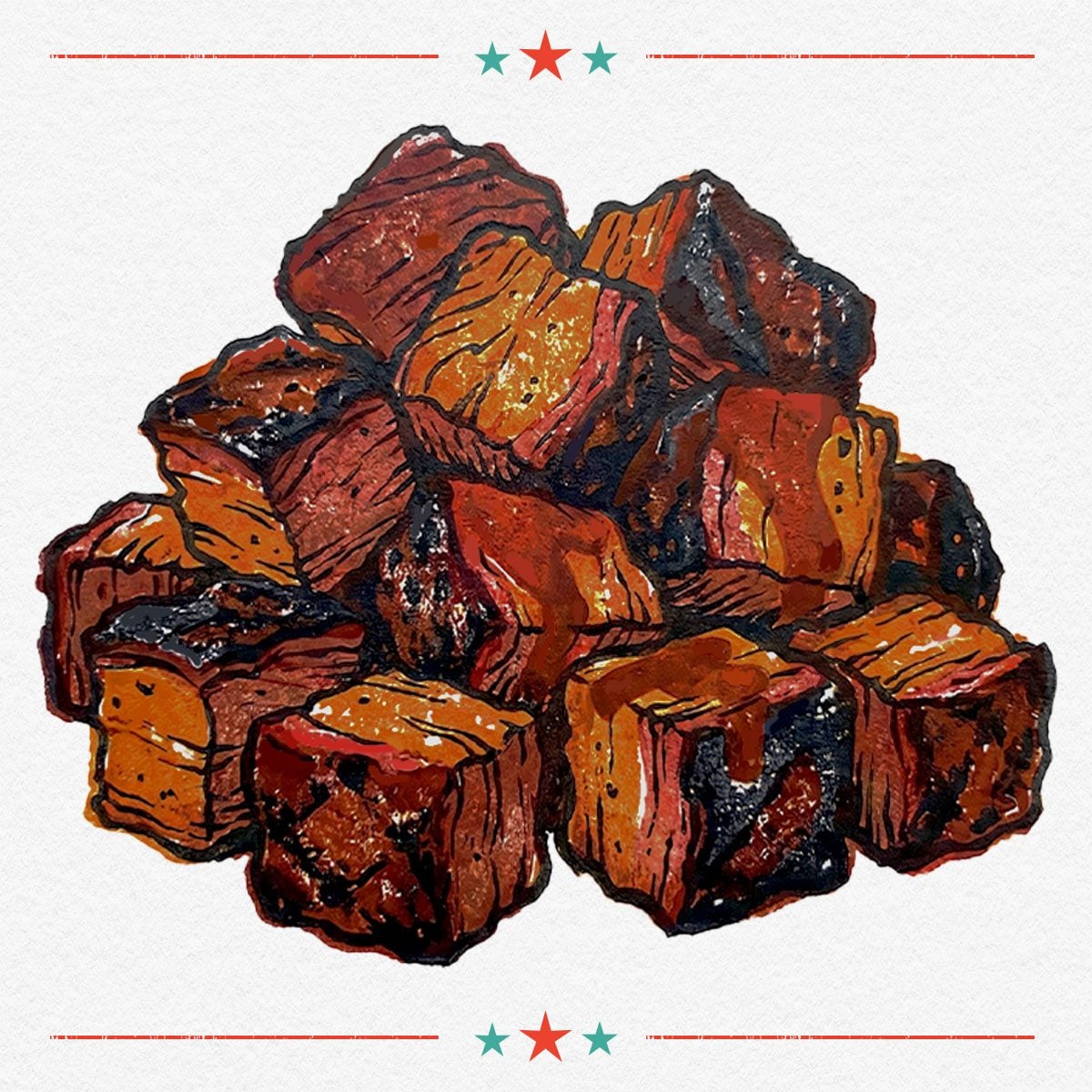
Burnt ends are among the most famous barbecue creations to come out of Kansas City. Originally, they were the charred edges and fatty trimmings from the highly marbled brisket point, given away for free to waiting customers. Today, cubed pieces cut from the point of a slow-smoked brisket are tossed in a sweet, sticky sauce and returned to the smoker to cook until deeply caramelized.
Since there are only a limited number of brisket points available on a given day, it’s not uncommon for pits to sell out quickly. To stave off disappointment, some pitmasters make burnt ends from cheaper cuts like pork belly and beef chuck, but burnt ends made from brisket are where the magic really happens.
“It’s a bite of food that I think people always underestimate when they try it for the first time,” Joe says. “When you eat a burnt end in Kansas City that’s cooked right, it’s a well-rendered, super succulent, soft and silky bite of meat you just don’t expect.”
Brisket
Kansas City does brisket a little differently from other barbecue regions. Here, locals love a solid brisket sandwich, but the meat isn’t sliced as thickly as you’ll find in a Texas barbecue joint. Instead, it’s thinly sliced like deli meat and piled high on soft white bread or rolls. One of the city’s most iconic examples is the Z-Man sandwich from Joe’s Kansas City Bar-B-Que, which combines smoked brisket with fried onion rings and melted provolone cheese.
Pork and sausage
While beef certainly gets a lot of love in Kansas City, pork is also an essential part of the tradition. You’ll find smoked pork shoulder for pulled pork for sandwiches and spare ribs that are slow-smoked until tender and slathered with a generous coating of sauce. Most pits also offer pork sausages, like classic Polish kielbasa or flavored sausages like jalapeno-cheddar.
Chicken and turkey
Kansas City smokehouses are also known for smoked poultry. Whole chickens or cuts like turkey breast, chicken breast or smoked chicken wings all have a place on local menus. On milder meats, the dry rub takes on a different character, highlighting how Kansas City’s balance of smoke and seasoning works across a variety of proteins.
Barbecue sides
You’ll find all the usual suspects on a Kansas City barbecue menu: macaroni and cheese, cornbread, coleslaw, french fries and potato salad, plus a few local specialties. Baked beans are popular, especially when pitmasters mix in pieces of pork, brisket or burnt ends to create a richer, meatier version.
One unique side is cheesy corn, a dish either created by or made famous by Jack Stack Barbecue (depending on who you ask). “It’s a cheesy version of creamed corn that sets us apart from everybody else,” Joe says. “Texas has elote, and other places do corn on the cob. But in Kansas City, we made cheesy corn to rival these other corn dishes.” Every Kansas City barbecue restaurant has a version of this beloved staple, and locals say it’s a must-have on any plate.
Kansas City Barbecue Recipes