

It’s been well over a decade since Team USA had a figure skating lineup as strong as the one traveling to the Milano Cortina Olympics this winter. The group includes current world champions Ilia Malinin and Alysa Liu, and hopes are high that they’ll both return to the States with hardware in hand. In the process, hopefully they won’t get embroiled in an international scandal—though for champion figure skaters, that’s always a distinct possibility.
Figure skating has long been a controversy-prone sport. For one, it’s maddeningly subjective, with a scoring system that no one understands (judges included). It’s also got particularly lofty stakes: Skaters train their whole lives for a handful of minutes on the Olympic stage, their dreams riding on slivers of steel. Throw in a dash of geopolitics (on the ice, the Cold War never ended), and you’ve got all the ingredients for drama on an operatic scale. While no one can predict what will go down in Milano Cortina, read ahead to catch up on skating’s biggest scandals before the Games begin on February 6.
Sonja Henie’s Salute (1936)
Figure skating’s first star, Norwegian Sonja Henie, is credited with bringing skating to the masses—first through newsreels, then through Hollywood. Trained in ballet, she pushed the envelope by incorporating dance and choreography into her routines. She also introduced short skirts and white skates to the sport, making it glamorous. And as a 10-time world champion and three-time Olympic champion, Henie remains the most decorated women’s skater ever. Even today, she’s upheld as a master of shaping and promoting her own image. There’s just one slight issue: her coziness with Adolf Hitler.

Sonja Henie in the 1944 film It’s a Pleasure.Keystone/Getty Images
In Berlin, ahead of the 1936 Winter Olympics—her last—Henie skated up to the führer. As Swedish skater Vivi-Anne Hultén recalled in the 1990s, “She went and gave a Hitler salute during the Olympic Games and shook hands with Hitler, and everybody said she became his girlfriend.” The idea that Henie actually had a romantic relationship with Hitler is widely disputed; the ice princess and the dictator did, however, reportedly go to lunch after Hitler congratulated her rinkside on winning her third Olympic title. The Nazi leader also wrote a lengthy inscription on a signed photo for Henie, which her family displayed at their Oslo home. Though Germany occupied Norway during the war, the Henies’s house went untouched.
“I don’t think Sonja Henie was a political person in any way, shape, or form,” Olympic gold medalist Dick Button told Vanity Fair in 2014. “She was an opportunist…. I don’t think she could have cared less who Hitler was, except for whatever power he had and what it would do for her career.” Opportunism did seem to be Henie’s distinguishing trait. Years after saluting Hitler, she starred in a 1939 anti-Nazi film called Everything Happens at Night. Henie plays a young woman, caught in a love triangle, whose father has escaped from a concentration camp. The reviews weren’t great, but Henie was getting paid: she’d signed a $300,000 contract with 20th Century Fox. In all, she starred in 11 Hollywood movies, skating in several of them—and at the peak of her career, she was one of the highest-paid actors in Hollywood.
A Risqué Showgirl Costume (1988)
Besides Henie, Germany’s Katarina Witt is the only women’s skater to win back-to-back Olympic gold medals. Known for her glamour and beauty, Witt was figure skating’s 1980s sex symbol. As a 2019 academic paper titled “Katarina Witt and the Sexual Politics of Sport in the Cold War” puts it, Witt and her coach “consciously cultivated her fame by increasing the sexual tension of her performances.” Oh my! One purported way to increase “tension” is by wearing a “provocative” outfit—and that’s exactly what Witt was accused of doing when she descended on the Calgary Olympics to defend her title.
“We’re here to skate in a dress, not in a G-string,” said Canadian coach Peter Dunfield. He was referring derisively to the glitzy showgirl getup Witt wore for her short program, which was set to Broadway tunes from Hello, Dolly! and Jerry’s Girls. While it seems Dunfield didn’t have the best grasp on what constitutes a G-string (perhaps he’d never seen one?), Witt’s high-cut ensemble did display a fringe of feathers instead of a traditional skirt. In response to the negative remarks, she said, “Why shouldn’t we stress what is attractive?” But Dunfield would hear none of it. “The real provocative side is the back,” he grumbled to the press, before adding, “but in the front, you’ve even got cleavage.”
Dunfield wasn’t the only one to weigh in on Witt’s costume. Former Olympic gold medalist Peggy Fleming said it was on the “borderline of being inappropriate,” though “not indecent—I’ve seen worse.” Joan Gruber, an international judge, acknowledged that points could be deducted for an outfit’s inappropriateness, though she’d “never seen the rules enforced.” Dorothy Hamill took a pragmatic view, speculating that the dress was a marketing tactic: “This costume is ready for an ice show, and I think there is a good possibility [Witt] will join one after the Olympics. I think she is looking at the future.” One person who seemed sanguine on the matter was Witt’s main challenger, American Debi Thomas. “I have a short program outfit [a unitard] that I think is great, but a lot of people might think is bizarre. Whatever works is fine,” she said.
Despite the brouhaha, Witt nabbed her second Olympic gold medal, closing out the women’s final with an alluring routine to “Carmen.” Yet afterward, the International Skating Union (ISU) instituted the so-called Katarina Rule, which required that competition outfits cover women’s hips and buttocks with a skirt. (In 2003, the ban was lifted.) In any event, it seems the raised eyebrows amused Witt. Explaining her outfit choice for her 1994 Lillehammer Olympics program, set to music from Robin Hood, she told The New York Times she wore “a man’s costume” so as not to be accused of “seducing” the judges. “I wore an outfit up to my neck. But I think that leaves more to the imagination. Sexier than cleavage, no?”
The Attack on Nancy Kerrigan (1994)
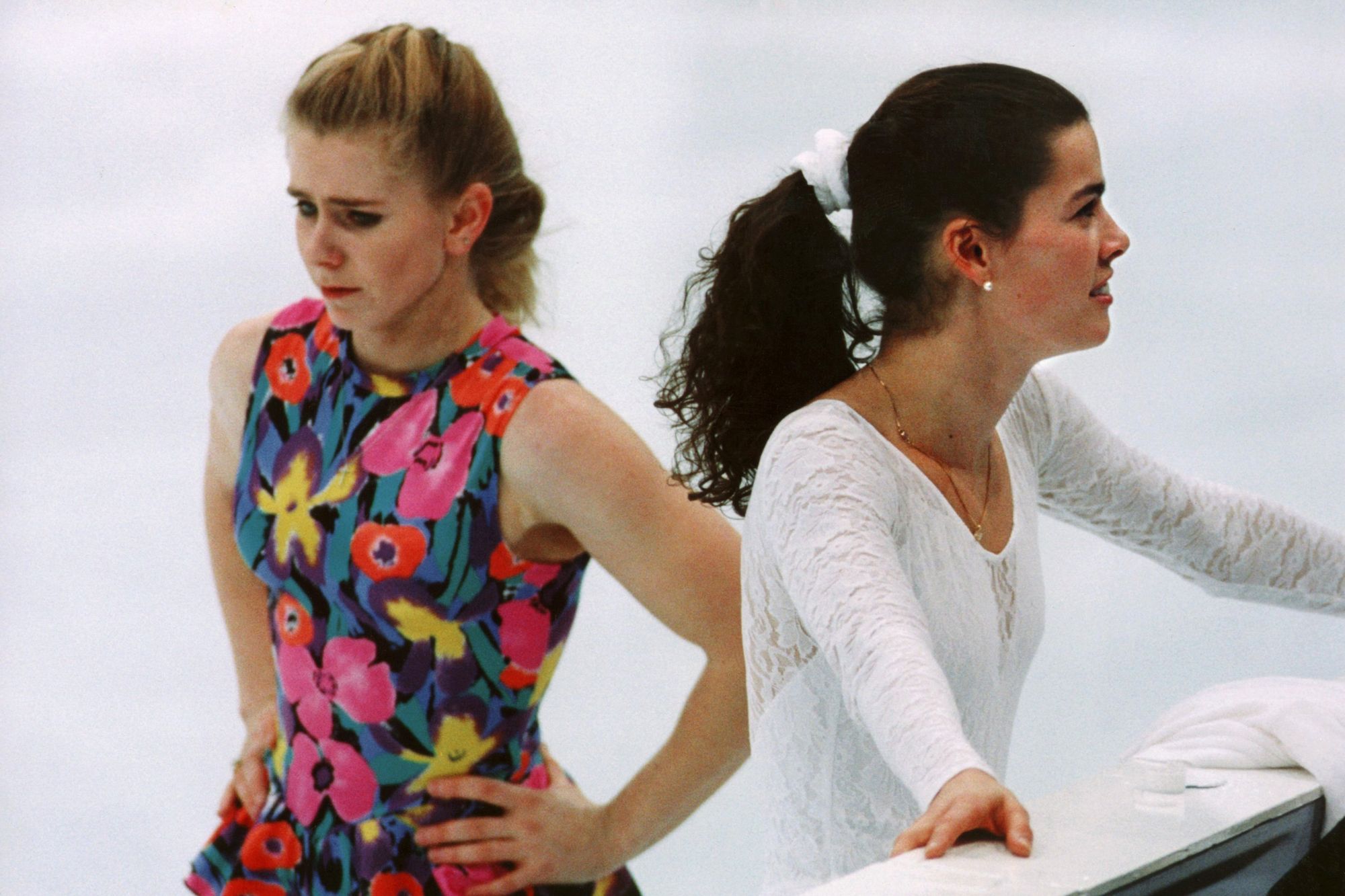
It was “the whack heard ’round the world.” Two days before the 1994 US Figure Skating Championships, Nancy Kerrigan was walking to her locker after practice when she was clubbed above the knee by a stranger. “Why? Why? Why?” she cried. The reason was shocking and all too obvious: Kerrigan, the reigning US champion, was in the way of another skater. Her longtime rival, Tonya Harding, yearned to win gold at the Lillehammer Olympics—not just for the accolade itself, but for the windfall of lucrative endorsements that would follow such a victory. For a moment, it looked like that might actually happen: An injured Kerrigan watched solemn-faced from the stands as Harding executed a perfect free skate, winning nationals and clinching her spot on the Olympic team.
But Harding’s triumph would prove short-lived. The FBI soon began to suspect that she was involved in Kerrigan’s attack, along with Harding’s ex-husband, Jeff Gillooly (has a small-time thug ever been more aptly named?), and her bodyguard, Shawn Eckardt. Despite their mob-style assault, these criminals weren’t exactly organized: A week after the attack, Eckardt confessed his involvement and quickly implicated two associates, along with Gillooly—and Harding. A couple of weeks later, Gillooly confessed and also agreed to testify that Harding approved the plan to attack Kerrigan. (He and Eckardt pleaded guilty to racketeering. Gillooly was sentenced to two years in prison, and Eckardt to 18 months.)
Harding has long maintained her innocence, saying she learned details about the assault after the fact and was responsible only insofar as she failed to immediately report Gillooly and his cohort. It was a claim that stretched credulity, but the Olympic Committee still cleared her to compete in Lillehammer. Meanwhile, Kerrigan, her leg healed, returned to the ice and was granted the second spot on the US Olympic team. The showdown was set.
Although both women came from working-class backgrounds, Kerrigan had been cast as America’s sweetheart, a role no doubt enhanced by her sky-high cheekbones and preference for “virginal” white dresses. Harding received the opposite treatment. A high school dropout who said she’d endured domestic abuse, she was described as growing up on “the wrong side of the figure skating tracks.” It was known that her mother sewed her sequin-heavy competition dresses, and the outfits were viewed as garish, especially when compared to Kerrigan’s understated ensembles—designed by Vera Wang, no less. And then there were their duelling styles. Kerrigan was known for her refinement (see: the signature spiral named after her), while Harding was the powerhouse, whose athleticism fueled gigantic jumps, including her triple axel—she’d been the first American woman to land one in competition.
In Lillehammer, the women’s short program drew an American TV audience of more than 110 million, making it one of the highest-rated broadcasts in US history. Kerrigan turned in the two best programs of her life, but still lost the gold by a 10th of a point to Ukraine’s Oksana Baiul. As for Harding, the strain of the investigation and media scrutiny seemed to catch up with her. She had a teary meltdown after her lace broke on the ice, and was allowed to restart her routine—only to end up in eighth place.
The following month, just before she was scheduled to compete at the World Championships, Harding pleaded guilty to conspiracy to hinder the prosecution. She was sentenced to three years’ probation, fined $160,000, and ordered to complete 500 hours of community service. Her life nosedived from there: Harding was stripped of her US title, banned from ever competing in skating again, and lampooned on Saturday Night Live and Seinfeld (though you can thank her for that Bette Midler cameo). After Penthouse announced it planned to publish stills from a video of Harding and Gillooly having sex, Harding said she was considering legal action—but Gillooly later claimed he and Harding made a deal with the outlet to sell the sex tape; they were each reportedly paid $200,000 for their trouble. A stint as a professional boxer followed (she went 3 and 3).
Like several women maligned in the ’90s, Harding was reevaluated in later years, and the sympathetic 2017 biopic I, Tonya helped to rehabilitate her image. Kerrigan, meanwhile, retired from competition after the Olympics and pursued a successful pro career (complete with endorsement deals). In a joint interview in 1998, she told Harding, “I hope you can find happiness.”
An Illegal Backflip (1998)
American skater Terry Kubicka completed the first backflip in competition at the 1976 Olympics. But the ISU banned the move shortly afterward in 1977, deeming it a violation of the rule that skaters land on one blade. Enter: Surya Bonaly. Born in France, Bonaly, who is Black, was adopted by white parents, a background that she said in a 2019 interview caused people in the skating world to perceive her as “a weird one.” Similar to Harding, Bonaly’s athleticism proved a double-edged sword: She was lauded as powerful, but faulted on the grounds that she supposedly lacked artistry. The judges, Bonaly seemed to think, didn’t appreciate her skating and scored her unfairly.
Bonaly’s irritation peaked at the 1994 World Championships in Japan, where she narrowly lost to the Japanese skater Yuka Sato. Frustrated by the outcome, Bonaly removed her silver medal during the ceremony, a gesture that The New York Times called a “temper tantrum.”
So what does this have to do with an illegal backflip? Well, by the time the Nagano Olympics rolled around four years later, Bonaly made it clear she was no longer playing nice or trying to be the judges’ favorite. Perhaps more to the point, she had suffered an Achilles injury two years prior and was in sixth place after the short program. She knew things weren’t going her way three minutes into the freeskate, after she’d fallen on a combination. So she improvised—figuring that at the very least, she’d make her last Olympics routine a memorable one.
Bonaly reached her leg back as if to try for a jump. But instead, she catapulted herself into the air, flipped over, and landed on a single blade. NBC commentator Scott Hamilton called the move “totally illegal in competition…she’s going to get nailed.” And so she did, dropping to 10th place. But Bonaly had no regrets. “I wanted to do something to please the crowd, not the judges,” she said when interviewed afterward.
Ahead of the 2024–2025 season, the ISU lifted the ban on backflips. While it’s not assigned points like other elements, the move can now be incorporated into free skate routines. Self-appointed “quad god” Ilia Malinin has been quick to take advantage of the new rule, performing the backflip most recently at the US Figure Skating Championships, where he took gold. “It almost gives the same energy [to the crowd] as if I were to do a quad jump,” he said in 2024. While it may be true that Bonaly didn’t always get a fair shake when competing, in the end, she did leave her mark: A backflip landed on one blade is now officially called “the Bonaly.”
Alleged Judging Corruption in Ice Dancing (1998)
Of all the skating disciplines, ice dancing is no doubt the most subjective—and for that reason, the most subject to possible collusion between judges. Unlike pairs skating, there are no jumps, no throws. Instead, most elements are choreographic—step sequences, hydroplaning, and twizzles (a continuous forward-moving twirl on one foot). Think: ballroom dance on ice. As even a casual Dancing With the Stars fan knows, ballroom couples are judged by how close they stay together, their synchronicity, and their speed.

Ruediger Fessel/Bongarts/Getty Images.
The problem is that to some extent, those qualities exist in the eye of the beholder. And so before the ice dancing competition at the 1998 Nagano Olympics had even seen its first crossover, its legitimacy was already being questioned. The defending Olympic champions, Russian couple Pasha Grishuk and Evgeny Platov, had won their last 21 competitions, despite Platov falling three times at three separate events. Their fans would take that as proof of their bona fides. But it might also suggest something less savory: that the scores were being rigged in their favor. That’s certainly what ice dancing coach Natalia Dubova thought.
During the waltz, the first of four dances at Nagano, Grishuk lost her edge on a twizzle and misstepped. Yet her and Platov’s first-place marks didn’t reflect the error. “They did this all before the competition. It was prepared before by the Russians and the French,” Dubova told the Los Angeles Times, referring to an alleged voting bloc comprising the Russian and French judges. After Grishuk and Platov, another Russian couple placed second, and a French couple third (one of the French skaters, Gwendal Peizerat, disputed that the scores were prearranged). This left Dubova’s pupils, the Canadian champions Shae-Lynn Bourne and Victor Kraatz, in fourth place, even though they’d skated cleanly.
Fanning the flames of the drama was the mutual antipathy between the couples. Grishuk told The New York Times that she could have learned Bourne and Kraatz’s “Riverdance” in a single day. Kraatz responded, “Why don’t they try?” He then told the outlet that the Russians always choose the “same sad, slow” music. Bourne added, “You just have to look very sad.” Grishuk seemed to reject that assessment, telling the Times her talent was as natural as “milk from cows.” Perhaps she was right. In the end, she and Platov nabbed their second Olympic gold, while Bourne and Kraatz finished fourth, off the podium. The judging controversy, however, incited a firestorm that was just getting started.
Judging Corruption in Pairs Skating (2002)
As of 2002, a Soviet or Russian couple had won every single Olympic pairs skating gold medal since 1964. So it wasn’t surprising that Russians Elena Berezhnaya and Anton Sikharulidze were the favorites heading into Salt Lake City. But nipping at their heels was a charismatic Canadian pair: Jamie Salé and David Pelletier, who had triumphed at the 2001 World Figure Skating Championships. The two couples were well-matched, and everyone anticipated a close contest. Yet no one could’ve predicted the subsequent scandal, involving James Comey and the Russian mob—or how it would forever reshape the sport.
Ahead of the Olympic free skate, the Canadians were in second, well within striking distance of a gold medal. Salé and Pelletier listened from the sidelines as Berezhnaya and Sikharulidze skated first, and then they heard it: A collective “oooh” cut through the crowd. The Russians had made a mistake, with Sikharulidze stumbling out of a double axel. Salé later recalled thinking, “The door is open.”
A real-life couple, Salé and Pelletier had decided to return to a crowd-pleasing program set to the score from Love Story that showcased their chemistry. They hit their side-by-side triple toes. They hit their throw triple salchow. They hit their side-by-side double-axel, double-toe combos—and so on, each element executed effortlessly. As they took their closing pose, the audience shot to their feet, raining down “6! 6! 6!” as Pelletier leaned over and kissed the ice. “I think it’s what every athlete dreams of: getting to the Olympics and being perfect,” Salé later remembered.
But in the kiss-and-cry area, what should’ve been the happiest moment of their lives turned into one of shock. Five of the nine judges had marked them second overall. “I literally felt like part of me was gone. I’m rubbing my hands, and I’m like, It’s going to switch, right?” Salé said afterward. It didn’t. “All hell broke loose,” Scott Hamilton recalled. Commentator Sandra Bezic lamented on air, “I’m embarrassed for our sport right now.”
According to the Netflix documentary Bad Sport, at a meeting the next day, French judge Marie-Reine Le Gougne said that Didier Gailhaguet, then president of the French skating federation, had instructed her to rank the Russians first. Almost immediately afterwards, she recanted the statement. Gailhaguet denied the accusation, defending himself on the grounds that there wasn’t a French couple that could benefit from him fixing the scores. Which was true—at least, in the pairs competition.
The very legitimacy of the Olympics was at stake, and an international investigation was launched. The Italian authorities turned over a wiretapped recording of Alimzhan Tokhtakhounov, a man said to have ties to the Russian mob. James Comey, who was then US attorney for the Southern District of New York, gave a press conference in which he alleged “a quid pro quo” had been arranged. In exchange for the French ranking the Russians first in pairs, the Russian judge would allegedly ensure the French won gold in ice dancing. Tokhtakhounov was arrested in Italy on charges of conspiracy to commit wire fraud and bribery, but fought his extradition to the US and was released by the Italian courts. The ISU banned both Le Gougne and Gailhaguet for three years. (Le Gougne never judged again.)
Four days after the pairs’ finals, the unthinkable happened: The ISU announced Le Gougne’s scores would be voided, and a second gold medal would be awarded to the Canadian couple at a joint ceremony. All four athletes stood together, smiling for photos through an undeniably awkward situation.
While skating survived the scandal, the 6.0 judging system did not. A new rubric was designed: A base value would be assigned to each element, giving judges clearer criteria for providing a grade of execution. But which judges gave which scores would now be anonymous, which some said would lend itself to further corruption. Which leads us to…
South Korea Files Complaint Over Silver Medal (2014)
They call her “Queen Yuna.” She’s acclaimed for having it all: technical prowess, elegance, and a flirtatiousness with the crowd. Under the modern scoring system, she’d broken the world record 11 times and was the two-time world champion and defending Olympic gold medalist. These Games would be her swan song, and many thought the gold was hers to lose.
For her short program, Yuna Kim skated to “Send in the Clowns,” perhaps fitting for someone at the end of her career. (She was only 23 years old—but, hey, this is skating.) She was flawless, while Russia’s Yulia Lipnitskaya, her top challenger, fell on her triple flip, and Japan’s Mao Asada, Kim’s rival, fell on her triple axel. Russia’s Adelina Sotnikova, however, skated a striking program to “Carmen” that had the home-team crowd clapping in time. Going into the free skate, Kim had a razor-thin lead. Sotnikova skated ahead of her and threw down an electric routine, though perhaps lacking in sophistication (at one point, she waved to the judges from a spiral). She landed seven triple jumps, but stumbled out of a combination. Skating last, Kim delivered another exquisite program, landing six triples and making no obvious errors. But when the scores went up, Sotnikova had accomplished a major upset, besting Kim by over five points.
The backlash was swift. Some saw the anonymity of the judges’ individual scores as undermining the outcome’s credibility: “They need to get rid of the anonymity if they’re going to create a fan base,” said American competitor Ashley Wagner. The judges she was likely alluding to were Alla Shekhovtsova of Russia—who’d been seen hugging Sotnikova and was the wife of the director of the Russian skating federation—and Yuri Balkov from Ukraine, who’d been suspended for a year after trying to fix the ice dancing event at the ’98 Olympics. (The ISU suspended Balkov for life last year after he was caught cheating again.) As The Atlantic pointed out, Sotnikova was an “unheralded” competitor, whose score was a whopping “40-point jump from her free-skate average over the past year.” Unusual indeed. Yet not everyone saw the Russian skater’s scores as obviously inflated. “I have to look at it and respect it,” Hamilton said of the result.
On top of the 2 million people who signed a change.org petition asking the ISU to open an investigation into the judging, the entire country of South Korea—where Kim is a cult figure and one of the highest-paid athletes ever—was outraged. The Korea Skating Union filed a complaint with the ISU for bias, but it was dismissed, as there was no hard evidence.
The only one who seemed unruffled by the controversy was Kim herself. At the press conference following the finals, she simply said, “The most important thing for me is to participate in the Olympic Winter Games. It’s my last competition, and I’m happy to be here.” Only a true queen could be so regal.
A Positive Doping Test (2022)
By the time of the women’s individual competition, Kamila Valieva, the rising star of the Beijing Olympics, had already helped Russia win the team event by being the first woman to land a quad—make that two—at the Olympics. A phenom with jump-packed routines and the poise of a veteran ballerina, it seemed nothing could stop her ascent to being one of the greats. Oh, and she was only 15 years old.
But then results arrived from a Swedish lab. A sample Valieva had given weeks earlier had tested positive for the banned substance trimetazidine. Her lawyer said she’d accidentally ingested the drug when she ate a strawberry dessert prepared by her grandfather on a contaminated cutting board. Yet the claim was seemingly undermined by the reportedly 56 medications and supplements discovered in her sample. The other substances were not banned, but two of them, when taken with trimetazidine, create a “trifecta…aimed at increasing endurance,” according to one doping official.

John Berry/Getty Images.
Valieva was suspended, and the medal ceremony for the team event was indefinitely postponed. Then the Olympics’ Court of Arbitration for Sport (CAS) ruled that as a minor, Valieva was a “protected person” who couldn’t be held responsible for doping. Against an uproar, the teenager was cleared to skate in the women’s event. Former gold medalist turned NBC commentator Tara Lipinski didn’t mince her words: “There is no question in my mind that she should not be allowed to compete.”
Instead of landing at the top of the podium, however, Valieva found difficulty landing anything at all. She fell twice and stumbled through other elements in her free skate. After taking her last pose, she slapped the air in apparent frustration. When she stepped off the ice, her coach immediately berated her, saying in Russian, “Why did you stop fighting?” It was a response that the International Olympic Committee president called “chilling.” After all, Valieva was still a child who’d been seen clutching a stuffed bunny between her routines. She ended up in fourth place.
After a drawn-out investigation, the CAS handed Valieva a four-year ban, retroactive to the date the sample was taken in December 2021. She was stripped of her Olympic gold medal in the team event and her scores were voided. (The US team moved up to first, followed by Japan, and the rest of the Russian team received the bronze medal.) The World Anti-Doping Agency approved of the ruling, but also called for adults, including coaches and doctors who provide prohibited substances to minors, to be held accountable. “The doping of children is unforgivable,” they said in a statement. As a result of the scandal, the minimum age for competing in skating in the Olympics was raised to 17.
-
“The Homeland” Is War on America: The Blood-and-Soil Nationalism That Killed Renee Good and Alex Pretti
-
Ye, Formerly Kanye West, Takes Out Ad in WSJ to Issue Apology
-
The Life—and Shocking Murder—of Playboy Playmate Dorothy Stratten
-
Belle Burden On Her Family’s “Legacy of Infidelity”
-
Susie Wiles, JD Vance, and the “Junkyard Dogs”: The White House Chief of Staff On Trump’s Second Term
