

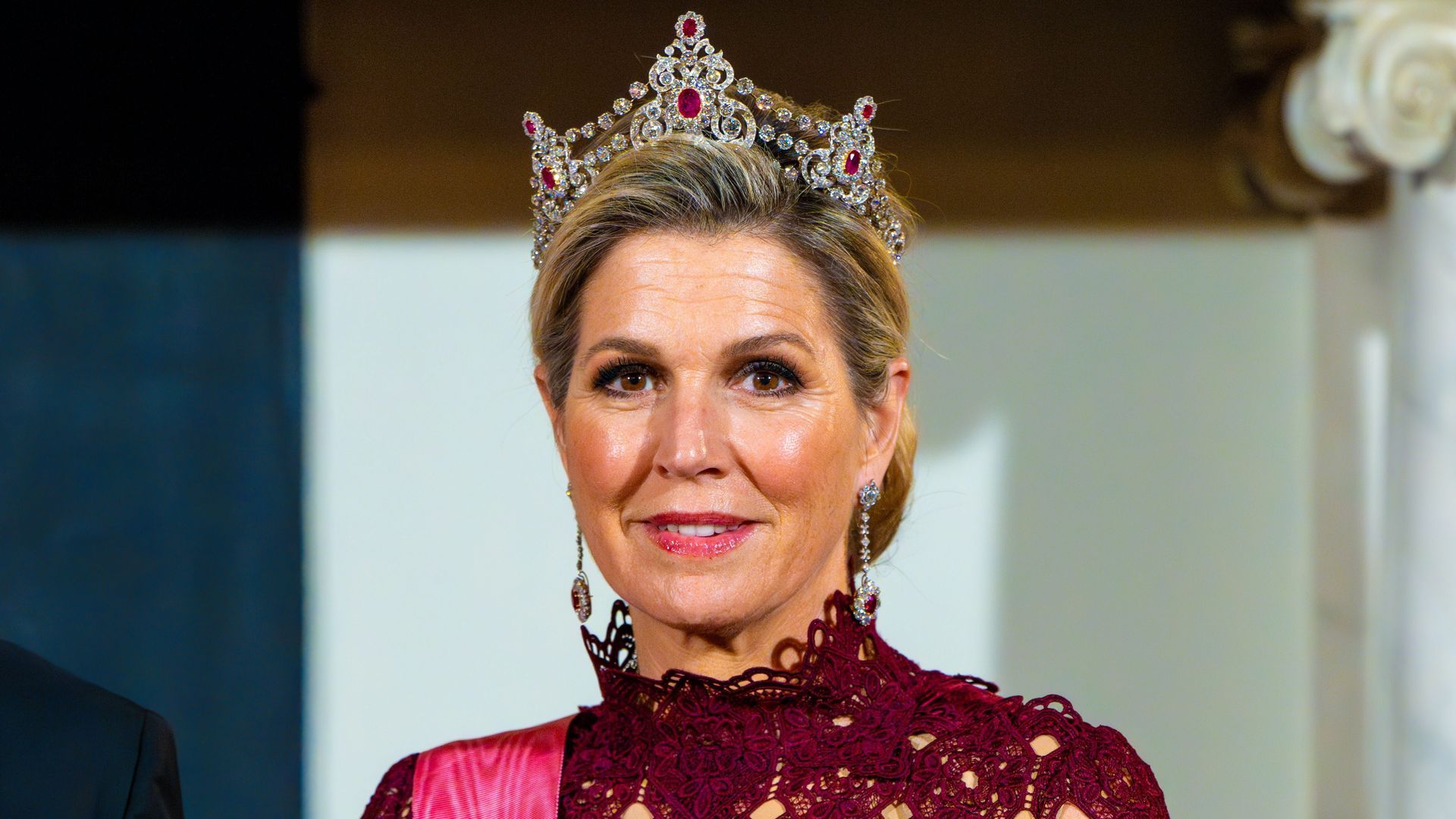
The jewels that form part of a royal collection are rarely the result of a purely aesthetic choice. Behind each commission there is usually a political context, a personal motif—an anniversary, a wedding, a birth—and often a very clear desire for permanence. The Mellerio ruby tiara worn today by Queen Maxima of the Netherlands was not created as just another ornamental jewel, but as a piece designed to consolidate image, lineage and continuity within the House of Orange.
Commissioned in the late nineteenth century and used, since then, by all Dutch queens, this tiara has gone through more than a century of history without losing relevance. Its trajectory allows us to understand, in addition to the evolution of taste and protocol, the role that jewelry has played—and continues to play—in the representation of feminine power within European monarchies.
Mellerio dits Meller: the favorite family jeweler of the European court
When King William III entrusted the commission of a large set of rubies to Mellerio, the Parisian firm had been building a solid reputation among European elites for centuries. Founded in 1613, Mellerio dits Meller is one of the oldest active jewelry houses and a rare exception in a sector marked by constant closures, mergers and reinventions. Its uniqueness lies in having maintained uninterrupted family continuity and a recognizable aesthetic identity, even in times of profound historical change.
Long before arriving in the Netherlands, Mellerio had already consolidated its position as a reference jeweler for royalty. One of the most decisive chapters in that history was its relationship with French empress Eugénie de Montijo, who, according to the firm, visited the jeweler’s shop every week.
During the Second Empire, Eugenia made jewelry a central element of her public image and found in Mellerio an ally capable of translating power, sophistication and modernity in pieces of great visual impact. That alliance definitively placed the company on the map of the great European courts, long before the queens of the north became regular customers.
A commission with a legacy vocation
In December 1888, William III commissioned Mellerio to create a set of jewelry for his wife, Queen Emma. The result was a complete set of rubies and diamonds, the centerpiece of which was an elaborately designed and balanced tiara. The use of sapphires was initially considered, but rubies were finally chosen, a choice that provided greater visual strength and a symbolism associated with power, protection and dynastic continuity.
The tiara contains a total of 385 precious stones, including rubies and diamonds, and is part of a larger set that includes earrings, brooch, choker and bracelet. The stones were integrated into a structure of scrolls and clusters that combined movement and symmetry. The design, attributed to the jeweler Oscar Massin, reflected the technical mastery of the house and its ability to create pieces designed not only to impress, but to last.
Jewelry that adapts to royal life
The death of King William III just two years after the commission marked the first major turning point in the history of the tiara. During her period of mourning, Queen Emma adapted the jewel to the strict standards of the time by replacing the rubies with diamonds, a possibility foreseen since the original design. This versatility—unusual in pieces of such caliber—reveals a very modern conception of royal jewelry: not as an untouchable object, but as a living element, capable of accompanying different life stages.
Other pieces of the set were also transformed over time. Elements of the necklace were reused as brooches, and some gems were dismantled to facilitate different uses. Far from detracting from the ensemble, these adaptations reinforced its value, making it a tangible testimony to the personal history of its owners.
From queen to queen: a carefully protected inheritance

Queen Juliana
getty images
After Emma’s death, the tiara passed to her daughter Wilhelmina and then to Queen Juliana. It was the latter who made a key decision for the future of the Dutch royal jeweler: to integrate the main crown jewels into the Orange-Nassau Foundation, ensuring that they would not fragment or leave the family.
Since then, the Mellerio ruby tiara has been worn by all the queens of the Netherlands, although each has done so in her own way. Wilhelmina was prudent and reserved; Juliana opted for the complete ensemble; Beatrix often chose to combine pieces of the parure without always resorting to the tiara. Each choice reflected not only a matter of taste, but also a certain conception of the institutional role.
Máxima, Amalia and the continuity of an inherited passion
With the arrival of Máxima Zorreguieta, the tiara has regained a prominence that seemed reserved for the past. It is no coincidence that she chose this tiara for her first official portrait as queen, a gesture loaded with symbolism that reinforced her link with the history of the House of Orange. Since then, Máxima has reserved it for state dinners and high-level diplomatic events, combining it with contemporary styles that allow the rubies to stand out without stiffness or excessive solemnity.
The tiara, until now associated almost exclusively with the queen, has also begun to write a new generational chapter. The heir to the throne, Princess Amalia, wore it for the first time on the occasion of the state visit of the Sultan of Oman, a reminder that the item would pass, eventually, to the future queen. It was not, in fact, the princess’s first contact with the tiara. As a child, Amalia used to try on her mother’s tiaras while she was getting ready for big gala events; one of those moments was immortalized in a photograph published on the occasion of her 18th birthday.

getty images
The princess has openly acknowledged her fascination with these historic jewels, once writing “I love tiaras. Show me one and I’ll know where it comes from. I know all the tiaras in Europe.”
“I used to wear my mother’s,” she continued. “I’d see one on her dresser and it was immediately on my head.” An amusing anecdote that speaks volumes about how these pieces continue to be part of the royal family.
More than 130 years after its creation, the Mellerio ruby tiara continues to fulfill exactly the function for which it was conceived: to represent the monarchy in its most visible and solemn moments. At the same time, it acts as a connecting thread between generations of women who have understood power from different places, but always valuing the heritage and history of a royal family.
