

Elsbeth Recap: Do Not Climb Ev’ry Bell Tower
By
Sophie Brookover,
a freelance writer and former librarian who writes about culture
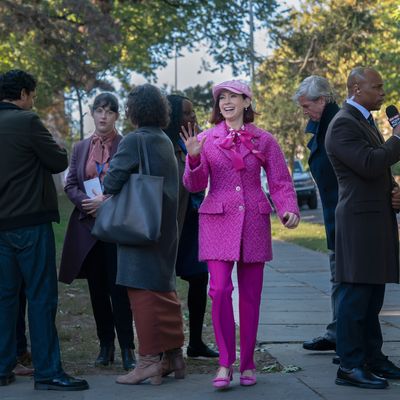
Detective Smullen thinks an accidental death is likely, but Elsbeth is left with a lot of questions unanswered by Mother Constance.
Photo: Michael Parmelee/CBS
This week’s murder is the saddest one of the season so far — for the victim and her friends, family, and fans and for the killer herself, too. What a theft of life and talent, and what a waste of care, quick-wittedness, and capability by Reverend Mother Constance. As I watched the episode unfold, my giddy delight in Dianne Wiest’s performance slid into sadness at what a dreadful corner Mother Constance felt herself backed into, disgust at Monsignor Frank (David Rasche) for placing his ambition above the needs of the convent, and further disgust at Mother Constance’s choice to exploit the solution to her long-ago crisis of faith in service of committing the worst of sins.
RIP, Alaïa Jade (née Alana Jacobs, of the Kansas City Jacobs, and played by Lindsey Normington). A fictional pop star with a mishmash of qualities drawn from the careers and lives of Madonna, Kesha, and Katy Perry, she is trapped in the contractually iron grip of her controlling producer, Shane Sills (Ben Chase), who owns Jade’s masters and can access the full contents of her cloud storage accounts, so that “if she so much as sang in the shower” he can monetize it. Her remaining works in fragmentary progress will provide enough material for at least two posthumous albums and possibly a hologram concert by spring. Like his late client, the reprehensible Shane is a composite of qualities drawn from real-world music-industry villains, including Dr. Luke and Scott Borchetta.
Alaïa Jade was so ready for a new chapter in her life that she was prepared to shell out $27 million on the Convent of Our Lady of Grace and Mercy to have the artistic and personal autonomy she craved. And sure, Shane is a ghoul. However, while tabloid and online gossip suggesting that Alaïa Jade was trying to break free from his control could provide him with a motive for killing her, Elsbeth, Detective Smullen, and Officer Reynolds never really consider him seriously as a suspect. A greedy, controlling jerk? One hundred percent yes. A murderer, though? Nah.
That would be Mother Constance, who abused her strict but just and rightful authority as her convent’s leader to overchastise Sister Darby (Eva Kaminsky) for being two minutes tardy with her usual 6 p.m. bell ringing. In the midst of Sister Darby’s dishwashing penance, her wristwatch lies unattended on the kitchen island behind her, and Mother Constance swipes it, resetting the time it shows by, what we later learn is, about 18 minutes. The next day, Sister Darby keeps an eye on the time during prayers and races to the bell tower to pull the rope at 6 p.m. on the dot. Unfortunately, that 18-minute shift by Mother Constance results in a vigorous bell ringing that pushes poor Alaïa Jade out of the belfry window to the pavement below.
And why? Why would an otherwise capable and benevolent (if controlling) person like Mother Constance stoop not to just murder but murder by proxy? Poor Sister Darby instantly blames herself, which is an extra layer of cruelty in this crime. We can see how much it burns Mother Constance up to see her charges be unceremoniously expelled from their home. No one will speak for them — the old and frail, the ones who rely on the order to supply their medications — to potentially block the sale to “this Jezebel” because the person who usually would advocate for the nuns, Monsignor Frank, places his ambition to be made bishop ahead of their well-being. This is as good a time as any to shout-out two of the cultural allusions Alaïa Jade incorporates, “Like A Prayer”–era Madonna and Katy Perry, whose 2015 attempt to purchase the convent of the Sisters of the Most Holy and Immaculate Heart of Mary in Los Angeles triggered a protracted legal battle.
What pushes her over the edge, into a scheme straight out of the sinister “for the greater good” philosophy at the heart of Hot Fuzz, is the disregard for how the sale would negatively affect her sisters and the disrespect to her as a senior spiritual leader (patriarchal hierarchy, never not one helluva drug). It turns out that Mother Constance’s power and authority are neither as powerful nor authoritative as she’d believed; her refusal to approve the sale is more of a suggestion than a formal requirement. As Monsignor Frank puts it, her preferences were taken into consideration and then set aside. It’s too much! Too much to resist snuffing out a very young life and making a kind and non-murderous nun believe she’s to blame for the death.
What was Alaïa Jade doing that was so bad? Sure, her public image as a party girl is messy as hell, and her latest music video is quite provocative, but as Shane explains to Elsbeth and Detective Smullen, that’s all for show — he is the one who’s placed all the salacious stories about her over the years. She was actually a workaholic with little inclination to party and intended to undertake a total renovation of the church to transform it into a recording studio. In fairness to Mother Constance, she probably would have done away with whoever was purchasing the convent.
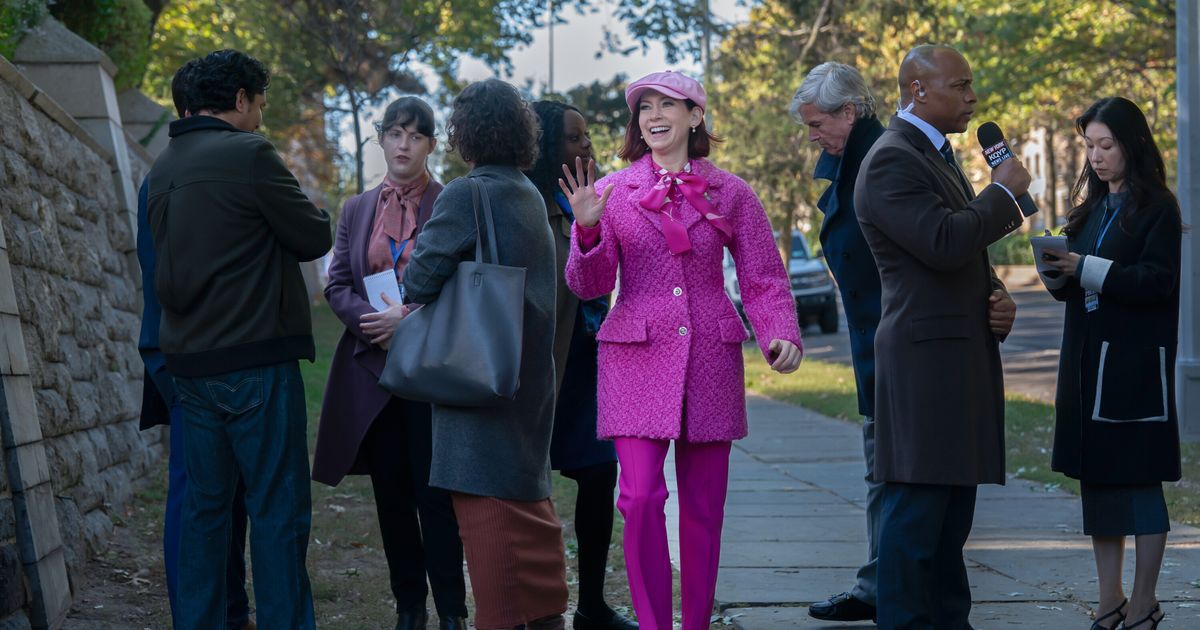
Based on Alaïa Jade’s public reputation and the structural unsoundness of the bell tower, Smullen thinks an accidental death is likely. But Elsbeth is left with a lot of questions unanswered by Mother Constance’s description of the young singer as having been very upset about the bell tower being off-limits. Photos from the phone of a devoted fan further weakens the chief nun’s story. They clearly show that Alaïa Jade, in conversation with Mother Constance outside the entrance to the bell tower, was smiling, not upset or angry at all.
Elsbeth’s continued pressure regarding the bell tower leads Mother Constance to play one last, remorseless card, confessing to Monsignor Frank that she may have encouraged Alaïa Jade to go up to the belfry. She feels partially responsible for that death and shares that she feels particular concern with how this information, were it widely known, would be a big problem for the convent, the church, and his chances at being named bishop. The priest immediately puts his foot down with Captain Wagner, insisting on the need for Elsbeth, Detective Smullen, and Officer Reynolds to show up at the convent with a search warrant the next time they want to pay a visit. Yes! Insist on the police following the rules! Even when the investigators are really nice!
Little does Monsignor Frank know that Elsbeth is one of the world’s most gifted devisers of work-arounds. She manages to get right back to the convent as a volunteer at their food drive. She even recruits Jack Wilson (Dominic Fumusa), who plays the dishy murder-solving priest Father Garvey on Father Crime from season two’s “Toil and Trouble,” to be her plus-one. The nuns are positively giddy to meet him in person, and even Mother Constance can’t turn down the multiple trucks of donations Jack brings with him.
While Elsbeth is at the convent for non-investigative purposes, she still gathers a case-cracking combination of insights from Sister Frances and Sister Darby about the timing of the bells versus when the 911 call came in and lyrics quoting Mother Constance’s description of “God’s divine light, gold and pure” from Alaïa Jade’s speedily released first posthumous single. After a theatrical presentation of the case, using the frame of the three pretty big, nonnegotiable commandments that Mother Constance broke on her road to perdition, we get a really nice postlude.
Sister Frances has been named Mother Superior, and thanks to an influential phone call by Alec Bloom, the convent (including the bell tower!) will be restored to its former greatness. Nothing can disrupt this moment of triumph! Nothing, except Teddy’s increasing doubts about Alec’s stump-speech story about being given sandwiches and taken under the wing of a kindly MTA driver named Pete. Pete Hannigan, who had sounded so certain about being that guy when Teddy reached him by phone, didn’t recognize Alec at all and now thinks he was talking about Ed Koch. Ed Koch was not only not a homeless kid in the late 1980s but he was serving as New York’s mayor at that time (from 1978 to ’89, to be precise). And yet, Alec claimed to recognize Pete instantly when they were introduced. Huh. Has Alec been embroidering the truth? Making up this story out of whole cloth? What will be the consequences for Elsbeth when Teddy inevitably does the most Tascioni thing and continues to investigate his mom’s aspiring beau?
• This week’s episode title is a pun on Agatha Christie’s novel And Then There Were None, most recently adapted for TV in 2015 by Sarah Phelps, who later went on to create a creepy, compelling TV adaptation of Tana French’s Dublin Murder Squad books.
• Is Darby the name of a saint? My grasp of naming conventions for Roman Catholic nuns is limited, so I’m hoping that a knowledgeable commenter can chime in with some expertise here.
• One thing I do know is that the 5:42 p.m. sunset in New York in November is a beautiful, beautiful fantasy. Sunset in Manhattan on the day this episode airs is scheduled for 4:34 p.m.
• This 1980 PSA about water conservation starring Ed Koch and a bunch of conscientious New York schoolchildren resurfaces on social media from time to time and is a delight.
• And finally, if you’re looking for a longer story about a morally ambiguous but not murderous, powerful-within-her-fiefdom nun, treat yourself to Lauren Groff’s Matrix. It’s gripping and gorgeous.
Elsbeth Recap: Do Not Climb Ev’ry Bell Tower
