

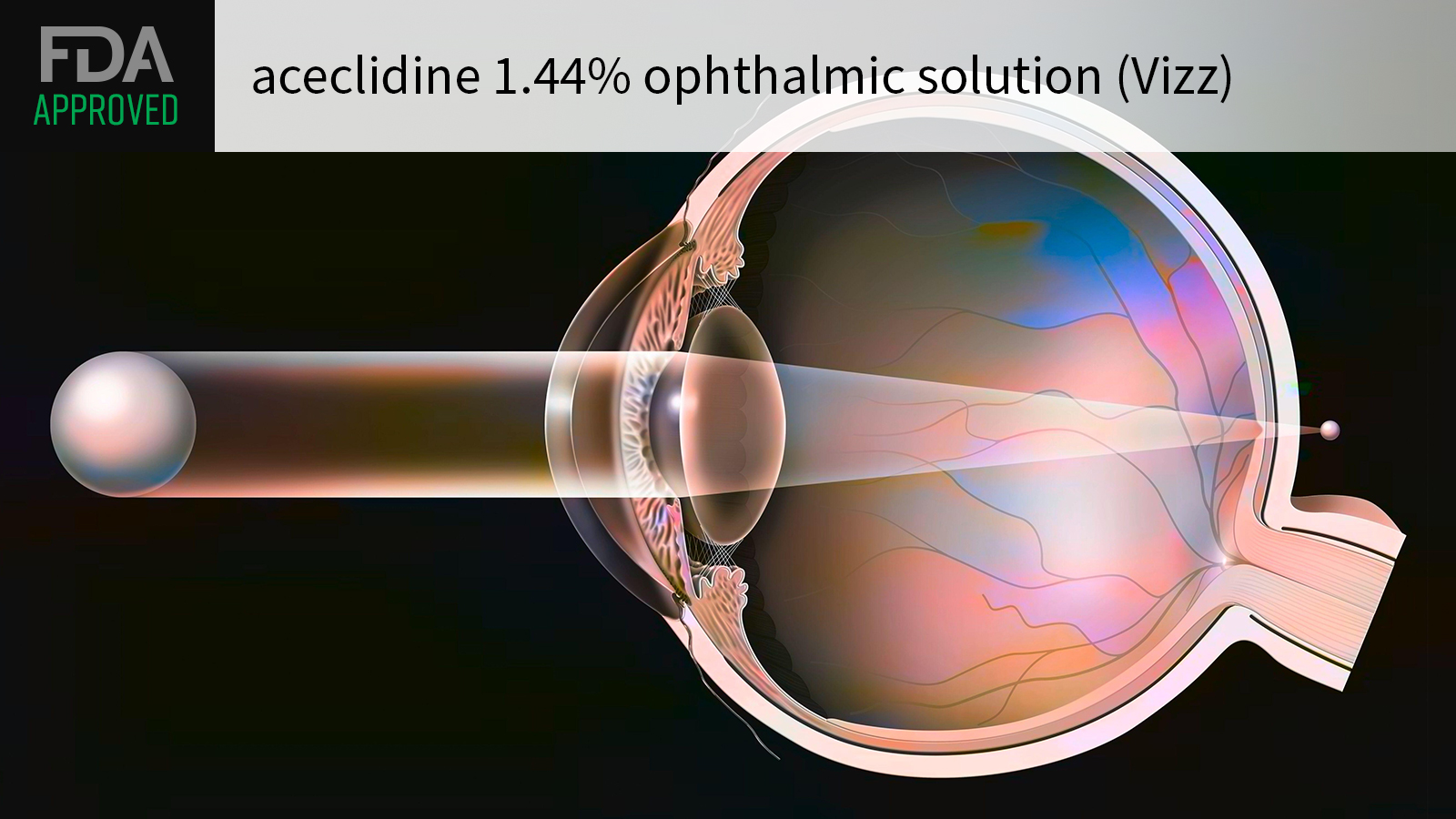
The FDA approved aceclidine 1.44% ophthalmic solution (Vizz) for adults with presbyopia, or age-related blurred near vision, maker Lenz Therapeutics announced on Thursday.
It marks the first aceclidine-based solution to be approved for the condition, which affects an estimated 128 million Americans — almost half the adult population.
Approval was supported by three phase III trials. In the CLARITY 1 and CLARITY 2 trials of 466 participants, the once-daily aceclidine solution significantly increased the proportion of patients gaining three lines or more in distance-corrected near visual acuity at 40 cm, without the loss of one line or more of distance-corrected distance visual acuity at 4 meters. For the primary endpoint, this outcome was measured 3 hours after administration on day 1.
- CLARITY 1: 65% vs 12% with brimonidine (P<0.01)
- CLARITY 2: 71% vs 8% with vehicle (P<0.01)
The studies also met their secondary near-vision improvement endpoints — the solution was rapid acting, with most patients seeing clearer within 30 minutes, and the improved vision lasted for up to 10 hours. A long-term safety study in which 217 participants got daily treatment for 6 months (CLARITY 3) also supported the approval.
“This FDA approval represents a disruptive paradigm shift in treatment options for millions of people who are frustrated and struggling with the inevitable age-related loss of their near vision,” study investigator Marc Bloomenstein, OD, of Schwartz Laser Eye Care Center in Scottsdale, Arizona, said in a statement. “I believe this will be a welcome solution for both optometrists and ophthalmologists who will now be able to offer a highly effective and sought-after presbyopia treatment that could immediately become the standard of care, with a product profile that will meet our patients’ needs.”
The most common adverse events in the CLARITY trials were instillation site irritation (20%), dim vision (16%), and headache (13%). No serious treatment-related adverse events were observed, the company said.
“Aceclidine is a cholinergic muscarinic agonist that stimulates muscarinic receptors located on smooth muscles,” according to the drug’s labeling. “Vizz is a predominately pupil selective miotic that interacts with the iris with minimal ciliary muscle stimulation. Vizz causes contraction of the iris sphincter muscle, resulting in a pinhole effect that extends depth of focus to improve vision.”
The warnings and precautions section of the label notes that patients may experience temporary dim vision after administration of the eye drops, warns of a rare risk for retinal tears or detachment with miotics, and advises caution for those with a history of iritis.
The FDA previously approved two pilocarpine hydrochloride ophthalmic solutions — Vuity in 2021 and Qlosi in 2023 — for presbyopia as well.
Lenz said it expects samples of its aceclidine eye drops to be available in the U.S. as early as October, with commercial availability shortly after that.
