

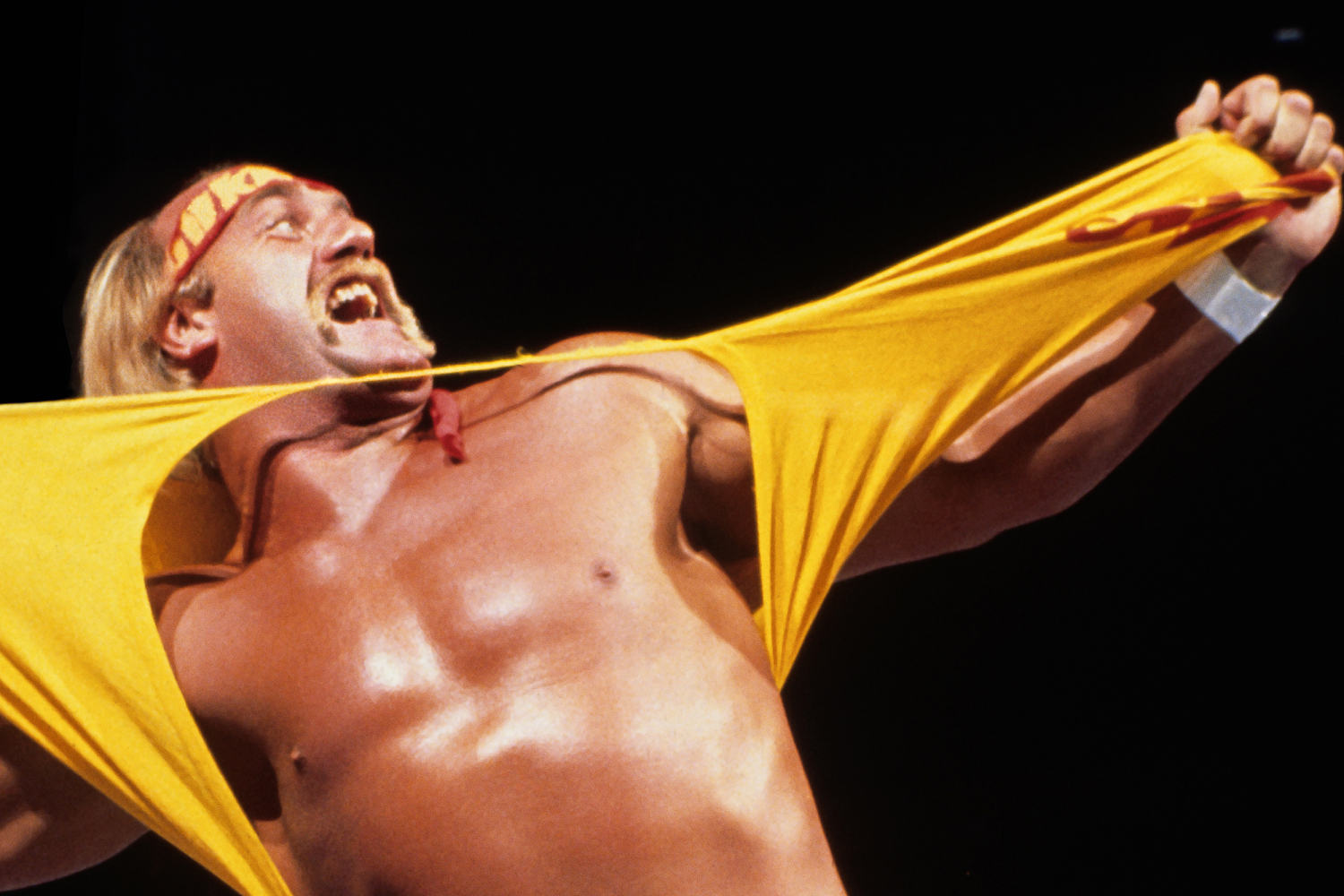
Hulk Hogan’s most memorable movie role was just 44 seconds long. At some point in the middle of 1990’s “Gremlins 2,” the titular monsters cause so much chaos that the movie itself stops. In a meta twist, the scene shifts to a movie theater where “Gremlins 2” is playing, and gremlins in the projection booth have destroyed the film reel. An usher asks a theatergoer for help. That theatergoer turns out to be Hulk Hogan (as himself); he stands up, gripping his popcorn, and screams at the gremlins that he’ll beat them up if they don’t restart the movie. “Do you think you gremsters can stand up to the Hulkster?”
The gremlins are duly cowed, and the movie resumes. In 1990, neither man nor movie monster could stand up to his bluster — or his biceps, which he liked to call his “24-inch pythons.”
Reagan-era America was saturated with violent jingoism — and pop culture was no exception.
Hogan, who died on Thursday, was the most iconic figure to emerge from the world of professional wrestling. As political commentator Carl Beijer puts it, the Hulkster “almost singlehandedly elevated professional wrestling from a regional curiosity that toured in high school gyms and county fairs to a global multimillion (eventually billion) dollar industry.” This made him “the most important professional wrestler who ever lived,” though Beijer also calls him “an absolute trainwreck of a human being,” citing memorable episodes like Hogan being caught on tape delivering an N-word-laden rant while he was in bed with a friend’s wife, and then participating in a Peter Thiel-funded lawsuit that killed Gawker for publishing that tape on its site.
The “Gremlins 2” appearance came when Hogan’s career was still going strong, but it presaged his long descent into a schlocky nostalgia act. It can be hard to remember just what the Hulk Hogan phenomenon was like during his 1980s peak — in the middle of the Reagan years and during the last, shrieking years of the Cold War.
During the height of 1980’s “Hulkamania,” Hogan frequently talked about his three “demandments” — training, saying prayers and eating vitamins. (He later added a fourth demandment, “believe in yourself.”) I’m not sure who ever believed that “vitamins” were all that built Hogan’s “24-inch pythons,” and in the post-Gawker era it had become painfully obvious that the man didn’t exactly enjoy deep spiritual peace.
In his heyday, though, when Hogan strode out into the ring to the strains of his entrance song, “Real American,” fans lost their minds cheering for him. The villains he fought, like the pro-Iran “Iron Sheik” or the supposedly Soviet wrestler “Nikolai Volkoff,” inspired surprisingly unironic hatred. When Volkoff (in reality the Croatian-born and fiercely anti-Communist Josip Nikolai Peruzovic) came into the ring singing the Soviet national anthem, fans were furious.
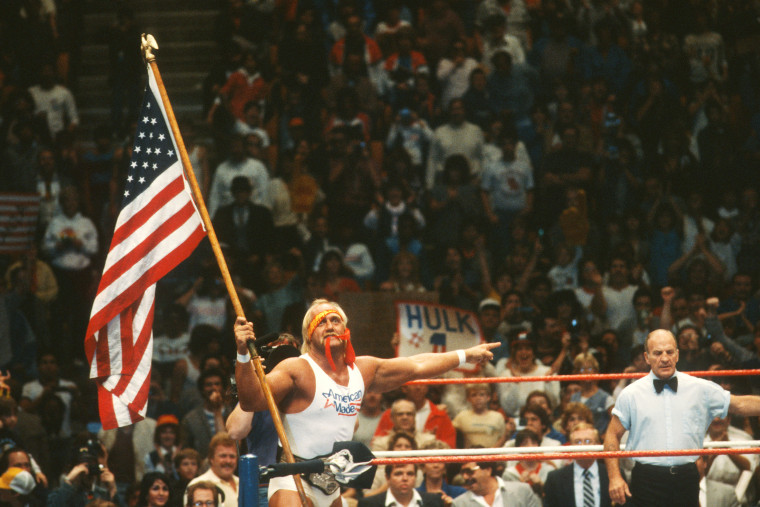
Reagan-era America was saturated with violent jingoism — and pop culture was no exception. Hollywood gave us a parade of muscle-bound movie murder machines like Sylvester Stallone and Arnold Schwarzenegger fighting with fictional commies similar to Volkoff (or sometimes Middle Easterners a la the Iron Sheik).
The fantasies playing out on movie screens and wrestling rings were a dreamy remix of an all-too-real foreign policy in which the U.S. did things like invade the island nation of Grenada in 1983 on the grounds that Grenada’s left-wing government was building an airport, and that it was theoretically possible that this airport could one day be used by the Soviet Union to bomb us. (Really.) The Reagan administration was secretly funneling arms to Contra death squads in Nicaragua, who murdered nuns and priests during their insurgency against the country’s left-wing government, while Arnold Schwarzenegger was fighting with left-wing guerillas in the jungles of an unnamed Central American country at the beginning of the first “Predator” movie in 1987. The United States was backing Saddam Hussein’s bloody war against Iran while “Real American” Hulk Hogan was duking it out with the Iron Sheik.
You can learn a lot about a society from looking at the stories it tells itself. A generation later, a bestselling book of advice for aspiring screenwriters advised that the hero of a movie should do something like “save the cat” early in the film so audiences would root for them.
In an atmosphere of unhinged nationalistic fervor that marked the last decade of the Cold War, the only thing the Sly and Arnold types or the Hulkster needed to be for us to root for them was big, strong, violent and on our side.
You can learn a lot about a society from looking at the stories it tells itself.
And yet, even by the standards of the era, Hogan the man seems to have been remarkably free from redeeming qualities. In the late 1980s, when wrestler and future politician Jesse “the Body” Ventura made an attempt to form a union, WWE founder Vice McMahon caught wind of it and nipped it in the bud. Years later, it came out in court that Hogan was the one who ratted out his co-workers to the boss.
In the late 1990s, as Hogan’s original schtick was wearing thin, he did one of the most memorable heel turns in the history of wrestling, becoming “Hollywood Hulk Hogan” and joining with a team of villainous wrestlers who called themselves “the New World Order.” But even that only lasted for a few years.
The rest of his career was a cycle of “returns” that rarely lasted more than a couple of years. The fans turned against him hard after the N-word/sex tape fiasco and the lawsuit quietly funded by the far-right billionaire Thiel that put the pesky Gawker out of existence.
His last big public act came last summer, when he tore off his shirt at the Republican National Convention, screaming about “Trumpamania.” One of President Trump’s now defunct Atlantic City casinos hosted two Wrestlemanias during the Hulkamania 1980s, so perhaps the Hulkster’s invitation to the RNC shouldn’t have been surprising.
Trump’s slogan “Make America Great Again” was lifted from Ronald Reagan’s campaign for president in 1980, and some of the worst things Trump has done harken back to the era of audiences cheering themselves hoarse for “Real Americans” beating up cartoonishly evil foreigners. Trump ordered as many airstrikes in his first five months in office as Joe Biden did in four long years, even fulfilling the long-time neoconservative dream of bombing Iran, and he’s overseen a brutal crackdown on immigrants. The president and members of his administration are working overtime to make Americans hating a foreign “other” cool again.
I have many fond memories of watching Hulk Hogan wrestle during my childhood, and some of the silly action movies of that era are still personal favorites. But one time through the bloodlusting 1980s was more than enough.
Ben Burgis is a political commentator and author. He has written articles for Jacobin and The Daily Beast.
