

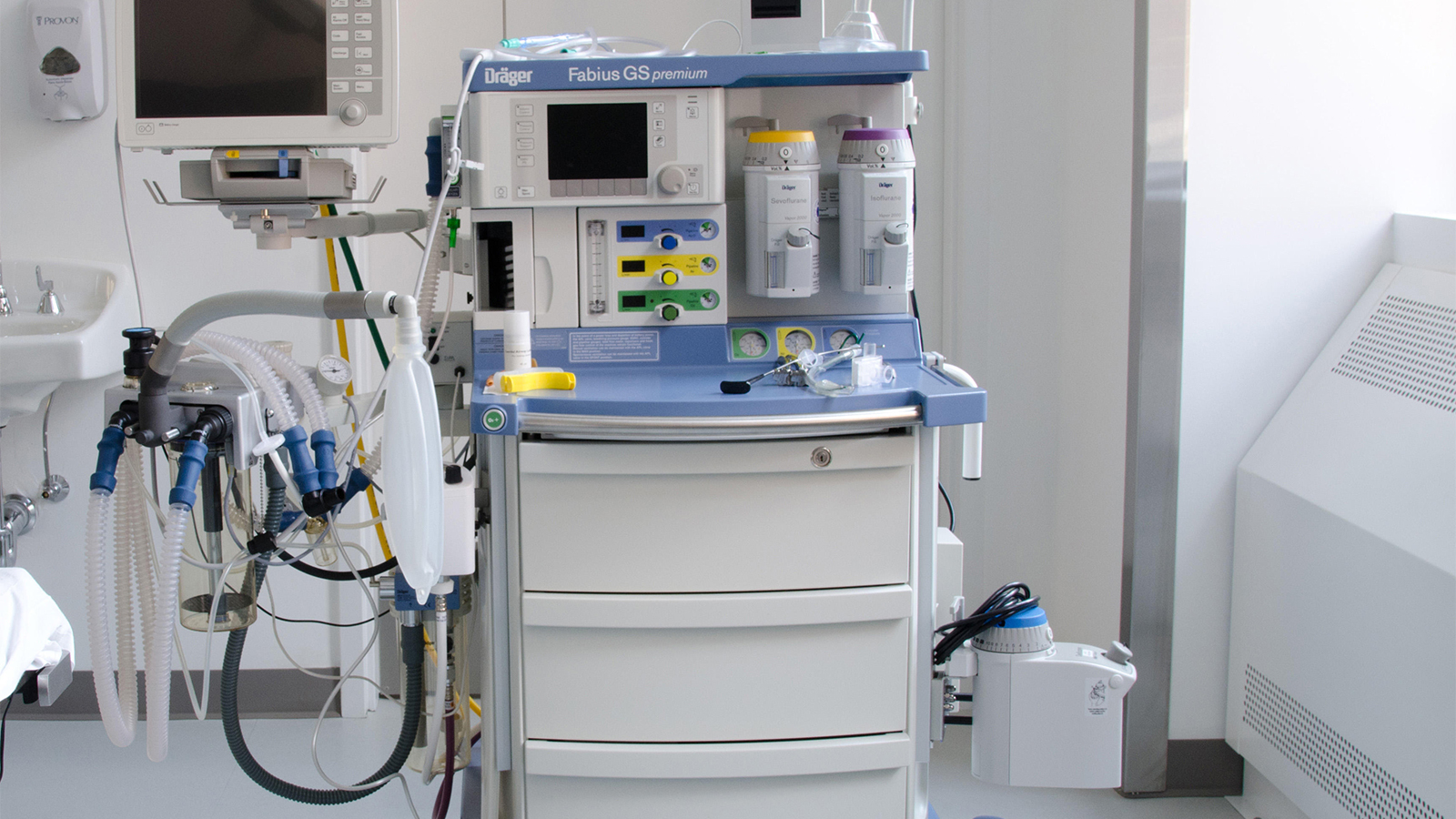
- Inhaled isoflurane sedation was on par with IV midazolam for children age 3 to 17 years in the ICU on mechanical ventilation in a randomized trial.
- Isoflurane also reduced time to extubation and decreased opioid consumption.
- There has been a progressive shift away from midazolam and benzodiazepines due to reported links to delirium, withdrawal syndrome, and adverse neurological events in children and neonates.
Inhaled isoflurane sedation was on par with IV midazolam for children in the intensive care unit (ICU) on mechanical ventilation, the IsoCOMFORT randomized trial showed.
In children ages 3 to 17 years, the mean proportion of time spent in the prescribed range with an adequate sedation depth without rescue sedation was 68.94% with isoflurane and 62.37% with midazolam, which met noninferiority criteria, Pierre Tissieres, MD, DSc, of Bicêtre Hospital in Paris, and colleagues reported in Lancet Respiratory Medicine.
This was true irrespective of age and purpose of intubation. “Additionally, there was a reduction in time to extubation and a more predictable delay to extubation after ending sedation, and decreased opioid consumption, with inhaled isoflurane compared with intravenous midazolam,” the group wrote.
While midazolam is the only sedative labeled for continuous use during mechanical ventilation in pediatric ICU patients, Tissieres and colleagues suggested their results support the use of isoflurane-based inhaled sedation as a safe and effective alternative.
Emphasizing the need for alternatives, they pointed to a systematic review of 15 pediatric studies showing undersedation in 10.6% of observations and oversedation in 31.8%. “Given that both oversedation and undersedation can have notable clinical consequences, improving sedation efficacy and increasing the proportion of time that critically ill children are adequately sedated is of clinical value,” Tissieres and colleagues added, noting that Europe approved the drug as a first-line sedative for pediatric use based on the trial results.
A progressive shift away from midazolam and benzodiazepines due to reported links to delirium, withdrawal syndrome, and adverse neurological events in children and neonates made this an important trial, Maria Cristina Mondardini, MD, of the University of Bologna, Italy, and Angela Amigoni, MD, of the University Hospital of Padua, Italy, wrote in an accompanying commentary.
A few questions need to be answered, though, they argued, including “[F]or which clinical conditions could patients benefit? Additionally, could it be used as a first-line treatment or as a second-line or later sedative for patients who are difficult-to-sedate?”
The phase III noninferiority trial included 96 children ages 3 to 17 years treated in 19 pediatric ICUs in Spain, France, Germany, and the U.K. for critical illness who were expected to require invasive mechanical ventilation and sedation for at least 12 hours and up to 48 hours.
They were randomly assigned in a 2:1 ratio to inhaled sedation with isoflurane or to IV sedation with midazolam, stratified by age group, admission for planned versus unplanned mechanical ventilation, and country. Target range for sedation depth was prescribed at baseline based on the COMFORT Behaviour (COMFORT-B) scale, with dosing titrated based on monitoring every 2 hours using the same scale.
The full analysis set for the primary endpoint included 92 participants (mean age 7.7, 38% female) who received at least 6 hours of the allocated study sedative and had at least three masked COMFORT-B assessments. No crossovers occurred.
Isoflurane led to less opioid requirement during treatment, with a least squares mean dose of 2.1 μg/kg IV fentanyl equivalents per hour versus 4.6 μg/kg per h with midazolam (P=0.0004).
In terms of safety, isoflurane reduced median time to extubation (0.75 vs 1.09 h, HR 3.30 per 1 h increment, 95% CI 1.54-7.07, P=0.011).
Serious adverse events occurred in somewhat more isoflurane-treated patients (31% vs 24%), but none were considered related to study treatment or led to death. Treatment-related severe hypotension occurred in one participant per group.
Notably, 58% of patients were prescribed deep sedation, a group for which it was important that the trial confirmed a benefit of early and more predictable extubation, the researchers noted.
However, with only 4% targeted for light sedation, more research may be needed, Mondardini and Amigoni wrote.
“Considering that most of the participants were admitted to the ICU for postsurgical conditions, one might have expected analgesic treatment to be prioritized,” they wrote. “This also poses the question of whether deep sedation was the reason for choosing a halogenate as the sedative? If so, it remains unclear whether light sedation with halogenates is routinely possible, and if so, what concentrations should be used.”
Limitations included having to downgrade the study from a superiority to noninferiority design due in part to difficulties recruiting during the COVID-19 pandemic and exclusion of children younger than 3 years due to potential risk of transient psychomotor side effects with use for more than 24 hours.
“The positive results observed in the IsoCOMFORT study contrast with the potential risk of reversible psychomotor symptoms in the youngest children and might have been related to the relatively short duration of treatment, warranting future studies in critically ill young children who were not included in this trial, as well as longer exposures,” the researchers noted.
Disclosures
The trial was funded by Sedana Medical.
Tissieres disclosed honoraria from Sedana Medical for participating in the IsoCOMFORT Study Steering Committee and acting as a consultant or investigator for product development for Paion, Baxter, Thermo Fisher Scientific, bioMerieux, Sanofi, and Viatris.
Co-authors reported being employed by and receiving honoraria from Sedana Medical for participating in the study’s steering committee; one co-author disclosed a relationship with Baxter Acute Therapies.
Mondardini and Amigoni had no disclosures.
Primary Source
The Lancet Respiratory Medicine
Source Reference: Miatello J, et al “Inhaled isoflurane for sedation of mechanically ventilated children in intensive care (IsoCOMFORT): A multicentre, randomised, active-control, assessor-masked, non-inferiority phase 3 trial” Lancet Respir Med 2025; DOI: 10.1016/ S2213-2600(25)00203-6.
Secondary Source
The Lancet Respiratory Medicine
Source Reference: Mondardini MC, Amigoni A “Isoflurane instead of midazolam: Is it really first-line?” Lancet Respir Med 2025; DOI: 10.1016/S2213-2600(25)00245-0.
