
Overview
Table of Contents
A Bluetooth speaker is one of those devices that, once you find one you like, you won’t be able to imagine how you lived without it.
Since both Bluetooth and speakers aren’t exactly new technology, you’ll find that this is one of the more expansive product categories (admittedly, this feels like the case for almost anything you buy these days).
Enter: the Mashable tech and shopping teams. We stay on top of the latest Bluetooth speaker releases, while also applying our audio and product testing expertise to determine when old favorites are the better choice. We spend time testing the speakers in our own homes, evaluating the balance in their sound, portability, and of course, their prices. (To learn more about how we choose the best Bluetooth speakers, check out the “How we tested” section).

Testing the JBL Charge 5 side by side with the Charge 3.
Credit: RJ Andersen / Mashable

Mashable reviewed the Sonos Move 2 after its release in 2023.
Credit: Stan Schroeder / Mashable
As of June 2025, our top picks include the near-indestructible JBL Charge 6, smart home-integrated Sonos Move 2, and charmingly retro (but brand new) Marshall Emberton III. You’ll find many of our top-ranked portable Bluetooth speakers below, along with new additions from Anker, Beats, Sony, and Ultimate Ears.
Our Pick

The Good & The Bad
-
Doubles as a portable charger
-
Even better sound than its predecessor
-
Can get loud enough to be used outdoors at a party
-
IP68-rated water- and dust-proof
-
Adjustable EQ with companion app
- Pair with other Auracast-enabled JBL speakers for stereo sound
-
On the larger side, so may not be the best option for folks looking for maximum portability
- At a higher starting price than the Charge 5
We have to start with the namesake of this speaker — it’s ability to charge devices. That makes it an exceptionally good choice for beach days or camping trips. JBL ditched the USB-A port on the Charge 5, opting instead for a USB-C to USB-C cable that allowed us to charge phones, earbuds, and even other speakers. Cool as it was, this feature alone isn’t what made this speaker stand out.
Even at the lowest volumes, the Charge 6’s sound easily filled a living room, but never sacrificed quality for loudness. When listening to Japanese Breakfast’s For Melancholy Brunettes (& sad women), the sound balance came through strong and clear. I could hear both the bass notes and Michelle Zauner’s voice ringing out with impressive clarity, and without losing the sound of the guitar. The companion app also comes with four different equalizer presets and a custom equalizer, so you can adjust the sound to be just right for your ears.
The Charge 6 also offers a couple of ways to amplify your sound even further. Thanks to the included Auracast, you can pair it with other JBL speakers with Auracast to double up on the sound or create a studio mode. When we tested it out with the Flip 6, it worked without a hitch. If you want a louder sound and more battery life, you can toggle on the speaker’s PlaytimeBoost mode, which offers an extra four hours of battery life, though the quality of the sound sometimes struggles in this mode.
Whether you’re taking it with you on the go or using it at home, the Charge 6 gives you options. For instance, the flat base allows it to sit on a table without any danger of rolling off, but if you prefer it to stand instead, it’s also reliably balanced, thanks to the silicone ends. Though this speaker is larger than most of our other picks, it does come with an adjustable handle strap, which you can loop, use as a handle, or remove entirely. Ultimately, though, if you’re looking for something that can easily fit into most bags, we recommend the smaller Flip 7 instead.
Details

The Good & The Bad
-
Impressive, balanced sound for its size
-
Waterproof and dust-proof
-
Rugged, durable, and drop-proof up to five feet
-
Fun, bold colors
-
Compact and easy to toss in your bag
-
It floats!
- USB-C chargeable
-
Bass isn’t as deep as larger speakers and gets distorted at higher volumes
-
We didn’t enjoy the Podcast Mode EQ setting
- No companion app
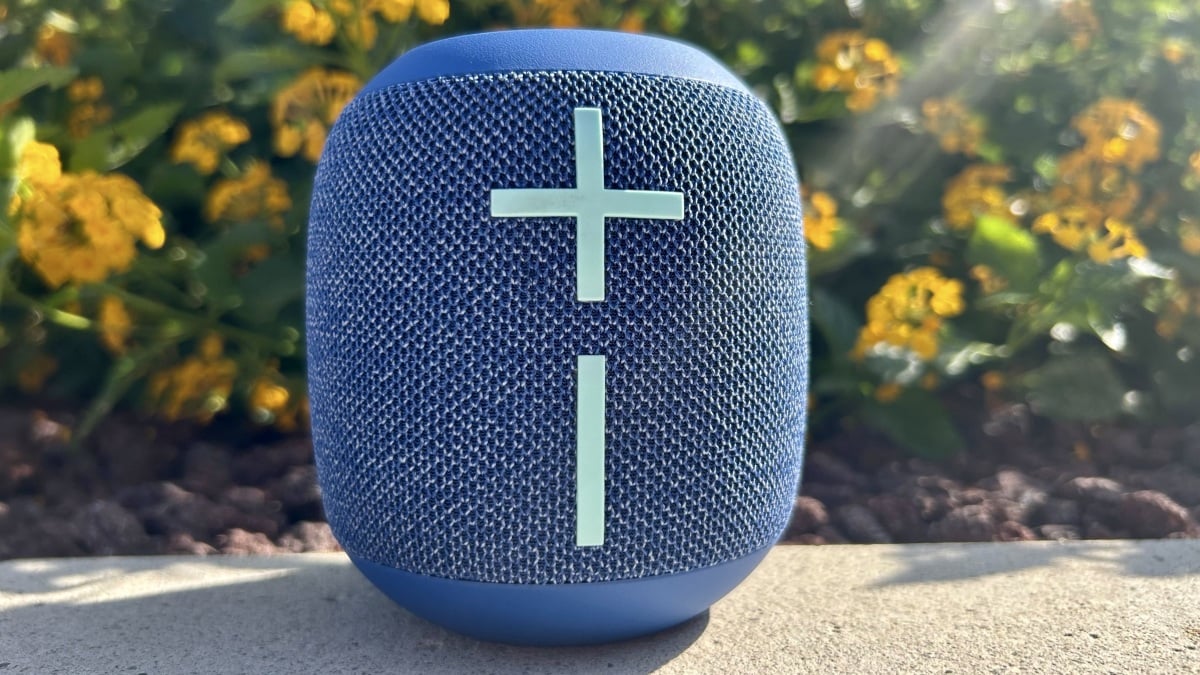
So what’s different? On the sound front, the Wonderboom 4 has less muddiness than its predecessor, especially at higher volumes. In addition to the Outdoor Boost mode, you’ll also get a Podcast Mode. We will say that we’re not necessarily fans of the new addition — hosts’ voices came through compressed, while background static felt more pronounced. Generally, this mode shone much better on the brand’s Everboom speaker.
However, the standard audio is good enough for listening to podcasts and music, so ignoring the new EQ feels like a fine concession. As with the Wonderboom 3, we found that overall, the sound profile is well-rounded and can get loud. We do wish that this speaker had been updated with a companion app for more customization.
On the bright side, it’s very easy to plug, play, and now charge, thanks to the addition of a USB-C charging port. While it’s not all that different from the Wonderboom 3, anyone who wants a no-frills speaker that sounds good will be happy with this one. The Wonderboom 4 is easy to find in stock and on sale, making it our updated pick for the best speaker under $100.
Details

The Good & The Bad
-
Built-in smart features supporting Alexa
-
Great audio quality
-
Easy switch from WiFi to Bluetooth
- 24 hours of battery
-
Pricey
-
Less portable than other Bluetooth speakers
-
No Google Assistant support
- Historically hasn’t gone on sale too often
To be clear, this speaker isn’t perfect, but we think the trade-offs balance out. For instance, you need a 3.5mm to USB-C adapter for line-in playback, but you can charge your phone from the Move 2’s battery by connecting it with a USB-C cable (similar to the Charge 5). It isn’t very portable for hikes or trips to the beach, but it’s easy enough to move from the kitchen to the backyard (and has IP56 dust and water resistance), making it great for entertaining. It’s also a great choice if you like using a speaker to listen to music around the house. While it doesn’t work with Google Assistant, it does work great with Alexa.
It can burn through the battery life faster at higher volumes, but it gets plenty loud without sacrificing sound clarity. In essence, there are a few trade-offs you make with this speaker, but if you’re looking for the best-sounding smart speaker, and the cons of this one don’t clash with your needs, we think the Sonos Move 2 is a great pick.
Details

The Good & The Bad
-
Lightweight and portable with detachable strap
-
Loud, room-filling sound
-
Dust-, rust-, shock-, and waterproof
- Long playtimes with a battery-saving mode
-
Sound gets a big tinny at high volumes
- Could use more practical features
Sony stuffed powerful audio components underneath the speaker’s casually chic sheath, including one tweeter, one woofer, and dual-passive radiators that, in combination, deliver emphatic sound. The default EQ dishes strong bass, and enabling the ULT mode effectively raises it with minimal distortion, depending on the music track. There’s even a Sound Field Optimization feature that auto-adjusts performance based on the noises around you, and it works well in all environments.
Great bass response isn’t the only reason we’re huge on the ULT Field 3. This speaker projects sound at a high range (up to 50 feet). Playtime is notably high, plus Sony’s Battery Care function ensures long-term use out of the battery by capping recharges at 90 percent. Lastly, durable craftsmanship protects the speaker against many environmental hazards, letting you rock out anywhere without worrying about damage.
Details

The Good & The Bad
-
Built-in carabiner is easy to use
-
Impressive volume, especially for the size
-
Slim and lightweight if you need to slip it in your bag
-
Sufficient playtime
-
Dust- and waterproof
- Plenty of fun colorways to choose from
-
EQ is unavailable when using Auracast
-
Battery saving mode decreases sound quality
- No voice assistance
While providing maximum portability and protection (IP67 dust- and waterproofing), this fifth-gen speaker has a fun factor that only a handful of other compact speakers can match. Its IP certification makes the Clip 5 a stellar shower companion, producing adequate clarity and enough oomph to wake you up during early bathing sessions. The customizable EQ and multiple presets are crucial for enhancing sound quality; adjusting the frequency levels helps balance output. Pairing two Clip 5 speakers together will open the door to stereo sound.
The Clip 5 has impressively loud volume that also diminishes mids and highs when raised all the way up. You can get better sound from other portable speakers, such as the UE Wonderboom 4 that costs about $30 more, but is well worth the pickup if audio is your priority. Otherwise, the Clip 5 is just as small, sturdy, and serviceable at a cheaper price.
Details

The Good & The Bad
-
Vibrant audio with surprisingly strong bass response
-
Customizable EQ to personalize sound
-
Dust- and waterproof
-
Holds a charge longer than most luxury Bluetooth speakers
- Built-in strap provides convenient portability
-
Limited feature set compared to other Anker speakers
-
No built-in power bank to charge devices
- Lacks a speakerphone
Playing songs on the Select 4 Go will reward you with enticing bass-forward sound that can be tweaked through Anker’s customizable 9-band EQ or a handful of presets (Bass, Balanced, Signature, Treble). The Signature preset produces dynamic range, something that’s unheard of for a speaker this low-priced, and the Balanced preset makes sound more natural. We’ve found the Select 4 Go to be pleasantly resonant when jamming out to different music genres, from alternative rock to hip-hop to jazz. Don’t confuse this for an audiophile speaker because it is far from that. The high-end isn’t as transparent as we would like.
Another key area where the Select 4 Go proves its worth is portability. On top of being tiny, it’s one tough-built speaker housed in sturdy plastic and covered in IP67 dust- and waterproofing. There is a built-in strap for attaching the speaker to a carry item via a carabiner. This serves bicyclists who choose to blast music from their backpacks when zipping through rush hour traffic or hikers needing an outdoor soundtrack to complete woodland expeditions. The 20 hours of playtime are also good for five days of moderate listening (four hours daily). It would have been nice if Anker designed the speaker to double as a portable bank for recharging media devices on the fly, but this isn’t a dealbreaker for a speaker that’s often on sale for $23.
Details

The Good & The Bad
-
Cool retro design
-
Three preset equalizer settings that sound noticeably different
-
Bluetooth connects and switches between devices easily
-
Long-lasting battery
-
App is easy to use but not necessary to have a good experience
-
Has a built-in mic if you want it
- Supports Bluetooth LE and Auracast
-
No customizable equalizer
-
Audio isn’t wildly better than speakers that are $50 cheaper
-
Not a true 360-degree sound profile
- Voice equalizer preset made podcasts sound weirdly compressed
So, for folks who appreciate good design, we recommend the new Marshall Emberton III. Not only does this premium Bluetooth speaker have Marshall’s iconic vintage look, but it’s also a solid-sounding speaker for its price point.
To our surprise, the speaker did perform. Right out of the box, it produced clear and well-rounded sound. Though it had a slightly heavier-bass mix, it made Still Woozy’s “Get Down” and Billie Holiday’s “Solitude” sound equally as good. We wish it had a custom equalizer, but if you download the companion app, you can choose between the Marshall preset (the speaker’s default sound), the Push preset that boosts bass and treble, and the Voice preset that enhances the mid-range for voice-focused content. The presets sounded markedly different, which isn’t always the case with the audio devices we test. We wouldn’t recommend the Voice preset, unfortunately. Like the podcast mode on the Wonderboom 4, this setting made podcast hosts’ voices sound compressed and less clear.
As for the on-speaker features, a light indicates battery life and both the power and Bluetooth buttons make the speaker ultra-easy to turn on and pair — we never had to spend more than 10 seconds connecting or switching between devices. Finally, the speaker also comes with a unique knob in the center to toggle the volume and song selection. This worked fine, but the dial control might not be for everyone.
Marshall promises a 32-hour battery life with this speaker, and after several days of medium to heavy use, the speaker still sat at about 60% battery life. With the app, you can also turn on battery preservation features to keep the charge going as long as possible.
For $169.99, it’s a good, but not incredible, sounding speaker, but it more than makes up for its small drawbacks with a cool retro design. Released in August 2024, its feature set and design aren’t that different from the Emberton II. So, if you want to save some money, you can pick up the Emberton II at a discount without sacrificing much sound quality.
Details

The Good & The Bad
-
Impressive battery life
-
Very budget-friendly
-
Satisfactory volume, especially for price point
-
Compact
-
Cute design
-
Can do stereo sound with two speakers
- IP67 water and dust proof rating
-
Charging cord and power adapter not included
-
Can lose sound clarity on certain genres
-
No on-speaker controls beyond on and off button
-
No cover for charging port
- Can be finicky to reconnect if you try to pair to more than one device
Surprisingly, the VAPPEBY portable speaker did actually deliver. Sure, being only $15 means it does come with its shortcomings: it won’t come with a charging cable or power adapter, it feels cheap and plasticky, and the audio quality suffers with music that’s more mix-heavy (especially at higher volumes). Plus, the connection can be touch and go if you’re not sticking to one device.
However, it gets decently loud and isn’t exorbitantly expensive, so you don’t need to feel overly precious with it. The sound quality is acceptable to use as a simple desktop speaker, or one you can bring with you in the shower or to the beach without too much stress (helped by its IP67 water- and dust-proof rating).
With just one button to play music and power it on and off, IKEA really brings this speaker down to the basics. All in all, you’ll get a speaker that’s compact, cute, and keeps the features and price down to a minimum.
Details

The Good & The Bad
-
Arguably the best call quality of any portable speaker
-
Massive sound upgrade from the original
-
Sleek handheld design built for travel
-
Lossless audio via USB-C connection
-
Increased battery life
- Plenty of stylish colorways
-
No spatial audio
-
Metal grille is incredibly fragile
- Weight is heavier than it looks
This level of performance carries over to voice assistance, a productivity feature that every Siri and Google Assistant user (the Pill is also optimized for Android) will love. Voice commands register accurately and execute as quickly as the speaker receives them.
The Pill’s second-most valued trait is lossless audio. To enjoy this, you must connect the speaker to a compatible device (e.g., laptop, MP3 player, smartphone, tablet) via USB-C input. Doing this boosts clarity and depth when vibing out to favorited playlists on Apple Music, Spotify, and Tidal. Beats also deserves credit for redesigning its sound architecture to expand frequency range and keep bass at the forefront for well-balanced output.
Details

The Good & The Bad
-
Very loud, bass-heavy performance
-
All-day long battery life
-
Nearly indestructible build quality
-
Adaptive EQ corrects sound based on your environment
- Variety of handy features
-
Might be too loud for small spaces
-
No speakerphone or voice assistance
-
High volume drastically drains playtime
- Expensive and heavy
First, sound quality. A portable speaker this colossal doesn’t hold back on bass or volume. The Hyperboom blasts music as loud as any home entertainment system, shaking the floor and walls with intense reverberation, while producing low end that slaps harder than a reactive counterattack from Will Smith. Two 25-millimeter tweeters will do that. Bass is exaggerated, but UE developed an Adaptive EQ that uses a tiny microphone on the top to adjust sound in real time based on ambient noise. We noticed the feature improved mid and high frequencies. Toying with the EQ in UE’s companion app helps increase clarity.
Niche features like the aux and optical inputs transform the Hyperboom into a home speaker that blends nicely with your home entertainment setup. There are dual Bluetooth inputs to pair the speaker with two media devices simultaneously. That means one person can play the DJ and another can hijack the playlist with their own music requests without compromising performance. UE programmed the Hyperboom to pair with several of the brand’s other mid- and high-range speakers, giving you full 360-degree stereo sound.
The Hyperboom is not an immaculate party speaker and is outdated in certain ways. Notice the lack of speakerphone and voice assistance. Keeping volume at about 60 percent is the safest way to protect one’s hearing and preserve battery life. Furthermore, the speaker has a steep MSRP ($400) and weighs a lot (13 pounds). Still, it’s an audio beast you’ll need on hand to feed adrenaline-pumping sound to large crowds.
Details
We created this guide by sifting through our past Bluetooth speaker reviews from Mashable staff and freelancers, as well as testing out new speakers specifically for this article.
-
Sound quality: This category speakers for itself (get it?), but we make sure to test every speaker with a variety of audio types (from audiobooks to videos to podcasts) and music genres. Where available, we look at equalizer options and see how they impact the sound of a speaker. Of course, we also test out the full volume range and evaluate whether it impacts the balance of the sound at any point. Other notable sound features we thoroughly test are adaptive audio modes, Bluetooth codecs, digital assistance (Google Assistant, Siri), mono and stereo, and speakerphone capability.
-
Battery life: A speaker’s portability (and usability) suffers if it can’t stay alive for a least a few hours. Typically, we test speakers out for at least a week with regular use to see how often someone might have to charge them. It’s not a perfect science, as we play around with special features and the volume settings. Our goal is to get the most accurate read of playtime for the average user and see if the speaker falls within the battery life claimed by brands. Something else we inspect is whether the speaker supports quick charging.
-
Design: For a Bluetooth speaker’s design, we look at a few different factors, including any water or dust proof rating, its size and options for taking it on the go, and even whether or not it would like nice (or distractingly bad) on a bookshelf in someone’s home.
-
Value: Finally, we look at how all the above contribute to the speaker’s price point. We expect a $200 speaker to have markedly better sound quality and more features than a $80 speaker. As we expand our testing pool, we take into consideration how different speakers match up to their competitors.
Frequently Asked Questions
If you’re twisting our arm, we have to give it up to JBL. Not only have JBL speakers beaten brands like Sonos and Bose in Mashable’s blind sound tests, but they’re also on the more affordable side. That’s a hard combo to beat. However, several brands are popular in the Bluetooth speaker market. Consumer favorites include Anker, Beats, JBL, Sony, and Ultimate Ears. Certain upscale audio brands like Bang & Olufsen and Bose continue to build out their collections with notable releases. Even low-cost speaker manufacturers like Treblab and Tribit are making noise with some of their inexpensive entries.
It’s hard to say one brand’s speakers are definitively the best, especially because the right pick for you will depend heavily on your budget. Obviously, you shouldn’t expect a $40 speaker to sound the same as our current top pick, the $199 JBL Charge 6. That doesn’t mean you have to blow out your budget to get high-quality sound. What we can say is that certain brands tend to be popular for a reason.
For our guide, we put together the standouts from each brand. All of the speakers we chose offer good value, portability, smart home compatibility, and durability. Most importantly, they sound terrific, with satisfying bass and fidelity.
Not really, but it doesn’t hurt to have this protection. You’ll want to own a waterproof speaker if you plan on playing music at the beach, pool, or in your shower. It’s not out of the question that your speaker could be a target for spills in the house. So, if you have the option to go waterproof (and you do), do it. It’s also worth educating yourself on ingress protection (IP) ratings to know the difference between each. Here is a breakdown below.
-
IPX0 – No water resistance
-
IPX1 – Survives vertical drip of 1 millimeter of water
-
IPX2 – Survives drip of 3 millimeters of water
-
IPX3 – Survives light water spraying
-
IPX4 – Survives omnidirectional water splashing (water resistant)
-
IPX5 – Survives water jet splashing up to 12.5 liters for 1 min
-
IPX6 – Survives water jet splashing up to 100 liters for 3 mins
-
IPX7 – Complete submersion up to 1 meter for 30 mins
-
IPX8 – Complete submersion up to 3 meters for 30 minutes
When you’re shopping for a new speaker, you’re going to see the word “wattage” a lot. While that might be meaningless to you when you see it on a product page, it’s actually a pretty simple concept. Basically, wattage refers to how loud your speaker can get without distorting the sound. Unless you enjoy really blasting your tunes or you regularly host parties, 50 watts is going to be more than enough for the average listener. But if you do like to crank it up to 11, the more watts, the merrier. While smaller portable Bluetooth speakers tend to have lower wattage, there are certainly some exceptions, including some of the products in this guide.
Our motto is quality over quantity. Having one amazing speaker is going to get you better sound than having multiple speakers that are just OK. If you’re fine with listening to music in a single room or plan on entertaining small crowds, then one speaker will suffice for mono presentation. Just make sure the environment has good acoustics. If you’re hosting larger crowds in larger settings or want a more immersive listening experience, then the way to go is pairing two of the same speakers (or speakers from the same brand) for stereo sound. Some models even let you pair up to 100 speakers at once to create full omnidirectional sound.
No. Some Bluetooth speakers are WiFi speakers. Not all WiFi speakers are Bluetooth speakers. Basically, a Bluetooth speaker connects to devices through (what else) Bluetooth, which is the most common wireless technology for the product category. WiFi speakers connect to devices through a reliable internet connection, making it a more appealing option for those with an integrated smart home ecosystem (e.g., Apple, Google, Sonos).
Essentially, yes. It’s all a matter of what audio codecs your speaker supports. AAC and SBC are the two most common codecs you’ll find on current portable Bluetooth speakers. There are some speakers that come with stronger codecs like LDAC to stream music at high-res 24bit/96kHz. All that means is you’ll hear more detail and nuance from recordings at a higher transmission. Something else to look for is LE Audio-ready speakers, which improve audio streaming at lower latency. Your speaker should run Bluetooth 5.2 or higher. Anything less than that could affect what you hear. The higher the Bluetooth version, the stronger the connection and streaming quality.

Bethany Allard is a Los Angeles-based shopping reporter at Mashable covering beauty tech, dating, sex and relationships, and headphones. That basically means she puts her hair through a lot, scrolls through a lot of dating apps, and rotates through a lot of different headphones. In addition to testing out and rounding up the best products, she also covers deals for Mashable, paying an especially obsessive amount of attention to Apple deals and prices. That knowledge comes in handy when she’s covering shopping holidays like Prime Day and Black Friday, which she’s now done for three years at Mashable.


