

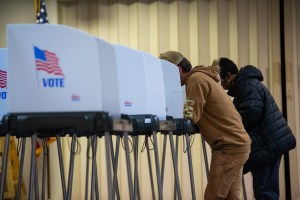
Ryan Wharton normally doesn’t vote.
But at a low point last year, the 28-year-old PR professional and freelance journalist found himself cashing in his pennies and quarters at a Coinstar machine for dollars he could spend on medication and groceries.
This time, the Texas resident voted for Democrats up and down the ticket. He told Fortune the economy under President Donald Trump had left him feeling completely hopeless. He struggles to imagine a future in which Gen Zers like him can live what he considers a “normal life.”
Texas delivered one of the biggest upsets of a wave election for Democrats. State Rep. James Talarico beat Republican Attorney General Ken Paxton by double digits, becoming the first Democrat to win a U.S. Senate race in Texas since 1988. Democrat Gina Hinojosa unseated Gov. Greg Abbott.
Across the country, Democrats flipped seven Republican-held Senate seats, including in Iowa, Ohio, and South Carolina, to take control of the chamber. In Kansas, Methodist pastor Adam Hamilton defeated Sen. Roger Marshall, the first time Kansans have sent a Democrat to the Senate since 1932.
Young voters led the shift. About 7 in 10 voters under 30 backed the Democrat in their local House race, according to The AP Voter Poll, a survey of more than 100,000 voters, after many in their generation supported Trump in 2024.
The economy was at the center. About 4 in 10 voters overall named it the top issue facing the country. Gen Z has borne the brunt of the affordability crisis, squeezed by inflation and rising costs just as they’re trying to build their lives.
In October, 91% of young registered voters told the Harvard Youth Poll that the cost of living mattered in their vote.
Fortune spoke to six young people across the country and across the political spectrum and heard the same core frustration: the future they were promised feels like it’s slipping further away, replaced by deep disillusionment with how the economy works today. Polling suggests that anger isn’t aimed only at Washington; young voters across party lines also say they’re worried about corporate power.
Prices are outrunning paychecks
For many Gen Z voters, affording even the essentials has become nearly impossible.
Between 2019 and 2024, the median home price rose 30%, while the median income of households headed by adults under 40 grew just 9%, according to the Pew Research Center. This year, the war with Iran pushed gasoline prices higher and fed inflation.
Entry-level work is harder to find, too. The unemployment rate for recent college graduates held at 5.6% this summer, above the rate for all workers, according to Federal Reserve Bank of New York data cited in Fortune’s reporting on Gen Z graduates.
Wharton told Fortune he’s been in “survival mode 24/7.”
“I’m always having to handle a new crisis. If it’s not groceries, it’s medication, and then God forbid, an unexpected expense like my dog’s vet bill comes up,” he said. “It just feels like I’m running out of time.”
A protest vote, not an endorsement
Wharton leans liberal. But even some Republican voters crossed party lines, citing the economy and the war in Iran.
Peter, a 26-year-old from Ohio who asked to be identified only by his first name, said he voted for Trump in 2024 but switched to Democrats in this year’s midterms because of what he called Trump’s “betrayal” on the economy and war.
“I genuinely cannot think of a more direct and egregious betrayal by a political candidate than running on a campaign of ‘no new wars’ and ‘fixing the economy,’ then destroying the economy for a foreign war,” he wrote to Fortune.
He made clear he didn’t switch because he prefers Democrats. He wanted to send Republicans a message.
“To be honest, I don’t actually think Democrats are the better choice. I voted because I wanted this midterm to send a message: if you, as a U.S. president, get us into another foreign war, your presidency is DONE,” Peter wrote.
He isn’t alone in his ambivalence. The AP Voter Poll found the Democratic Party only modestly more popular than the GOP. Sophia Robertson, student chair of the Harvard Public Opinion Project, which conducts the Harvard Youth Poll, told Fortune that Democrats should be cautious about reading the results as a mandate.
“A lot of people are angry about the state of the economy, about disruption, about all of these top issues, about international conflicts,” Robertson says. “But that doesn’t mean they’re affirmatively excited about the Democratic Party.”
“The system that was set up may not be supporting Gen Z”
The biggest takeaway from the young people who spoke to Fortune: they don’t believe the system is set up for them to succeed.
Amrita Bhasin, a 25-year-old sustainability startup founder from California, believes the status quo wasn’t built for her generation to thrive. “I think Gen Z is realizing that the system that was set up may not be supporting Gen Z, and the question is, what are our politicians going to do about that?”
Megan, a 27-year-old personal trainer from Texas, feels none of her representatives, including the president, have offered a solution to the cost of living, which squeezes her even on a $70,000 salary.
Alex, a 28-year-old budtender at a dispensary in Alaska, still can’t afford health insurance, doesn’t qualify for Medicaid yet, and feels trapped by the cost of living. Both women asked to be identified only by their first names.
“I live with my boyfriend and his mom because, at 28, even with his good-paying job, we can’t quite save up enough for a place that’s decent,” she told Fortune.
She ties those costs to the One Big Beautiful Bill Act, the tax-and-spending law Trump signed in July 2025, and to the state’s Republican leaders. “Most of all, I don’t want to see Dan Sullivan and Mike Dunleavy come into power again; they cut state funding all across the board from Medicaid to schools, and I’m sick of it.”
As of Thursday, Sullivan’s Senate race against Democrat Mary Peltola was still too close to call.
Robertson says the most interesting finding in the Harvard poll was how much young people care about corruption, and why. Nearly 9 in 10 called it important to their vote, second only to the cost of living. Young voters, she says, are increasingly connecting corruption to what they pay.
“It isn’t a rejection of corruption on some sort of normative grounds,” she says. “It’s that corruption is directly taking money out of their pockets, and they’re looking for politicians who will hold themselves to account and thereby make their lives more affordable.”
Concern about corporate power also cuts across party lines. In the same poll, 81% of young Democrats, 67% of independents, and 60% of young Republicans said they were concerned.
Amaia Choate, a 24-year-old in Washington state, said that as a transgender, first-generation American, social issues were at the front of her mind when she voted. Her biggest frustration, though, was with the system as a whole.
She grew up in rural Aberdeen, Washington, raised as a conservative and a staunch believer in capitalism. “Me and all my friends, we grew up being told that Republicanism or conservatism, capitalism was just the be-all and end-all to American society,” Choate told Fortune.
She didn’t finish high school. She earned her GED, went straight to work in a factory, and experienced homelessness throughout her young adult life. She now earns more as a peer support counselor but still can’t afford groceries.
“A lot of us live in pretty destitute conditions. I have to go to the food bank every week to make sure that I get my meals.”
Adults always told her about the American dream and how they bought their first homes, Choate said, but she and her peers grew up in an economy that looked nothing like it.
“That disappointment that has grown among all of us has sort of fomented a resentment for the system as a whole.”
She’s since become a communist organizer.
