

This roundup of The Conversation’s environment coverage was first published in our award-winning weekly climate action newsletter, Imagine.
In a world without plankton, I wouldn’t get stung by jellyfish when swimming in the sea. But my friend’s fish and chip shop would go bust. There’d be big climate implications too.
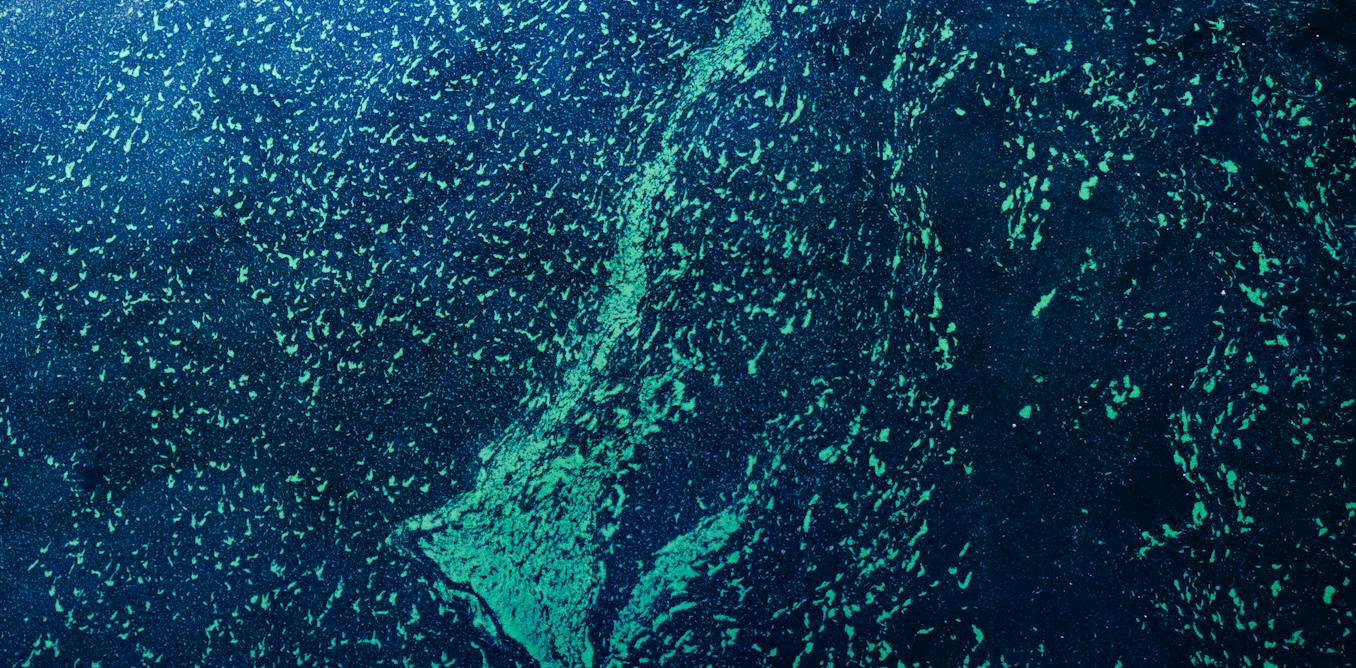
Plankton, meaning “drifter” in Greek, encompasses all the viruses, bacteria, insects, larval fish and jellyfish that don’t actively swim. Instead, they drift in oceans, rivers and lakes, at the whim of currents and tides. Many are microscopic; some, like barrel jellyfish, are huge.
I recently explored the planet’s reliance on plankton in a new episode of BBC Radio 4’s Life Without series with TV presenter and comedian Alan Davies. Listen to this thought experiment here.

Don’t have time to read about climate change as much as you’d like?
Get a weekly roundup in your inbox instead. Every Wednesday, The Conversation’s environment editor writes Imagine, a short email that goes a little deeper into just one climate issue. Join the 50,000+ readers who’ve subscribed so far.
First, a quick food web refresher. Algal plankton or phytoplankton are single-celled organisms that photosynthesise to produce oxygen and capture carbon dioxide. These form the base of the marine food web. Next up, it’s zooplankton, tiny marine animals that feed on phytoplankton. Without zooplankton like copepods (a microscopic crustacean), young fish, basking sharks and blue whales wouldn’t have anything to eat. When those animals die and sink, so too does the carbon captured during photosynthesis, so phytoplankton are an essential climate variable.
Climate canaries
Climate change increases the frequency of marine heatwaves and the distribution of some plankton is already shifting towards the poles where ocean temperatures are cooler. By looking at the fossil record of plankton, researchers have found that some plankton are now less able to adapt to climate change than they were in the past.
Geological warming around the last ice age 21,000 years ago was relatively gradual. A study by paleobiologists at the University of Bristol found that “current climate change is too rapid and is reducing food supply … making plankton difficult to adapt to this time”.
Plankton postcodes
Depending on their location, phytoplankton’s chemical fingerprint varies. So much so, that crime scene investigators can diagnose drowning in a specific location depending on the presence of certain microscopic plankton.

Subphoto.com/Shutterstock
This “postcode” also gets transferred to other animals as they feed on these ocean drifters. Plankton postcodes have helped a global team of marine biologists map the feeding habits of 114 different species of sharks.
Christopher Bird and Clive Trueman at the University of Southampton found that sharks living in coastal waters, such as the great white or reef sharks, had been feeding close to where they were caught. Sharks in the open ocean, such as mako sharks, appeared to get most of their food from a specific plankton postcode, no matter where in the world they were caught. And knowing where sharks feed helps protect them.
Read more:
How plankton help control clouds over the world’s most remote oceans
Cloud control
Plankton help control the formation of clouds over remote seas in the Southern Ocean far from land.
“Clouds are made up of many tiny droplets of water that have condensed from water vapour onto microscopic particles floating in the Earth’s atmosphere. These particles are known as cloud condensation nuclei. Plankton essentially help provide clouds with these nuclei to form around,” says Daniel Grosvenor, a researcher at the University of Leeds.
His team found that more cloud droplets tended to occur above patches of the ocean with more plankton. Plankton could influence cloud albedo (the amount of energy from the Sun that’s reflected back to space). Grosvenor’s study also suggests that, in a lifeless ocean without phytoplankton, the Southern Ocean’s surface would probably be “somewhat warmer”.
