

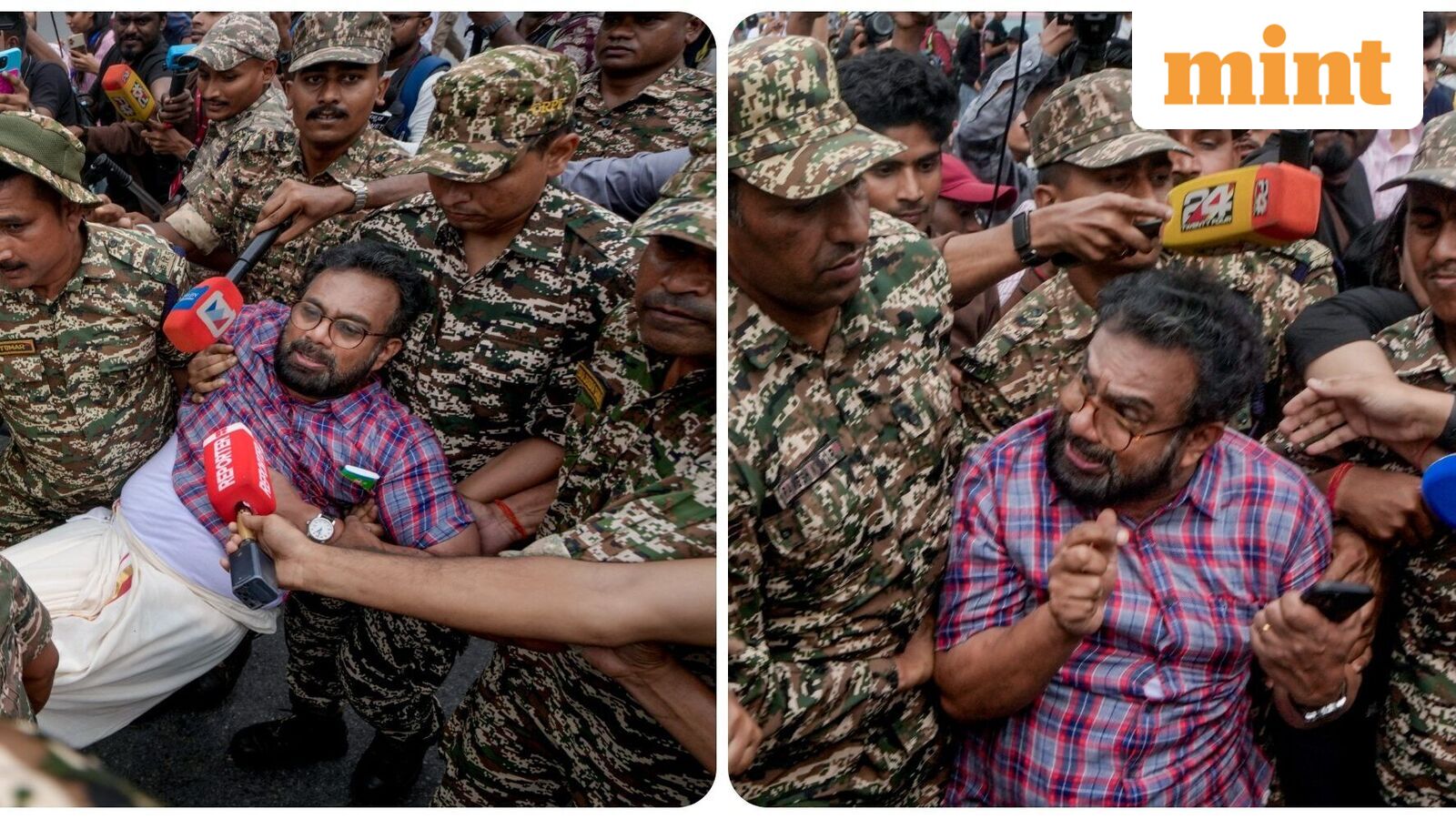
CPI(M) Rajya Sabha MP John Brittas sought President Draupadi Murmu’s intervention, expressing concern about the health of Jawaharlal Nehru University (JNU) students who have been on a hunger strike since October 3. He said in a post on X that the strike entered 17th day on Monday (October 19).
“The indefinite hunger strike by JNU students, now in its 17th day, and the deteriorating health of the participants demand urgent intervention,” John Brittas wrote on social media.
He said that, as a former JNU student, “I am deeply concerned by the present situation.”
“A university that nurtured debate and dissent must not punish them. Its democratic traditions must be preserved, and its students’ voices deserve to be heard, not silenced,” Brittas wrote on X.
Who is John Brittas?
John Brittas is a Communist Party of India (Marxist) leader from Keralam. Born on May 15, 1966, in Pulikurumba, Naduvil, Kannur, Brittas is married to Sheba Brittas and has one son and a daughter.
In his profile on the Rajya Sabha website, Brittas’s profession is registered as a “senior Journalist, Media top management Personnel”.
He earned a BA, MA, MPhil, and PhD from Calicut University, Kerala and Jawaharlal Nehru University, Delhi.
John Brittas was elected to the Rajya Sabha in April 2021, and has since served as a member of several committees, including Committee on Commerce, Committee on Communications and Information Technology, Committee for the Ministry of Electronics and Information Technology, Committee on Public Undertakings, Committee on Transport, Tourism & Culture and India-Vietnam Parliamentary Friendship Group.
Why did Jon Brittas write to the President?
John Brittas took to X to share his letter to the President, urging her to take “immediate action to revoke the unjust rustication of elected JNUSU representatives, withdraw the objectionable provisions of the Chief Proctor Office (CPO) Manual, and resolve the students’ outstanding grievances”.
The Jawaharlal Nehru University Students’ Union (JNUSU) said its office-bearers and 14 other students have been on an indefinite hunger strike since October 3.
JNUSU president Aditi Mishra, vice president Gopika and general secretary Sunil are among those observing the hunger strike, the students’ body said on October 5.
Referring to the Jawaharlal Nehru University Act, 1966, Brittas said the legislation identified social justice, secularism and a democratic way of life among the university’s foundational principles. The act designates the President as the Visitor of the university.
He urged President Murmu to intervene under Section 8 of the Act and take appropriate steps towards revocation of the rustication orders, withdrawal of alleged objectionable provisions of the CPO Manual and urgent resolution of the students’ outstanding grievances.
Why are JNU students on hunger strike?
The union has opposed the disciplinary action against its elected representatives and sought their reinstatement. The office-bearers have remained under rustication for several months, following protests earlier this year.
On Monday, Brittas said the rustication of elected students’ union representatives, including the former JNUSU president, had raised serious concerns.
“The exclusion of elected representatives from the University directly affects the functioning of the students’ union and weakens the mechanism through which students collectively articulate their grievances,” he wrote.
Brittas also raised concerns over the continued enforcement of the CPO Manual, which provides for fines and disciplinary measures for several forms of protest and assembly.
Recalling his years as a student at JNU, he said the university had long provided a space for debates, discussions and democratic activities.
He cautioned that disproportionate disciplinary measures could discourage students from raising legitimate grievances over fear of punitive action.
He also flagged unresolved concerns relating to gender justice, equal opportunity, admissions and basic campus facilities, saying the prolonged impasse had assumed serious proportions in view of the risks to the health of those on hunger strike.
What are the protesters’ demands?
The union said the hunger strike will continue until their demands regarding the revocation of the CPO Manual and rustication orders against union office-bearers are addressed, according to PTI.
The JNUSU also called for a review of the CPO Manual, arguing that its provisions affect students’ rights and participation in campus affairs.
According to PTI, the protesting students are also demanding:
1. Immediate attention to the “crumbling” infrastructure on the JNU campus
2. Reinstatement of the Gender Sensitisation Committee Against Sexual Harassment (GSCASH)
3. An independent inquiry into an alleged recruitment scam through the Internal Quality Assurance Cell (IQAC);
4. Re-constitution of the Equal Opportunity Cell in accordance with the proposed Rohith Act.
‘Admin had not made any concrete efforts to hold negotiations’
JNUSU on Friday claimed that Vice-Chancellor Santishree Dhulipudi Pandit acknowledged the ongoing hunger strike for the first time but refused to speak to rusticated students when she visited the protest site.
In a statement issued on Friday, the students’ union criticised the vice-chancellor’s public expression of concern over the health of the hunger strikers, alleging that the administration had not made any concrete efforts to hold negotiations.
JNUSU president Aditi Mishra alleged that the vice-chancellor briefly visited the hunger strike site on October 16 and told the protesters that their demands had been fulfilled and they should end their strike.
“When I came running to the site so I could speak to her, she got in her car and said she will not speak to rusticated students,” Mishra said, asserting that the protest would continue until all demands were met.
The union said the administration had communicated its interest in initiating another round of negotiations at 11 am on Friday, but no concrete steps had been taken to finalise the meeting.
It accused the university administration of making public statements to create an impression of concern while failing to engage meaningfully with the protesting students.
In a statement issued on Monday, the V-C said the competent authority, on behalf of the university administration, went to meet the students on hunger strike at 8.50 AM on October 16, and found that none were present at the protest site.
JNU Vice-Chancellor (V-C): ‘Medical care is even being given’
Jawaharlal Nehru University Vice-Chancellor (V-C) Santishree Dhulipudi issued a statement on Monday, saying that the competent authority, on behalf of the university administration, went to meet the students on hunger strike at 8.50 am on October 16, and found that none were present at the protest site.
“Medical care is even being given to the rusticated students on humanitarian grounds… twice-a-day check-up from Day 1 as per medical protocol,” the statement said.
The V-C further said two rounds of discussion regarding the students’ demands have taken place, and more meetings will follow.
“Further, before that on October 9, 2026, the same committee (on administration’s behalf) had met the strikers at the vice-chancellor’s office and discussed the matter for more than four hours. The result of the meeting was that the two groups sitting on hunger strike ended their strike after assurance by the committee. The groups refused to meet together; they met separately,” the statement said.
The V-C’s statement said the administration has been “most democratic and humanitarian”, and has not taken any action against the rusticated students, despite destruction of “public property worth ₹20 lakh”.
“This was bought with money given by Government of India, Indian taxpayers’ money,” it added.
JNU students’ union hits back at V-C’s remarks
In response, the JNUSU alleged that its rusticated office-bearers were denied medical check-ups during the first six days of the hunger strike, claiming that their vitals were monitored through a private laboratory during the period.
JNUSU also questioned the vice-chancellor’s visit to the protest site at 9 AM, alleging that it was aimed at creating a narrative that only a few students were participating in the agitation.
Claiming that hundreds of student volunteers and hunger strike participants were staying at the site round-the-clock, the students’ union questioned why the V-C had not informed them before her visit or chosen to visit in the evening.
Defending its legitimacy, the JNUSU said it is an elected representative body with a mandate from around 9,000 students, and not merely a students’ group. Its representatives have been elected through independent election committees and notified by the office of the dean of students, it said.
JNUSU also alleged corruption in university recruitment and questioned the administration’s commitment to protecting taxpayers’ money.
Strike ‘illegal’?
According to JNUSU, the chief security officer cited the rustication and out-of-bounds order against a union office-bearer and alleged that the ongoing hunger strike was illegal.
The students’ body further alleged that the office-bearers were warned that their period of rustication could be extended if they continued with the protest.
JNUSU further alleged that the administration had denied medical check-ups to union office-bearers participating in the hunger strike.
It said it had conveyed to the vice-chancellor that the hunger strike would continue until its demands were addressed.
(With inputs from ANI, PTI)
