

Advertisement

AI and Nigeria’s Crisis Response: A Young Journalist Reflects on Shuaib’s Book
By Rukaiya Ahmed Alibe
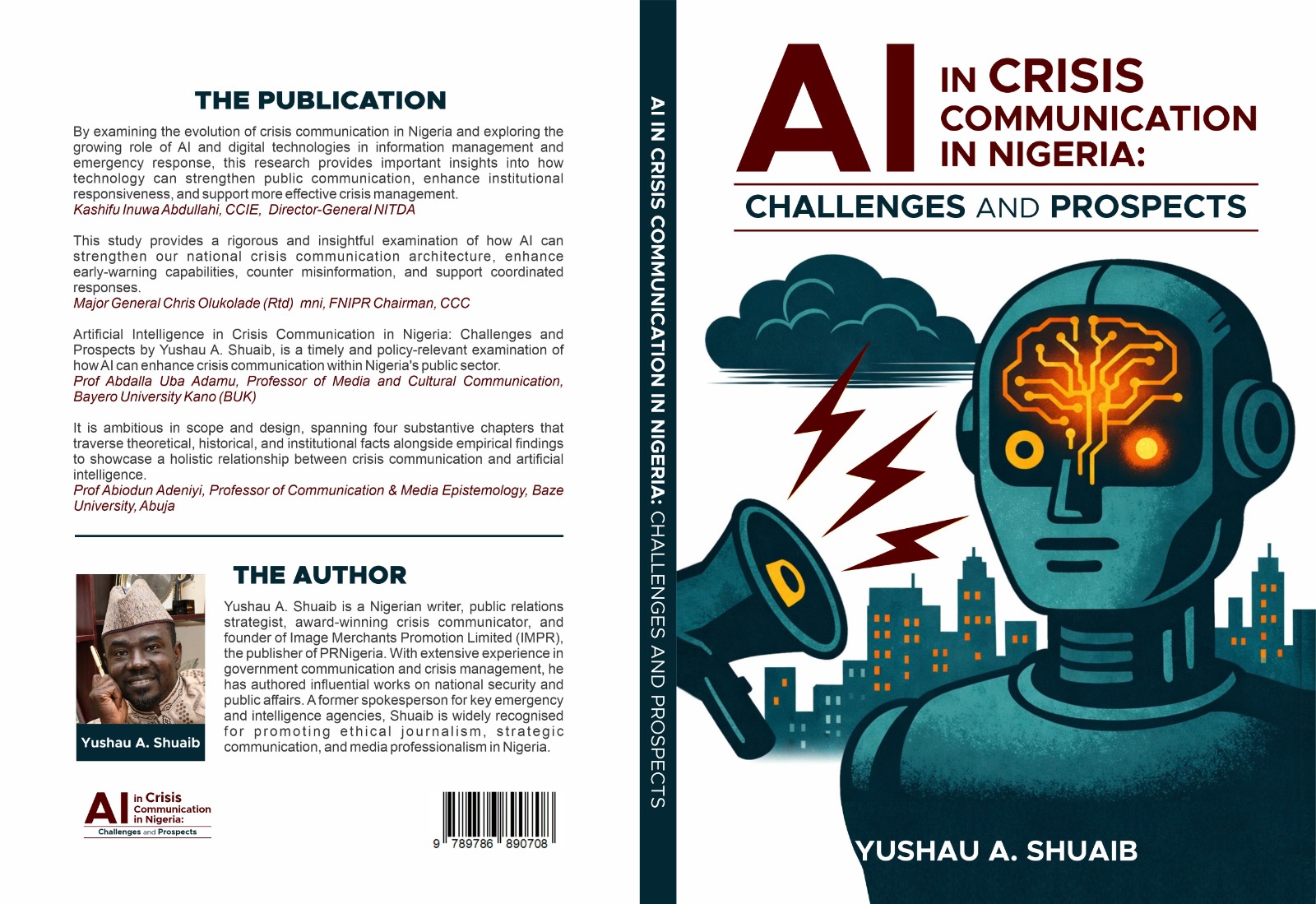
AI in Crisis Communication in Nigeria: Challenges and Prospects is a 207‑page book written by Yushau A. Shuaib, a Nigerian writer, public relations expert and crisis‑communication strategist. He is also the founder of Image Merchants Promotion Limited (IMPR), the publisher of PRNigeria. The book offers an eye‑opening exploration of how Artificial Intelligence (AI) is gradually reshaping crisis communication and disaster management in Nigeria.
From the very first chapter, the author explains how AI is being used globally to reduce disaster risks in countries such as the United States, Germany, Japan, Kenya and Nigeria. As I began reading, I expected the book to focus mainly on Nigeria’s challenges. Instead, I was surprised to learn that Nigeria is already using AI‑powered systems for flood early warnings through agencies like the Nigerian Meteorological Agency (NiMet) and the Nigeria Hydrological Services Agency (NIHSA). This discovery caught my attention because I had not imagined that Nigeria had reached this level of technological adoption in disaster management.
However, the book also makes it clear that AI usage in crisis communication remains limited. Despite the many crises Nigeria faces—ranging from insecurity and flooding to public‑health emergencies and economic shocks—many public institutions still rely heavily on traditional communication methods.
To assess AI’s effectiveness, the author draws on surveys, interviews, case studies, government reports and policy documents. The findings show that AI is already being used to share information, monitor social media and make crisis messages clearer and faster. Yet its use in early warning, risk analysis and coordination remains underdeveloped.
The book identifies several challenges slowing down AI adoption: poor internet connectivity, inadequate funding, shortage of skilled professionals and unclear government policies. It also highlights concerns about misinformation, privacy, accuracy of AI‑generated content and public trust.
One of the most important lessons I gained is that AI cannot replace human judgment. It can process large amounts of information quickly, but during emergencies—when lives are at risk—human understanding, empathy and decision‑making remain essential.
Another key point is the need to make AI useful to ordinary people, not just government agencies. Communities affected by insecurity or natural disasters need timely, clear and accessible information. In regions like Lake Chad, where access to information is often limited, AI‑supported communication could be helpful—but only if it considers local languages, internet access and community realities.
This book also made me realise how much disaster‑management practices are changing. AI was not something we discussed deeply in school, so learning how it is already being used in Nigeria—especially for flood warnings—was exciting. It opened my mind to an area I had not paid much attention to before.
As someone who works in journalism and reports on issues affecting communities in the Lake Chad region, I find this topic highly relevant. During crises, timely and accurate information can save lives. AI can support this process, but it must be used responsibly and alongside human expertise.
In the end, the book helped me understand the growing role of AI in crisis communication and disaster management. It also shows that although Nigeria has started using these technologies, much more needs to be done to improve adoption, coordination and public awareness. This book is a reminder that learning does not stop in the classroom—there is always something new to discover.
