

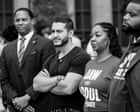
Abdul El-Sayed has an impressive résumé: Rhodes scholar, professor of epidemiology at Columbia University, executive director of the Detroit health department. And, at 41, the Michigan Democratic senatorial candidate represents a new generation of politicians, a shift that he also embodies sartorially. Whereas casual dress for many politicians is a tieless dress shirt with rolled up sleeves, El-Sayed has embraced a post-corporate, digital nomad-ish uniform: fitted black T-shirt, slim jeans and sneakers.
His progressive politics are having a moment among liberals, and he remains unswervingly disciplined about his message: “Money Out of Politics, Money in Your Pocket, Medicare for All.” On paper he appears well-aligned to Democratic sensibilities in this moment, and he is competitive in the polls. But his support is softer than overall Democratic sentiment would dictate, especially among Black voters.
A Washington Post-Schar School poll released last month found that among likely Black voters, 83% said they wanted Democrats to control the Senate yet only 67% backed El-Sayed. His campaign reps attribute some of this gap to a heavily financed onslaught of negative ads run against him in the primaries, and they’re desperately trying to undo the harm.
But El-Sayed is attempting to do so in a novel, and risky, way: employing political universalism to focus on a common set of issues that he believes will be broadly resonant rather than focusing on the specific, sectarian and uniquely differentiated interests of the disparate groups huddled under the Democrats’ big tent.
In explaining his strategy, El-Sayed said, “Democratic politics too often tries to pander to folks on their differences rather than to bring us together across our similarities.” He continued: “I want to campaign on those things that all of us need and deserve in our lives.”
It’s a lofty ideal in principle – especially for older Black voters who might be more accustomed to direct appeals. But in practice it means that group-specific concerns go unacknowledged: the “Priorities” section on his campaign website doesn’t mention the names of minority groups or the words “racial” and “racism”. Instead, his references are oblique, sidestepping direct invocations.
Women and LGBTQ+ Michiganders are only explicitly mentioned in a section about healthcare freedoms with his pledge to “fight to codify the rights once protected by Roe v Wade into federal law”, and a stance that he will “oppose any effort to criminalize certain medications and the use of lawfare or funding cuts to stop healthcare providers from providing full-spectrum healthcare that meet all the needs of their diverse communities”.
The site focuses on immigration and his pledge to abolish ICE, without mentioning the words “Hispanics” or “Latinos”, even though the Detroit Metro Times reported in April that most of the people arrested by federal immigration agents in Michigan, as of that time, were from Latin America.
Under a subsection called “Civil Rights & Liberties”, El-Sayed simply promises to “protect the rights of all Americans, regardless of where they live, where their parents came from, how – or if – they pray, their sexual orientation, gender identity, how old they are or how much money they make”. And the site invokes the Flint water crisis without mentioning Black people or racism, instead saying that he will “fight for a federal water guarantee that every family has access to at least 50 gallons of clean water per person per day”.
The closest the site gets to mentioning Black people directly is in the use of the acronym HBCUs (historically Black colleges and universities) among a list of education services and institutions he would seek to fund.
This lack of acknowledgment may well be manifesting in a lack of enthusiasm.
On 3 October, a brisk, clear Saturday, El-Sayed held a public rally in Flint, a city of roughly 80,000 people, the majority of whom are Black. A line snaked around the St Michael Catholic church as people inched forward to get one of about 400 seats inside. But, when the event began, only about on in 10 of those seats appeared by the Guardian’s count to be filled by Black people. The stump speech, a little more than 20 minutes long, went much the same way that his campaign site does: sticking to the central platform message and not explicitly acknowledging the constituent demographic groups of the Democratic coalition.
When the attenders were allowed to ask questions, Michele Kelly, a 67-year-old grandmother, lifelong Flint resident and supporter of El-Sayed, said that many people in low-income housing where she lives lack information and enthusiasm. She asked him what he and his team could do to “get that demographic riled up and encouraged to come out” and support him.
Kelly said after the event that she was specifically referring to Black people in her question, and “if I hadn’t raised my hand, there wouldn’t have been no conversation about Blackness”. But, in his answer, El-Sayed never directly addressed Black people, instead referring to “those folk” and “people like that” and bemoaning money in politics and a “profound lack of trust”.
After El-Sayed won the primary in mid-September – without winning the Black vote – his campaign issued a press release “outlining the legislation he will introduce or support in the US Senate to directly address the priorities of Black communities across Michigan”, which included small business, home ownership, health and voting initiatives. It is buried on his site’s “News” vertical under scores of other press releases issued since.
The El-Sayed campaign said via email that “Abdul has made more than two dozen visits to Black churches and participated in upwards of 100 events and meetings with Black elected officials, community leaders and organizations across the state”.
Earlier Saturday, before the church rally, El-Sayed was at a private meet-and-greet in at the Flint home of attorney Christopher Burtley, chair of the state’s Black leadership advisory council. About 100 people showed up, eight in 10 of whom were Black, by the organizers’ estimates.
after newsletter promotion
Burtley says that the overwhelming feeling he detects toward El-Sayed from the Black community in Flint is “unfamiliarity”. Phyllis Sykes, founder and executive director of the International Center of Greater Flint, and Burtley’s cohost at the meeting, chimed in: “People were on the fence.” She added, “I don’t think he has really been plugged into the African American network or whatever here like I know he has with some of the international populations.” None of that bodes well just a month out from election day. Both Burtley and Sykes are supporters of El-Sayed.
The biggest names in Black Democratic politics are attempting to ameliorate this problem. Not only did former vice-president Kamala Harris travel to Michigan to campaign with El-Sayed last month, but former president Barack Obama is also scheduled to do the same later this month. Obama will stump with El-Sayed on 24 October, the first day of in-person early voting in the state, and just 10 days before election day.
It’s an 11th-hour appeal, although it is unclear whether the enormous goodwill Obama has accrued is transferrable. He has a strong track record in Michigan: he campaigned for Gretchen Whitmer and Debbie Stabenow and Elissa Slotkin in their respective winning gubernatorial and Senate bids. But both Harris and Obama are mainstream, establishment Democrats with whom the staunchly progressive El-Sayed has publicly taken umbrage, and the memory of those cleavage points resists erasure.
He continues to make clear that he disagreed with Harris’s position on the war in Gaza. And although he would endorse her during her presidential run, he would later say that watching a “manufactured campaign of joy on behalf of Democrats” in the midst of the war was “nauseating”. And recently, CNN’s KFile resurfaced El-Sayed’s long-running, often acerbic, critiques of Obama, including his HuffPost essay after Obama’s 2012 re-election: “So let’s be clear, for progressives who care about peace, prosperity, civil liberties, and the future of our country, Obama’s reelection last night was no victory,” he wrote. “It was the rock we chose over the hard place.”
Among El-Sayed, Harris and Obama, the hatchets appear to have been buried, but it remains to be seen if the voters, particularly Black ones who adore Obama and were burned by Harris’s defeat, will choose him.
Then there is the general Islamophobia El-Sayed faces. He is Muslim, and if successful, would become the first Muslim in the United States Senate. The Washington Post poll found that four in 10 likely Michigan voters would not consider voting for a Muslim candidate for president, and “El-Sayed’s support among that group is six percentage points lower” than for Jocelyn Benson, the Democratic candidate for governor in the state.
At his rallies, El-Sayed addresses his identity by directly positioning it as subordinate to more common-interest political considerations. “My name and my faith isn’t the reason you pay too much for gas,” El-Sayed said in Flint to applause.
When asked if he’s worried about an anti-Muslim Bradley effect, El-Sayed doesn’t directly answer the specific question, instead saying more broadly, “I’m worried about everything.” The Bradley effect is a political campaign theory that takes its named for the 1982 California gubernatorial election. The Black candidate, Tom Bradley, was ahead in the polls but lost the election, presumably because some respondents provided false poll responses about their willingness to support a minority candidate.
It is worth noting that El-Sayed underperformed the polling in the primary. As the New York Times put it, much of the pre-election polling showed him with “a commanding lead over” his opponent, but on election night he “eked out a narrow victory”. El-Sayed says of it all: “I don’t trust polls; I trust what I’m seeing on the ground.”
His closing pitch is to push beyond individual group identities and operate as single identity. As he told the crowd in Flint, he was betting on Michiganders’ willingness “to take a bet on a politics that is good for all of us”, those who understand “that America has always been about people grasping together what they cannot have alone”.
It is possible that what appears to be an emerging blue wave and the public’s strain over affordability and dislike of the Iran war will lift him to victory without more direct appeals to constituent groups. But not doing so is a large gamble on principle, while doing so would only take a small rhetorical tweak.
