

Paraguay has provided updated information to the United Nations about the Chaco Biosphere Reserve, a protected area where deforestation from farming and cattle ranching threatens the survival of Indigenous communities.
The country had until the end of September to respond to a UNESCO request to provide updated management plans and zoning, which critics say are only selectively enforced. There was no automatic consequence for not meeting the deadline, but UNESCO officials said they’re monitoring the site to ensure it doesn’t lose its designation.
“We aim to provide member-states with the necessary technical support and opportunities to complete or improve their documentation, with the ultimate objective of ensuring strong and functional biosphere reserves,” a UNESCO official wrote in an email to Mongabay in September.
The biosphere reserve covers approximately 7.5 million hectares (18.5 million acres) of the Gran Chaco, one of the largest tropical dry forests in the world. Millions of hectares of the biome have been deforested, most of it for farming and cattle ranching, over the last two decades. Much of the region is the ancestral territory of the Indigenous Ayoreo.
The Ayoreo-Totobiegosode continue to live in voluntary isolation, making them especially vulnerable to outside disease where farms and ranches are expanding. They’re the last uncontacted Indigenous group in South America outside of the Amazon Rainforest.
The biosphere reserve was established in 2001 and then expanded in 2011, partly due to the presence of Indigenous groups living in voluntary isolation.
In 2005, it was included in UNESCO’s Man and the Biosphere (MAB) Program, a biodiversity conservation and sustainable development initiative that aims to enhance the relationship between people and their environments.
Private property is legal within the biosphere reserve, with strict regulations about clearing. But critics have spoken out about a lack of enforcement.
“In practice, the biosphere reserve hasn’t gone beyond being just a designation, a protection category, without actually advancing to a stage of regulation or stronger control over human activity,” Miguel Ángel Alarcón, general coordinator of Iniciativa Amotocodie, a nonprofit that helps the Indigenous Ayoreo defend their forests in the Gran Chaco, told Mongabay in May.
In 2023, the MAB Program asked Paraguay to develop a management plan and more clearly defined buffer and transition zones for the biosphere reserve. It said the plans should account for all stakeholders, with a particular emphasis on the inclusion of Indigenous communities in governance and territorial management.
Paraguay provided the information to the MAB Program by the September 2026 deadline but didn’t respond to Mongabay’s request for details.
The MAB program also declined to share details, saying they could become available in 2027 following an internal review and decision-making process.
“The future status of the reserve will depend on progress in these areas, including effective management, stakeholder inclusion, and alignment with MAB criteria,” the UNESCO official said in a May email to Mongabay.
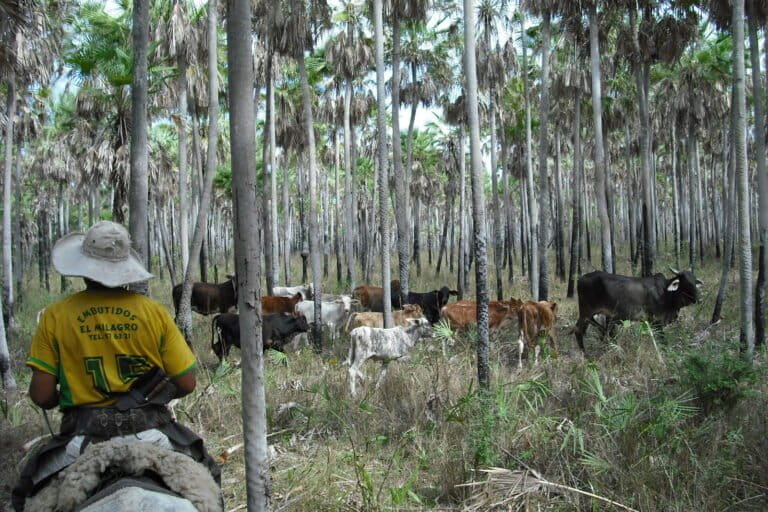
Banner image: Cattle in Karanda’y palm tree savanna (Bajo Chaco), Alto Paraguay Province. Image by Peer V. via Wikimedia Commons.
Credits

