

- At the recent biennial meeting of the International Whaling Commission, Antigua and Barbuda introduced a controversial resolution on the “sustainable use” of whales, which introduced a path toward the reintroduction of commercial whaling. The resolution was ultimately withdrawn.
- A separate bid to establish a South Atlantic Whale Sanctuary failed to pass, as it has at several previous meetings.
- Delegates did approve resolutions aimed at addressing cetacean strandings, the fish maw trade and vessel strikes, as well as the “Hobart Declaration” commemorating the 80th anniversary of the IWC.
- Observers criticized the IWC for failing to adequately address climate change, but also praised the body as a whole for remaining steadfast in supporting the ban on commercial whaling and for its contributions to science and conservation efforts.
A push to reopen the door to commercial whaling failed at the recent meeting of the International Whaling Commission (IWC) after a controversial resolution was taken off the table on the last day.
The draft resolution, put forward by the Caribbean nation of Antigua and Barbuda and co-sponsored by Palau, St. Kitts and Nevis, St. Lucia and Togo, called for the IWC to discuss the “sustainable use of whale resources” and introduced a path toward the reintroduction of commercial whaling. The bill, however, was ultimately withdrawn by another Caribbean nation, Grenada, which did not co-sponsor the bill, leaving the IWC’s 40-year-old global moratorium on commercial whaling intact.
The IWC, an intergovernmental organization that oversees the management and conservation of cetaceans, including whales, dolphins and porpoises, convened its 70th meeting between Sept. 27 and Oct. 2 in Hobart, Tasmania. Approximately 400 delegates from all 89 member governments and several observer organizations attended this year’s commission meeting, which has been held biennially since 2012. The meeting marked 80 years since the IWC was established and 40 years since the moratorium it placed on commercial whaling took effect.
The International Convention for the Regulation of Whaling, the international agreement that established the IWC in 1946, only refers to baleen and toothed whales, leading some to believe the moratorium only applies to these species, and not smaller cetacean species.
Experts say the moratorium has aided the recovery of many whale species once on the brink of extinction due to whaling. But other threats to whales remain. Fishing gear, fast-moving vessels and various forms of pollution continue to kill or injure cetaceans around the world. Then there’s the growing threat of climate change, which is disrupting cetacean food supplies, habitats and migration patterns.
A 2023 study by a team of international scientists found that one in four cetacean species, accounting for 26% of 92 assessed species, are currently threatened with extinction.
Commercial whaling hasn’t entirely disappeared either. Norway and Iceland continue to allow commercial whaling, under an objection and a reservation, respectively, to the IWC’s moratorium. Japan, which withdrew from the IWC in 2019 but remains an observer, also continues to allow it. (In September, the Icelandic government announced it would introduce a bill banning commercial whaling in February 2027; whether it will pass remains to be seen.)

Whaling support from non-whaling nations
The small number of countries that continue to hunt whales wield considerable influence at the IWC. Antigua and Barbuda, for instance, has long taken a strong pro-whaling stance despite having no history of commercial whaling — a position critics say closely aligns with the interests of one of its major donors, Japan. In an interview with local media in 2024, Ambassador Daven Joseph, Antigua and Barbuda’s representative at IWC, acknowledged his country had received $200 million in Japanese assistance over two decades and implied it was related to the two countries’ shared pro-whaling stance, but dismissed any suggestion that this aid was problematic. The governments of Antigua and Barbuda and Japan did not respond to Mongabay’s questions about whether Japan’s support and Antigua and Barbuda’s pro-whaling position were linked by the time of publication.
Likewise, the West African nation of Togo, one of the resolution’s co-sponsors, has long received aid from Japan but has no history of commercial whaling. Neither Togo nor Japan responded to Mongabay’s request for comment by the time of publication.
Fabienne McLellan, CEO of the Swiss NGO OceanCare, who attended this year’s meeting as an observer, called Antigua and Barbuda and its allies “agents of chaos” at the IWC.
“Their proposed resolution was a major factor of concern, and once it was withdrawn, another destructive trump card was played by Antigua & Barbuda to try and prevent a much-needed budget increase for the IWC and block the approval of the budget,” McLellan said in a statement. “Both attempts fortunately failed.”
“In the end the overall results of the meeting are satisfactory as the majority of countries stood strong in support of defending the ban on commercial whaling, which is one of the most shining success stories in the global efforts to protect wildlife,” McLellan added.

No pass for the South Atlantic Whale Sanctuary
The bid to establish the South Atlantic Whale Sanctuary failed once again at this year’s IWC meeting, despite receiving “a lot of ‘yes’ votes,” McLellan told Mongabay in an interview.
The sanctuary proposal, first introduced by Argentina, Brazil, Gabon, South Africa and Uruguay in 2018, has been repeatedly blocked by a minority of pro-whaling countries. In 2024, the bid fell short of the three-quarters majority needed to pass by just one vote.
Countries that voted against the sanctuary included Antigua and Barbuda, Benin, Cambodia, Côte d’Ivoire, Grenada, Laos, Marshall Islands, Mauritania, Morocco, Naoero, Nicaragua, Norway, Palau, Senegal, St. Kitts and Nevis, St. Lucia, Suriname and Tuvalu. McLelland characterized the group as “the usual bloc that just didn’t want this to proceed.” Iceland, along with the IWC’s newest member, Türkiye, abstained from voting.
The proposed South Atlantic Whale Sanctuary would cover approximately 21 million square kilometers (8.1 million square miles) of the South Atlantic Ocean. It would border the Southern Ocean Whale Sanctuary, established by the IWC in 1994, and the Indian Ocean Whale Sanctuary, established by the IWC in 1979. In both, commercial whaling is prohibited.
Helena Symonds, a marine mammal researcher and co-director of the whale-research station OrcaLab in British Columbia, Canada, who also attended the IWC meeting as an observer, said the establishment of the South Atlantic Whale Sanctuary was crucial for aiding the continued recovery of whales.
“The whales are basically in recovery right now, but [no species] has reached pre-whaling standards or positions,” Symonds told Mongabay in an interview. “Putting out the South Atlantic Sanctuary, which makes it contiguous with the other two sanctuaries, means that the whales have the ability to move within those areas and perform their life behaviors and outcomes … it’s providing an area for whales to live their lives naturally.”

Other key decisions at the IWC
What did pass at the IWC were resolutions aimed at improving the collection and sharing of data on global cetacean strandings; addressing the global trade in fish maw, or swim bladders, for which cetaceans are sometimes caught as bycatch; and working toward reducing vessel strikes involving cetaceans.
Switzerland submitted a draft resolution calling for better data collection and conservation measures on the deliberate “taking,” or killing of small cetaceans by the fishing industry, but ultimately withdrew it. Mark Worthing, the conservation director of the Canadian nonprofit Pacific Orca Society, called the withdrawal “disappointing.”
“Small cetaceans and dolphins don’t often get as much attention or care or interest amongst the larger cetaceans,” Worthing, who attended the IWC as an observer, told Mongabay in an interview, “but they are dying all over the place in fishing nets and stranding incidents and bycatch … and they don’t even really get counted. So we don’t have clear numbers as to how impacted they are by fishing and sometimes even whaling.”
The Hobart Declaration, a symbolic resolution commemorating the 80th anniversary of the IWC, also passed.
“The Hobart Declaration was welcomed as the first collective statement from the Commission, on its role, history and future,” the IWC wrote in a media statement. “Putting aside the different policy positions, the Commission spoke with one voice to recognise the challenges, achievements and resilience of the IWC as it commemorates 80 years of cetacean science and stewardship, and looks to the future.”

Criticism and praise for the IWC
Worthing said that climate change was not treated as a priority at the IWC meeting, and that the U.S. even lobbied successfully to get the “words ‘climate change’ removed from the work plans of the scientific committee and the conservation committee” — a development he called “extremely uncomfortable.”
“Fossil fuel corporations are the new whalers, and climate change affects all of us,” Worthing said. “It affects the krill in the Antarctic. It affects orcas. It affects ocean currents, strandings, fisheries, everything. I think the IWC should basically create an entire committee focused specifically on climate impacts and understanding the climate impacts and the climate benefits of whales.”
On the other hand, Worthing praised the IWC for the work it contributes to the scientific and conservation community for cetaceans, saying that this work is “underappreciated.”
The next biennial IWC meeting is slated for 2028. McLellan said she hopes conservation-minded countries will prepare well for that meeting, and come ready with a response if pro-whaling countries put forward another resolution like the one Antigua and Barbuda submitted this time.
“Because we know that those initiatives by the sustainable whaling camp will come back,” McLellan said. “We already know that writing is on the wall.”
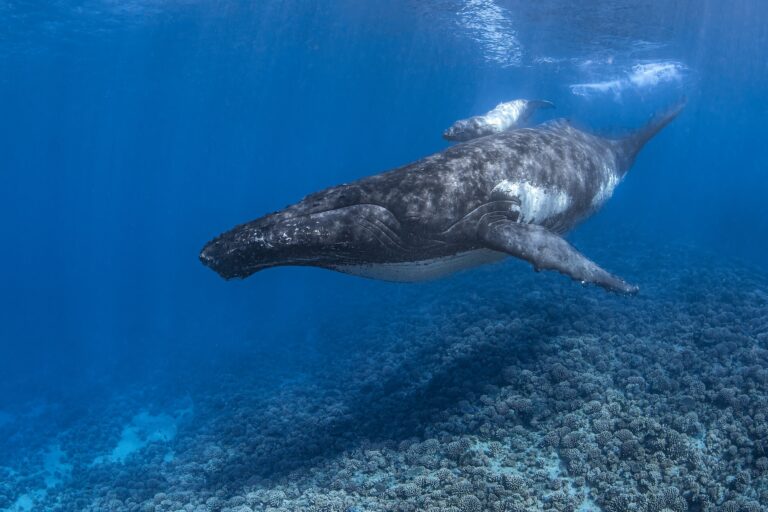
Banner image: Humpback whales (Megaptera novaeangliae) in French Polynesia. Image by Lars von Ritter Zahony / Ocean Image Bank.
Elizabeth Claire Alberts is a senior staff writer for Mongabay and was a 2024-2025 fellow with the Pulitzer Center’s Ocean Reporting Network. Find her on Bluesky and LinkedIn.
Citations:
Braulik, G. T., Taylor, B. L., Minton, G., Notarbartolo di Sciara, G., Collins, T., Rojas‐Bracho, L., … Reeves, R. R. (2023). Red‐list status and extinction risk of the world’s whales, dolphins, and porpoises. Conservation Biology, 37(5). e14090. doi:10.1111/cobi.14090
Tessier-Larivière, C., Cabrol, J., Lesage, V., Ramp, C., Bérubé, M., Sears, R., … Winkler, G. (2026). A 28-year record of the isotopic niche of baleen whales in the Gulf of St. Lawrence, Canada: A perspective on ecosystem changes and potential for food competition. Frontiers in Marine Science, 12. 1679523. doi:10.3389/fmars.2025.1679523
Van Weelden, C., Towers, J. R., … Bosker, T. (2021). Impacts of climate change on cetacean distribution, habitat and migration. Climate Change Ecology, 1, 100009. doi:10.1016/j.ecochg.2021.100009
Cite this article
Elizabeth Claire Alberts (2026). International Whaling Commission rejects push to revive commercial whaling. Mongabay Conservation news. DOI: https://doi.org/10.66709/news-331801
Credits

