

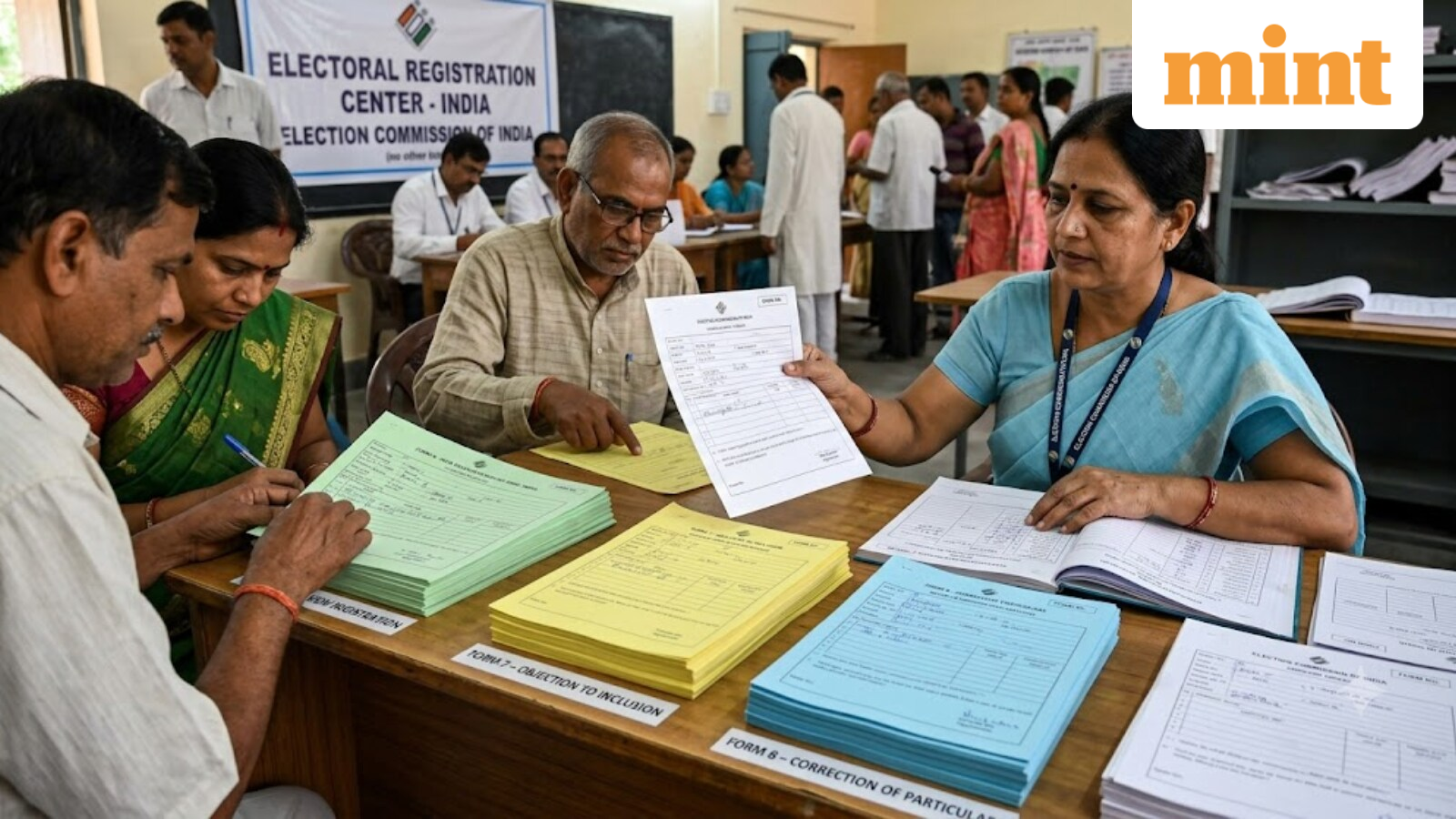
Some of these forms are part of the Registration of Electors Rules, 1960, which set out how electoral rolls are prepared and revised.

Since the Election Commission of India (ECI) started the Special Intensive Revision (SIR) of electoral rolls in June 2025, voters have had to deal with several forms to add, remove, or update names on voter lists.
Some of these forms are part of the Registration of Electors Rules, 1960, which set out how electoral rolls are prepared and revised. Others have been introduced specifically for the SIR exercise.
Here is what each form is meant for.
Form 6: Adding a name to the voter list
Form 6 is the statutory application used by a person who wants to be registered as an elector.
Under the SIR process, it has another important role. A voter whose name does not appear in the draft revised electoral roll has to use Form 6 to get their name added again. Such an application must also include a declaration.
Form 7: Objecting to a name or asking for its removal
Form 7 is used when an elector wants to challenge the inclusion of a name in the electoral roll or request that a name be deleted.
One Form 7 can be used for one electoral-roll entry, and the applicant must give a reason for the objection or deletion.
A voter can use the form to remove their own name, for example, after shifting to another address. They can also object to another person’s name being included in the roll. However, an objection against another elector can only be filed by someone whose own name is already present on that electoral roll.
Form 8: Changing or correcting voter details
Form 8 is used for several purposes. These include changing an elector’s address, correcting details in the electoral roll, getting a replacement EPIC and marking an elector as a person with disability.
However, its use during SIR has led to concerns among voters who have moved to a new address.
Many such voters have said they were asked to use Form 6, which is normally meant for adding a name to the electoral roll, instead of Form 8.
The ECI’s automated system does not accept a Form 8 application if the voter has not submitted a pre-filled enumeration form at their previous address.
Form 6A and Form 6B: Overseas voters and Aadhaar
Form 6A is meant for overseas electors. It allows Indian citizens living abroad to register as voters as long as they have not acquired citizenship of another country.
Form 6B, meanwhile, allows an elector to provide their Aadhaar number for authentication of their electoral-roll entry.
Submitting Aadhaar details through Form 6B is voluntary. Aadhaar details are also optional on the SIR enumeration form.
Forms 9 to 11B: Lists voters can check
Forms 9 to 11B are not applications submitted by individual voters. They are lists maintained by electoral registration officers (EROs) and displayed on the notice board of their offices under Rule 16 of the Registration of Electors Rules, 1960.
These lists allow voters to keep track of claims and objections submitted in their constituency.
Officials authorised to receive applications also maintain these lists under Rule 15.
Under the rules, a claim or objection can be accepted without a hearing seven days after it is listed, unless someone submits a written request for an inquiry.
Form 9: Form 6 applications
Form 9 contains the list of Form 6 applications received by the electoral authorities.
Form 10: Form 7 applications
Form 10 records the Form 7 applications received, including objections and requests for deletion.
Form 11: Other Form 8 applications
Form 11 lists Form 8 applications received for purposes other than a change of address.
Form 11A: Address change within the constituency
Form 11A contains Form 8 applications submitted by voters seeking to change their address within the same constituency.
Form 11B: Address change outside the constituency
Form 11B lists Form 8 applications from voters seeking to move their registration to an address in another constituency.
About the Author
Kanishka Singharia
Kanishka Singharia is a Senior Content Producer at Mint with a passion for news, trends, and the stories shaping the digital world. She specialises in spotting viral narratives by constantly tracking social media platforms and turning them into engaging, reader-friendly stories. Her work ranges from fast-paced breaking updates to sensitive human-interest features, blending speed with clarity.
With over four years of experience in news and trend reporting, Kanishka has worked with leading organisations such as Hindustan Times and Times Now. She moves seamlessly between profiling business leaders and telling the stories of everyday people, covering national developments just as effortlessly as the memes and conversations that dominate online culture.
She also reports on real estate developments and civic challenges in major urban hubs like Bengaluru, Delhi, and Gurugram. Her coverage frequently explores the struggles of startup founders, inspiring journeys of CEOs, and the experiences of candidates dealing with the complexities of visa processes.
Kanishka holds an undergraduate degree in Journalism from Delhi University and a diploma from the Indian Institute of Mass Communication. Rarely offline, she spends much of her time scrolling through X, LinkedIn, Reddit, Instagram, and Facebook in search of the next big story. When she finally logs off, she enjoys binge-watching shows and exploring cafes in pursuit of good food and better conversations.
