

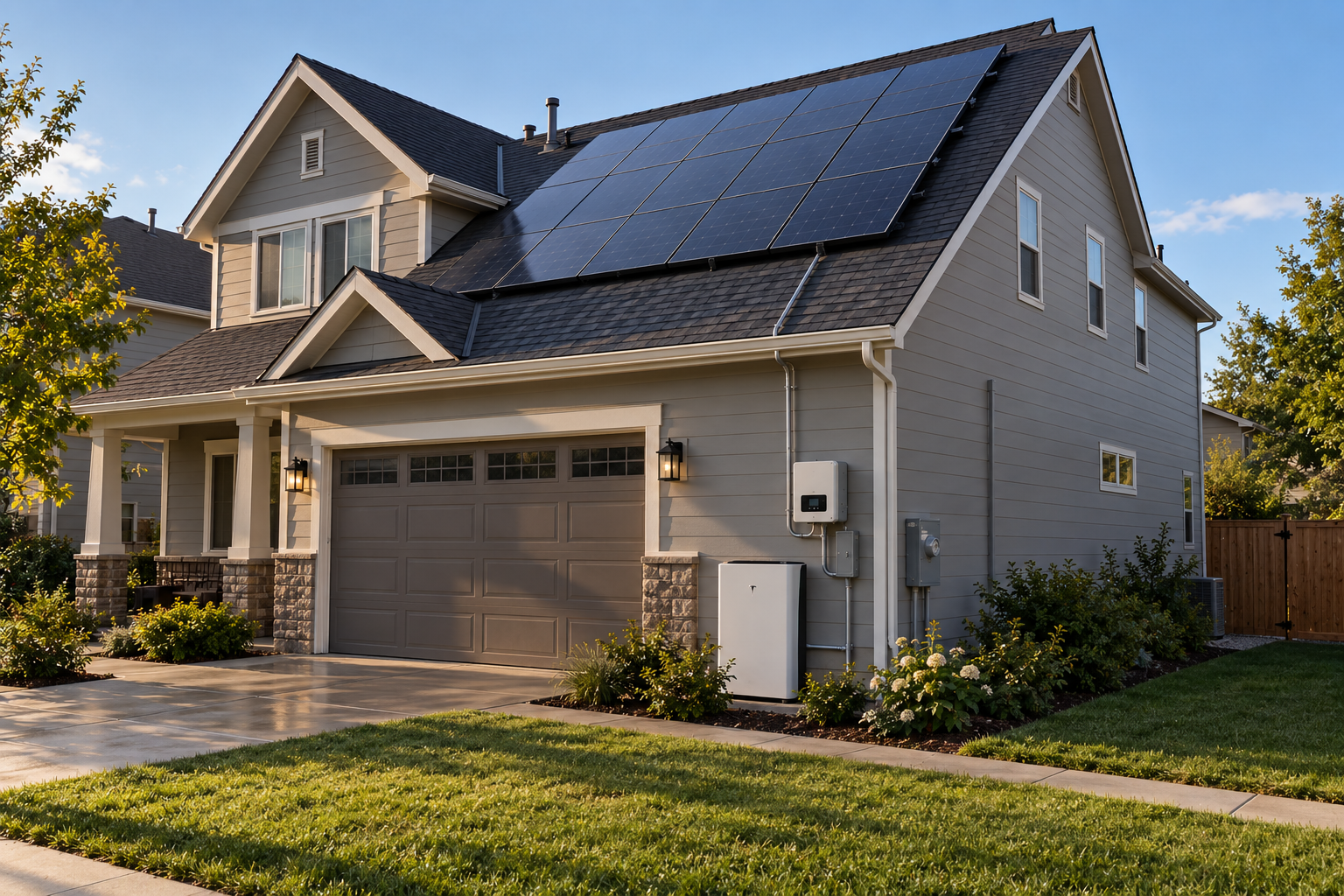
Battery storage was paired with 37% of new U.S. residential solar installations in 2025, up from 25% a year earlier, with adoption accelerating both in California and across other states.
More than one-third of new residential solar installations in the United States included battery storage in 2025, as batteries increasingly shift from an optional addition to a standard component of rooftop solar projects.
Battery storage was paired with 37% of new residential photovoltaic systems in 2025, up from 25% in 2024, according to Lawrence Berkeley National Laboratory’s latest U.S. Distributed Solar and Storage Data update.
The annual dataset includes roughly 5.3 million distributed solar and solar-plus-storage systems installed through the end of 2025. That includes about 450,000 systems installed during 2025, representing an estimated 93% of the U.S. distributed solar market for the year.
California remains a major driver of the trend
About 74% of new residential solar installations in California included storage in 2025, up from 58% in 2024. But battery adoption also accelerated outside the state. Across all other states in Berkeley Lab’s comparison, the residential storage attachment rate climbed from 7% to 17% in one year.
Berkeley Lab highlighted particularly large increases in Arizona and Texas. Hawaii and California continued to post the highest residential storage attachment rates in the country.
California’s rise in solar-plus-storage installations follows the state’s transition to its Net Billing Tariff, commonly called NEM 3.0, in April 2023. The policy reduced the value of electricity exported by new rooftop solar customers during many hours, increasing the value of storing excess daytime generation for later use.
That change quickly altered the composition of California’s rooftop solar market. More than half of California solar customers were pairing batteries with their systems, up from about 20% in October 2023.
Growth is no longer limited to California
Battery attachment rates outside California more than doubled from 2024 to 2025. Berkeley Lab did not attribute that increase to any single factor, but installers in other markets are increasingly confronting changes to net-metering structures and time-of-use electricity rates that can increase the value of consuming stored solar power rather than exporting it.
Storage adoption also increased in the non-residential market, although it remains far below residential levels. Batteries were attached to 11% of U.S. non-residential solar installations in 2025, up from 7% in 2024. California’s non-residential attachment rate increased from 12% to 18%, while the rate across all other states doubled from 4% to 8%.

The typical amount of energy stored in residential batteries did not change significantly. Median residential storage capacity remained 13.5 kWh in both 2024 and 2025.
However, the power those systems can deliver increased sharply. Median discharge capacity increased from 6 kW in 2024 to 11.4 kW in 2025. Berkeley Lab attributed much of that increase to growing deployment of the Tesla Powerwall 3, which has higher discharge capacity than previous versions.
The report cautions that its attachment rates do not capture the entire distributed storage market. They exclude batteries added later to existing solar installations as well as standalone battery systems.
That means the data measure how often installers pair batteries with new solar projects, rather than the full rate of residential battery deployment. Even under that narrower definition, the year-over-year increase suggests solar-plus-storage is rapidly becoming a larger part of the U.S. residential market.
This content is protected by copyright and may not be reused. If you want to cooperate with us and would like to reuse some of our content, please contact: [email protected].
