

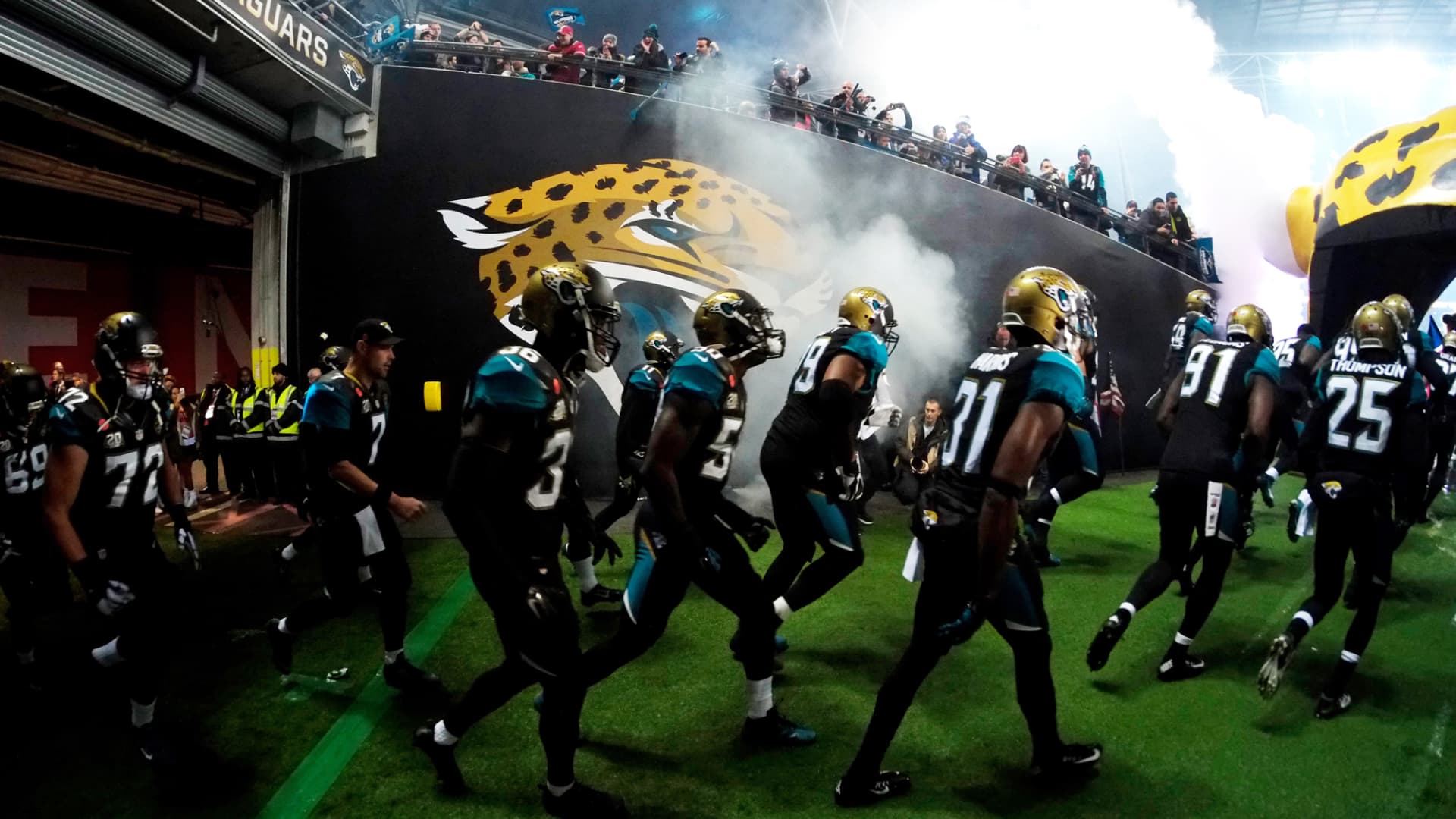
The Jacksonville Jaguars take the field prior to kickoff against the Dallas Cowboys at Wembley Stadium in London, Nov. 9, 2014.
Getty Images
As the NFL season begins, a new kind of defensive strategy is taking shape: Stopping drone disruptions.
Last month, the Jacksonville Jaguars became the first NFL team to publicly announce an agreement with a drone defense company, seeking to protect against interruptions or security threats. The company, Ondas-owned Sentrycs, will control the skies in and around EverBank Stadium, home of the Jaguars, during game days.
A representative for Sentrycs told CNBC the system will be activated for the first time on Sunday before the Jaguars’ game against the New England Patriots.
“As drones become increasingly accessible, we recognized the importance of moving beyond detection and adding an effective mitigation capability to our security strategy,” said Jaguars Director of Events and Facilities Security Bobby Lyle in an August news release.
The NFL, which is now on Week 3 of its 2026 regular season, told CNBC that it recorded 10,852 drone violations near stadiums between 2021 and 2025. Only a few of those resulted in disrupted games.
In 2025, a playoff game in Baltimore between the Ravens and the Pittsburgh Steelers was paused due to a drone flying overhead. The stadium saw a similar incident in 2023.
While the league previously had the capacity to identify and track drones near its 30 stadiums, evolving technology allows for the mitigation of threats by intercepting the communication link between an operator and the drone, taking control, and landing the aerial vehicle.
Sentrycs said it recently signed deals with two other NFL teams, though CNBC could not confirm which franchises.
Earlier this month, in tandem with Major League Baseball, the NFL sent a letter to the Department of Homeland Security arguing more resources are needed to protect fans and players from drones during competition.
“Unauthorized drone activity presents an ongoing and growing challenge,” the letter said.
Rising violations
Sentrycs was one of several firms contracted to stop drone disruptions during the FIFA World Cup this past summer, which took place across 104 matches in the U.S., Canada and Mexico.
The FBI reported about 700 instances of intercepting a drone during the four-week tournament.
“What surprised us the most was the sheer number of drones in the air at one time,” said Ondas founder and CEO Eric Brock.
The federal government provided state and local authorities about $250 million in funding before the World Cup for drone defense. Now, those resources and improvements made ahead of the tournament can benefit other big, in-person events like concerts or festivals.
“Nobody worried about this a few years ago. Now everyone has to worry, and it’s happening very fast,” said Jason Moore, Sentrycs’ general manager for the U.S. and Canada.
Drone defense operators must take special classes to become certified through a federal program.
The systems require both hardware and software. Once equipment installation is complete, operators detect threats through optical systems including radar and thermal technology. Sentrycs also uses radio signals for detection.
“The system allows for the operator to detect and then take over the drone’s controls and to move it out of the way and land safely,” Moore said.
The system is also capable of using radio frequencies to find the pilot of a drone and alert police to their exact location. With officers on patrol, response time from the moment of detection to when a law enforcement officer could be at the scene of the operator can be as little as two minutes, according to Brock.
While some experts cite the threat of civilian drones being equipped to deliver explosives or chemical or biological agents, authorities and defense executives say the more common risk is annoyance and interruption.
“In most cases drones are operated by people either not paying attention to or ignoring the rules,” said Kristian Brost, general manager of Robin Radar USA, which was also contracted to help with drone security during the World Cup.
Robin Radar, headquartered in the Netherlands, operates equipment at two dozen European airports. About a dozen large European airports have been forced to temporarily suspend flights due to drone incursions in the last year, according to findings by the European Commission and various media reports.
Robin Radar Systems
Source: Robin Radar Systems
“Most drones weren’t nefarious, but they still pose a threat and must be detected and taken down,” said Brost, who served in the U.S. Marine Corps in Iraq during the opening stages of the 2003 war, working with emerging military technologies. “Defeating drones is really the ultimate team sport as we need a sensor team, a software team, radar detection and someone to bring the attacking drone down, without hurting anyone on the ground.”
Drones are also becoming an increasingly serious problem for airplane pilots.
This summer there were two incidents in the busy New York airspace: One at Newark Liberty International Airport in which a United Airlines pilot reported narrowly missing a drone, and one near John F. Kennedy International Airport, where a JetBlue pilot reported hitting a drone as he came in for a landing. No injuries were reported in either instance.
How drone defense works
One of the challenges the drone defense industry faces is keeping up with the rapid advancement in technology.
“Nobody thought there could be small things flying around with no humans 15 years ago,” said Mary-Lou Smulders, a longtime drone defense executive turned industry consultant. “Regulations were built for [Boeing] 747s and 727s — passenger aircraft — not drones.”
That’s beginning to change. On July 1, the Safer Skies Act went into effect after being passed by Congress in December and signed by President Donald Trump. The law is designed to give state and local authorities permission to bring down drones encroaching on airports and major venues.
Executives and operators focus on four stages when trying to bring down a drone in restricted airspace, whether the drone’s operator is being negligent or trying to cause trouble. The first is to detect the offending drone.
“If you see it with your eyes before you see it on a radar or sensor screen, you’re already too late,” Smulders said.
Defense teams then try to identify the drone and determine how fast it’s moving and at what altitude. The third stage is to track the drone and attempt to contact the operator through a radio frequency. The last stage is interdiction, or intercepting the drone.
Smulders and Brost agree the easiest and safest way to have a takedown is to disrupt the communication between an operator and a drone itself by stopping the controlling radio frequency.
“That however can cause problems as you may be cutting off legitimate radio frequencies as well,” said Smulders. “It is a delicate dance.”
And while most drone defense leverages radio frequencies, Israeli defense firm Israel Weapon Industries, or IWI, develops and sells a drone defense technology that, instead of cutting communications, allows for a defender to shoot drones out of the sky.
The device, called the Arbel, fits on most automatic rifles, including the AR-15, and helps the shooter follow, target and take out drones using bullets.
The company is now part of drone defense at 20 European airports and at 10 sites in the U.S. IWI declined to comment on the types of facilities or specific locations in the U.S. where it operates.

