

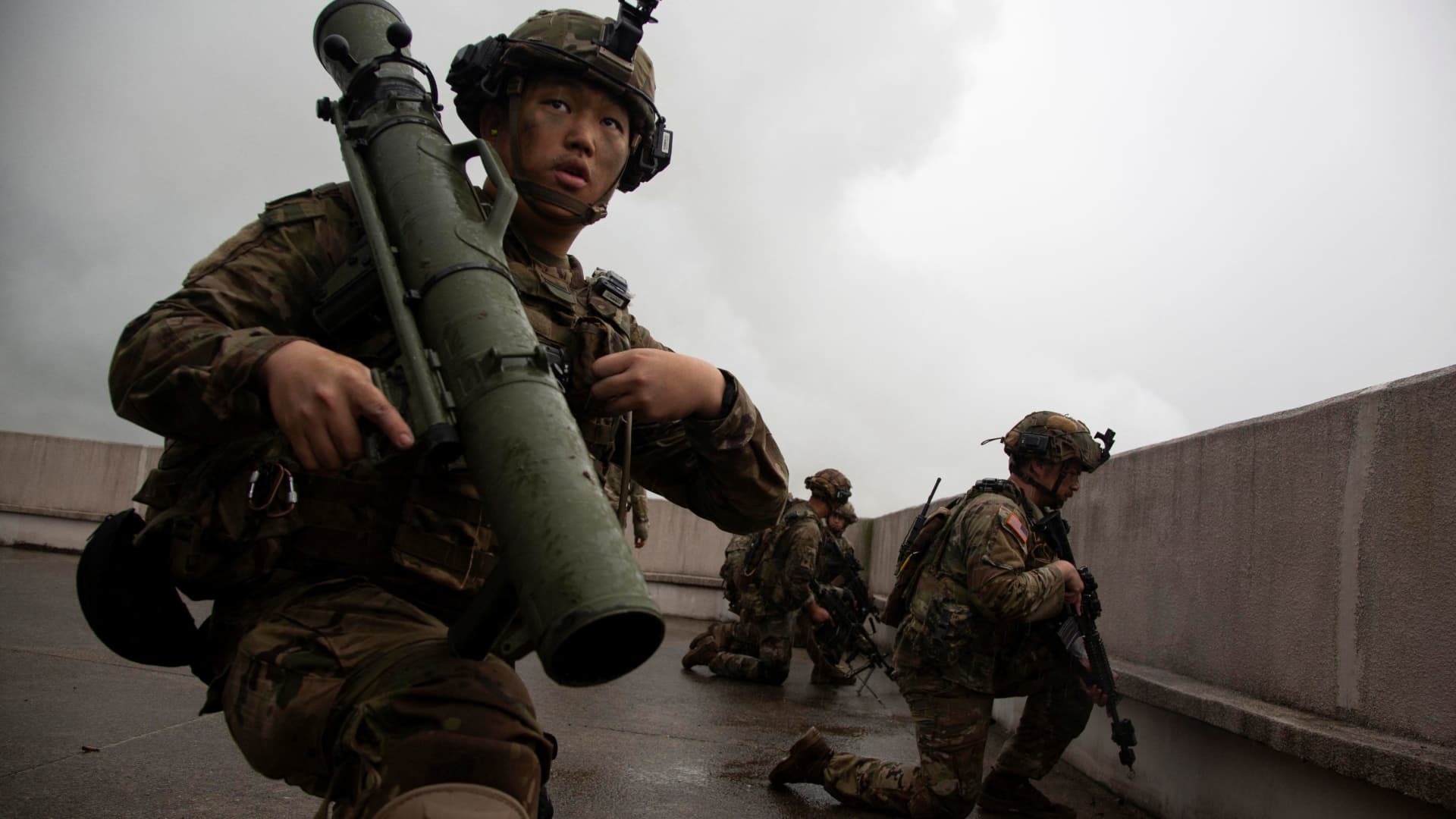
U.S. soldiers from 2nd Infantry Division, participate in a UFS/TIGER Combined Urban Operations plan as part of Ulchi Freedom Shield (UFS) exercises at Wollong Urban Area Operatiions training center on Paju in Gyeonggi-do, South Korea, 23 August 2023.
Jeon Heon-Kyun | Pool | via Reuters
At the United Nations General Assembly on Tuesday, South Korean President Lee Jae Myung used a meeting with U.S. President Donald Trump to revisit one question in their countries’ military alliance: who would lead their combined forces if war resumed on the Korean Peninsula?
The two sides’ 30-minute summit covered strategic investment, shipbuilding and nuclear cooperation, as well as the transition of wartime operational control, or OPCON, to South Korea.
The renewed attention on OPCON comes after Trump abruptly curtailed the annual Ulchi Freedom Shield military exercise between the two countries last month, prompting concerns about combined readiness.
The topic appeared again most recently as new defense minister Kang Shin-chul took office on Tuesday, after he argued that a structure in which Korean commanders take the lead, backed by the U.S. military, would make the combined defense system “much stronger”.
The same day, the ruling Democratic Party launched a task force on a transition, saying the move would benefit national security. The task force will look at reclaiming wartime OPCON, according to South Korean media, although no further details were given.
The proposed OPCON transition would see a South Korean general lead the future CFC, with a U.S. general serving as deputy.
But what is wartime OPCON, and why does Seoul want to lead it?
An equal alliance
Despite South Korea being an independent country, its alliance with the U.S. has a strange quirk: in peacetime, Seoul has operational control of its armed forces, but in wartime, designated South Korean units are placed under the command of what is known as the Combined Forces Command, which is headed by a U.S. four-star general with a South Korean deputy.
OPCON gives a commander the authority to organize and deploy assigned forces, designate them missions and direct their operations. It does not give the United States ownership of South Korean forces, and the CFC is still subject to joint guidance from the two countries’ national and military authorities.
But for Lee’s government and many South Koreans who support the transition, taking back wartime OPCON represents greater military autonomy and a more equal alliance with the United States.
The transfer has been a long-standing objective for many South Koreans and is often presented as a symbol of full national sovereignty and military independence, Korean affairs analyst Gabriela Bernal wrote in a Lowy Institute commentary in March 2025.
When CNBC asked Henry Haggard, a former U.S. diplomat in Seoul, whether it was accurate to say South Korea does not control its forces in wartime because OPCON would shift to the U.S.-led CFC, he agreed.
However, Yang Uk, a research fellow at the Asan Institute for Policy Studies, cautioned that saying South Korea does not control its own military is “too simplistic.”
The CFC is jointly directed by the two allies, Yang said, and its commander’s nationality is not equivalent to one country exercising sovereign control over the other’s military.
Nevertheless, under the current system, Seoul would not be able to independently direct the wartime operations of the South Korean units assigned to the CFC.
A 70-year debate
The current OPCON arrangement stems from the Korean War, when then South Korean President Syngman Rhee transferred command authority over South Korean forces to the U.S.-led United Nations Command in July 1950.
In 1978, operational control shifted to the newly established U.S.-South Korea Combined Forces Command.
Seoul regained peacetime operational control in 1994, but wartime control remained with the CFC.
Multiple South Korean administrations have since sought to complete the wartime transition. Initially, the two sides agreed to transfer wartime OPCON in 2012, but then postponed the target to 2015.
Under former President Park Geun-hye, the allies abandoned a fixed timetable in favor of a “conditions-based transition.” Successive administrations have supported the eventual transfer, but so far have not succeeded. Lee is now seeking to complete the process before his term ends in 2030.
The capabilities that must be satisfied to complete the transfer are Seoul’s capacity to lead the combined forces, the possession of sufficient capabilities to counter North Korean threats, and having a strategic environment conducive to a stable transition.
“The third condition, in particular, is open to interpretation,” said Lami Kim, Korea chair at the International Institute for Strategic Studies.
Both commanders-in-chief of South Korea ROK and the U.S. will then determine the appropriate timing for the transition.
Operational readiness
But just because South Korea wants to take back wartime OPCON, can it? Officials in Seoul are confident, but experts that spoke to CNBC still see some way to go.
In May 2026, then defense minister Ahn Gyu-back said that “even if wartime operational control were returned tomorrow, we would have little difficulty defending ourselves,” only to be corrected by President Lee Jae Myung who said it would have “no difficulty at all.”
Lieutenant General Chun In-bum, a retired South Korean army general and former commander of the country’s Special Warfare Command, told CNBC bluntly that South Korea was not fully ready to retake wartime OPCON.
“Critical gaps remain in high-altitude strategic C4ISR and theater missile defense against nuclear threats,” he said, referring to command, control, communications, computers, intelligence, surveillance and reconnaissance capabilities.
Wartime OPCON transfer is yet to be completed partly because transferring command authority could weaken alliance interoperability and military readiness, at least in the short term, according to IISS’ Kim.
Chun echoed similar sentiments, saying that “As North Korea evolved into an asymmetric nuclear power, the operational threshold rose.”
Those questions have become more pressing following Trump’s decision to scale back the Ulchi exercise in August, a move which experts said would risk the readiness of U.S.-South Korean forces.
“Scaling back drills does not destroy the alliance overnight, but changing them abruptly and unilaterally damages confidence in how the alliance is managed,” Yang said. “And wartime OPCON transfer should be capability-based, not deadline-driven.
“The real issue is not whether OPCON is transferred by 2030. It is whether the alliance will be stronger and more credible on the day after the transfer,” he added.
