

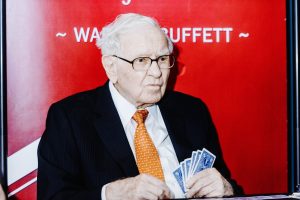
Investing legend Warren Buffett further pared back his role at Berkshire Hathaway, announcing Friday that he has stepped down as the conglomerate’s chairman.
In a letter to shareholders, he suggested his age, 96, weighed on his decision, saying that one of his great grandchildren just turned 1, and is “moving a bit faster than I am these days.”
“Serving as your Chairman has been the privilege of a lifetime, and I have never taken your trust for granted. Father Time always wins. He has, however, been generous with me,” he added later.
Berkshire’s class B shares dipped 0.3% on Friday and are up 1% so far this year, significantly lagging behind the S&P 500’s 11.5% year-to-date gain as investors have cooled on the stock while chasing the AI trade.
In January, Buffett officially relinquished the CEO job to Greg Abel after six decades at the helm, following his announcement of the change in May 2025. But his transition from chairman to chairman emeritus is much more abrupt and is effective immediately.
He will continue to serve as a director on the board, while his son Howard will succeed him as chairman under a long-standing plan. Susan Decker will stay on in her role as the company’s lead independent director.
“The company is in excellent hands, and I look forward to remaining a shareholder alongside you,” Buffett added later.
While announcing his decision to step down, he also cited Abel’s success in his short tenure as CEO. After running the conglomerate’s non-insurance operations, he has taken over his new job “in every respect” and is calling the shots without any second-guessing from Buffett.
In fact, Abel has already started deploying Berkshire’s massive cash pile, which had been growing bigger and bigger for years as Buffett bemoaned sky-high valuations and the lack of any good bargains to be had.
Earlier this year, Abel bought $10 billion shares of Google parent and AI hyperscaler Alphabet as well as reaching a deal to acquire homebuilder Taylor Morrison for a total enterprise value of $8.5 billion.
With Abel firmly in charge, now is the right time to “complete the transition,” Buffett explained.
He pointed out that Howard, 71, has been a Berkshire director for 33 years, representing a longer apprenticeship than the one the elder Buffett had before becoming Berkshire CEO at the age of 34.
“Greg runs the company; Howard will guard its culture and values — both worth more than anything on our balance sheet. Think of Howard as a policy the shareholders own and hope never to claim against,” he wrote. “Howard cares deeply about Berkshire, as do all of our Directors. No company has been or will be more shareholder-minded than Berkshire.”
Howard and his two other siblings are also responsible for giving away their father’s vast fortune, which is listed at $145 billion on the Bloomberg Billionaires Index.
Buffett previously acknowledged that some of his earlier ambitions for giving that wealth away haven’t gone as planned.
Instead of a single sweeping plan, he’s handing over most of his remaining wealth to his three children’s charitable foundations, allowing them to distribute about $500 million each year.
“All three children now have the maturity, brains, energy and instincts to disburse a large fortune…” Buffett wrote in a letter to shareholders released in November. “Ruling from the grave does not have a great record, and I have never had an urge to do so.”
Howard has generally kept a lower profile than his father. But he and his siblings spoke to CNBC earlier this year about his philanthropy.
He highlighted the dilemma of addressing poverty in places where the rule of law is undermined by conflict, mentioning countries such as Congo or Sudan. Addressing economic opportunity is not enough to solve poverty alone, he said.
“There’s a lot of things you can fund that will go nowhere,” Howard said. “If you’re not addressing the real issue of rule of law then you just can’t have success.”
