

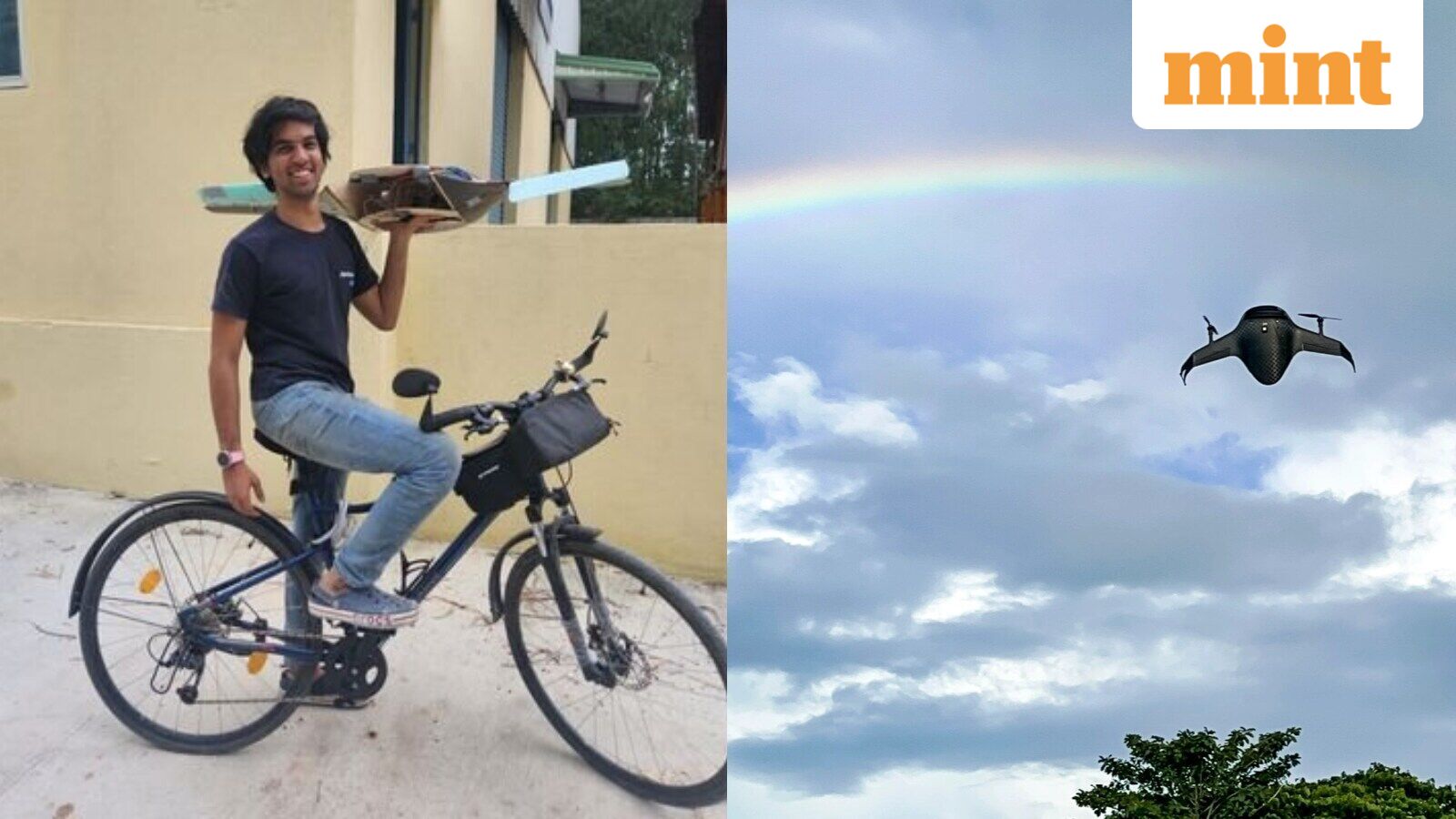
Meet Naman Pushp, the 21-year-old founder and CEO of Airbound, focusing on drone delivery. It has reportedly completed more than 13,000 autonomous flights across Bengaluru and the Guntur region.

Meet Naman Pushp. The 21-year-old is building an aerospace company around a problem he first encountered while experimenting with drones as a teenager. Six years ago, Pushp’s lockdown project won him $500 at a hackathon. Now based in Bengaluru, he is the founder and CEO of Airbound. His startup has already raised $37 million in a Series A round led by Greenoaks, taking the company’s total funding to nearly $50 million, reported India Today.
From lockdown project to start up at 16: Story behind Airbound
In 2020, Pushp was 15 when the COVID-10 led pandemic shut schools and parks, confining many kids like him to his home. This is when he shifted his focus to something that always intrigued him as a child—making robots. Soon he began experimenting with drones. He called the project Open Drone and entered it in a hackathon, winning $500. He invested the prize money back into the project and used it to build his first prototype. That first drone is said to hang on the wall of Airbound’s office.
Who is Naman Pushp
Born in Mumbai, Pushp spent parts of his childhood in Hyderabad and Malaysia before returning to India. He studied at Dhirubhai Ambani International School. His interest in building things reportedly began in Malaysia, where he made simple robots in Class 5 and 6. He also entered robotics competitions and engineering projects.
At 16, Pushp, still a school student, received his first venture cheque from GradCapital. As he was a minor, investors had to speak to his father before investing. He was later admitted to Carnegie Mellon University, which he chose not to attend to focus on the problems around building drones.
Naman Pushp realised that conventional aircraft spend much of their energy carrying their own weight, making the payload, the goods being transported, secondary. This made drone delivery difficult to compete with road transportation in terms of cost. This is where his startup Airbound came into the picture to reverse that equation.
About Airbound
Airbound’s current TRT aircraft weighs about 1.5 kg and can carry around 1 kg of cargo. It takes off vertically and transitions into horizontal flight. Pushp’s company is said to be developing a model to carry a 5 kg payload with further plans to expand manufacturing.
“We want to build towards a world where everything has cost parity with trucking,” Pushp has said in a post he shared on LinkedIn.
Airbound has reportedly completed more than 13,000 autonomous flights across Bengaluru and the Guntur region. These include over 1,000 flights for Narayana Health. Its drones transport samples between a clinic and a hospital, making it faster and more effective than traditional ground transport.
Narayana Health’s new Banashankari hospital in Bengaluru was designed without a diagnostic laboratory. It is said that the hospital relies on Airbound’s drones to move medical samples between facilities.
For now, the company can provide up to 20 flights a day on one clinic-to-hospital route.
In Andhra Pradesh, Airbound reportedly had plans to connect Amaravati, Vijayawada and Guntur, with a long-term target of 10,000 flights a day. Additionally, the state government is said to be aiding in creating a network of ground observers to support private operators while keeping flights within visual line of sight.
What’s next?
The next challenge is expected to be manufacturing. Airbound is betting on lightweight carbon-fibre aircraft that can be produced at scale.
“100 aircraft a day will start to feel very small,” Pushp remained optimistic at an event, as reported by India Today.
About the Author
Sneha Biswas
Sneha Biswas specialises in covering entertainment and pop culture, with a specialisation on Bollywood, Hollywood, OTT platforms, K-pop, K-dramas, and major developments in the US entertainment industry. She believes in telling stories that balance speed with substance, and in making entertainment journalism contextual, culturally aware, and reader-first rather than purely reactive.
With over six years of experience in digital media, Sneha currently serves as a Deputy Chief Content Producer at Live Mint. She has spent more than three and a half years with the HT Group and returned to the organisation in February 2025, joining Live Mint to uplift the entertainment section. Over the past year, she has been closely involved in entertainment coverage including breaking news, explainers, trend reporting, box office reports and analysis for the audience.
Sneha is Google News certified, having completed training focused on newsroom best practices, digital reporting, and SEO-driven content strategies. Her work reflects a strong understanding of audience behaviour, search trends, and the evolving consumption patterns of entertainment news across formats.
Prior to her current role, Sneha has worked across multiple content and editorial functions within digital newsrooms, building expertise in content planning, editing, and real-time coverage. Her professional interests lie at the intersection of entertainment, internet culture, and global pop trends.
Working for the National city team, Biswas closely follows global entertainment movements while maintaining a strong pulse on what is happening in India.
