

Advertisement

FRSC and the Work of Building Safer Highways in Nigeria
By Lawal Dahiru Mamman
“Institutions are nothing without men.” – Charles de Gaulle
Institutions love to measure modernisation by hardware. New patrol vans. Surveillance cameras. Automated portals. Bureaucracy is drawn to the visible tangibles and the grand commissioning ceremonies that follow them.
While these upgrades are undeniably critical, they represent only half of the institutional equation. The most sophisticated digital database is useless without an ethically grounded officer to operate it; the most advanced patrol vehicle is ineffective without a motivated marshal behind the wheel; and the most comprehensive traffic laws remain mere ink on paper without disciplined, committed personnel to enforce them on the asphalt.
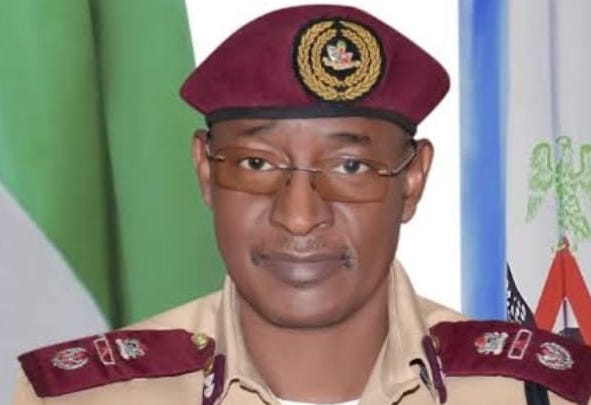
This fundamental truth lies at the heart of the Federal Road Safety Corps (FRSC) under the leadership of Corps Marshal Shehu Mohammed. The recent announcement approving the promotion of 7,472 personnel, comprising 2,134 Officers and 5,338 Marshals, is far more than a routine human resources exercise or a periodic distribution of new ranks.
It represents a calculated, strategic investment in human capital designed to inject fresh leadership energy, elevate professional standards, and fortify the operational capacity of Nigeria’s lead road safety agency.
For an organisation tasked with the high-stakes mandate of preserving human life across thousands of kilometers of volatile transit corridors, workforce morale is not a secondary human resources metric, it is an absolute operational necessity.
Road safety marshals operate in demanding, often hazardous environments. They are the first responders at gruesome crash sites, the regulators standing in intense heat to direct chaotic traffic, and the front-line officers confronting aggressive, non-compliant motorists.
When career progression becomes stagnant, opaque, or politicised, the resulting institutional fatigue inevitably leaks onto the highways, manifesting as compromised enforcement, public friction, and operational decay.
Dedication, discipline, and distinguished service are no longer empty words in the Corps. With the elevation of over 7,000 personnel, the Corps Marshal has made that clear to every command nationwide.
This approach reflects the core tenets of driving profound, sustainable institutional change from within by systematically aligning internal administrative rewards with overarching policy goals. The promotion exercise transforms rank from a passive symbol of longevity into an active instrument of performance management.
As the Corps Marshal noted during the announcement, the true strength of the FRSC is not measured solely by its patrol vehicles, technology, or enforcement architecture, but fundamentally by the quality, character, and commitment of the men and women who stand between road users and the catastrophic consequences of unsafe behaviour.
Every new pip, stripe, and insignia decorated across commands from August 26 to August 28, 2026, carries a corresponding increase in operational accountability.
Worthy of note is that this sweeping promotion comes at a pivotal juncture in the evolution of road safety administration in Nigeria. Under the current leadership, the FRSC is aggressively executing a multi-pronged modernisation agenda: transitioning toward intelligence-led enforcement, deploying automated biometric licensing systems, integrating health insurance data into driver profiles, and expanding targeted interventions like Operation Guduma to dismantle vehicle identity fraud and dangerous overloading practices.
However, high-intensity operational enforcement cannot be sustained by a demotivated workforce. When personnel feel valued by their leadership, their posture toward the public shifts from transactional or punitive to professional and protective.
A newly promoted officer or marshal, recognised for merit, is far more likely to uphold the integrity of the Corps, treat motorists with dignity, and execute complex field directives with precision.
Elevating 2,134 Officers into higher tiers of leadership shows that the FRSC is consciously addressing a critical governance need — “supervisory depth”. Modern highway enforcement requires proactive decision-making at the tactical level. Commanding Officers, Heads of Special Units, and Field Operations Chiefs must possess the institutional authority and confidence to manage complex road emergencies, coordinate inter-agency operations with sister security services, and lead public enlightenment campaigns within local communities.
Re-energising the middle and senior officer cadres ensures that operational commands across all 36 states and the Federal Capital Territory possess the leadership density required to execute national safety mandates effectively.
The elevation of 7,472 personnel also reinforces Nigeria’s standing as a benchmark for road safety administration across the ECOWAS sub-region and the broader African continent. As the FRSC continues to export its operational expertise, evidenced by landmark bilateral partnerships with nations like Sierra Leone and active policy leadership at the United Nations, the internal health of the agency must mirror its external reputation.
Continental leadership cannot be sustained by an institution with broken internal systems. By demonstrating that internal career progression is governed by transparency, merit, and professional discipline, the FRSC sets an example for paramilitary and law enforcement bodies across West Africa.
In the long run, the true metric of this promotion exercise will not be measured in the administrative gazettes of the Headquarters in Abuja, but on the roads of Nigeria’s busiest transit corridors: the Lagos-Ibadan Expressway, the Abuja-Kano corridor, the East-West road, and countless regional arteries. It will be measured in faster emergency response times, firmer enforcement against dangerous mix-loading and illegal number plates, courteous interaction at checkpoints, and a measurable reduction in road traffic crashes and fatalities.
Corps Marshal Shehu Mohammed has redefined the narrative surrounding rank within the Federal Road Safety Corps. Rank is not merely worn as a badge of personal accomplishment; it is an entrusted public utility, continuously evaluated by the quality of service delivered to the motoring public.
Through aligning organisational rewards with public safety outcomes, the FRSC is ensuring that its greatest asset — its human capital — is fully mobilised to build safer, more disciplined, and highly secure highways for all Nigerians.
Lawal Dahiru Mamman writes from Abuja. He can be reached at: [email protected]
