

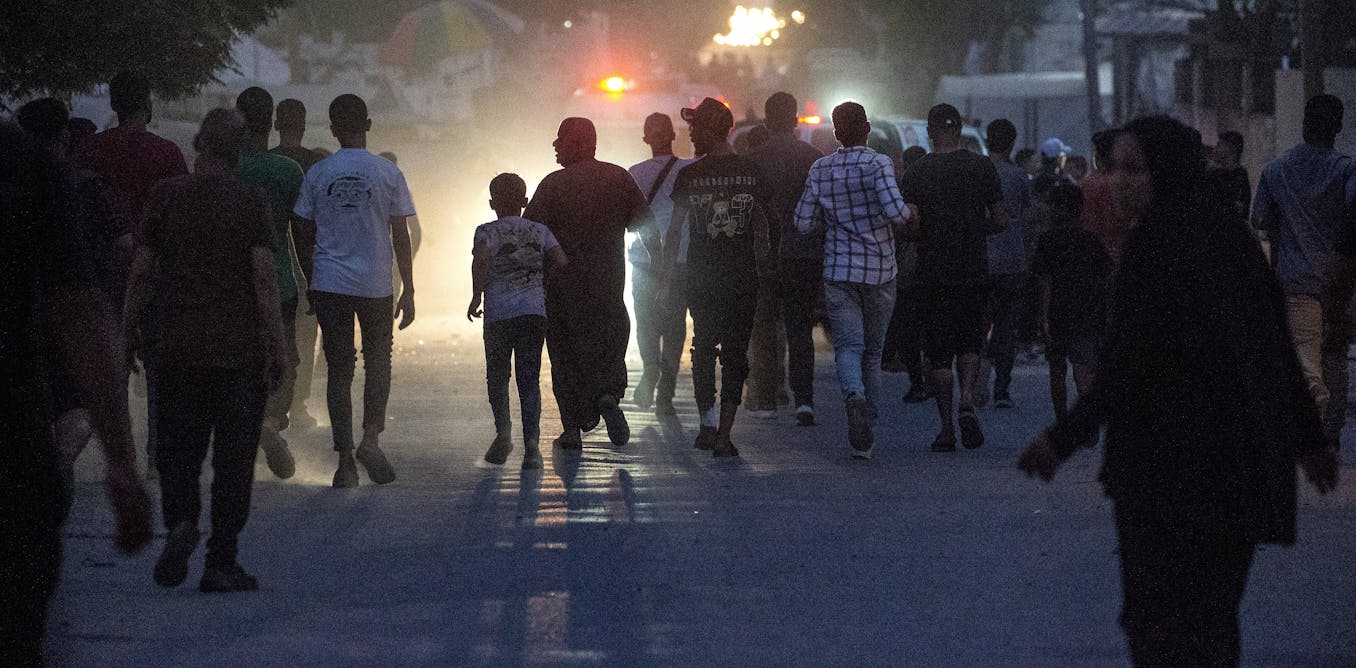
Hamas’s agreement to US president Donald Trump’s disarmament roadmap is welcome news. It potentially unlocks the stalemate that has kept 2 million Gazans living in catastrophic conditions since the ceasefire was announced more than nine months ago.
But there are concerns. Israel is unlikely to accept the plan, as it will require the withdrawal of the Israeli military from Gaza. The Israeli prime minister, Benjamin Netanyahu, is likely to try to stall at least until elections are held in late October.
Hamas knows this, and being in no rush to disarm, will also be content to slow-walk the process. If or when there are additional negotiations, each party is likely to object to the details to delay the process further or suspend it altogether.
Some of these hurdles can be overcome through sustained diplomatic engagement and pressure on both parties. But this is far from guaranteed. And an additional challenge that could derail any potential progress looms large beyond Gaza’s borders: the deteriorating situation in the West Bank.
I just returned from a month of fieldwork in the West Bank, meeting with local NGO workers, community leaders and youth activists and documenting settler violence, forced displacement and land seizures. Many people I met, whether in cities, refugee camps or rural areas, said they fear a repeat of Gaza in the West Bank. They fear another major war, another Nakba (meaning “catastrophe”: the term Palestinians use to describe the mass displacement of Palestinians in 1948). One person I spoke with said they felt as if “it’s going to explode”. This is a common view among people in the West Bank.
Pressure cooker
After spending weeks travelling around the territory, it wasn’t hard to see why. I have been visiting the region for more than 20 years, and life in the West Bank has never been easy for its residents. But now, it’s like a pressure cooker.
Travel within the West Bank has become much harder and slower, with additional checkpoints, gates and unpredictable road closures – mostly near expanding settlements – adding hours to simple journeys of less than 20km. On the roads that are open, settlers have lined the pavement with Israeli flags and blacked out the Arabic writing on multilingual road signs with spray paint.

Julie M Norman
In the cities, petrol stations are out of fuel and hospitals are short of medicine. Civil servants are out of work or earning only partial wages, as Israel continues to withhold much-needed tax revenues to the Palestinian Authority. More people are also being squeezed into urban areas as a result of both Israeli military seizures of neighbouring refugee camps and settler violence against rural communities. This is adding additional strain and tension to urban areas.
For example, I visited Tulkarem, where two refugee camps, once home to more than 33,000 people, now sit like empty ghost towns. In January 2025, the residents were forced out of the camps by the Israeli military. Most are still living in temporary shelters in schools or mosques, or in overcrowded apartments housing 30 to 40 people.
Residents of Jenin Camp were also displaced last year, and in late July, Israeli defence minister Israel Katz instructed the IDF to take control of another refugee camp, suggesting another major offensive and further mass displacement.

Julie M Norman
Other areas I visited rarely make international headlines, but they are well known within Palestine. For example, the Jordan Valley is a mostly rural area that stretches about 10km wide and 100km long. It hugs the West Bank’s border with Jordan and is comprised mostly of small, simple farming villages. The region is also part of what is referred to as Area C under the Oslo Accords, the peace deal signed between Israel and the Palestine Liberation Organization (PLO) in 1995. The deal divided the West Bank into three areas with specific levels of security and control. Area C is under Israeli civil and military control.
All of Area C has experienced accelerated Israeli settlement growth, with over 100 new settlements approved by the current Israeli government since 2023. These are illegal under international law but supported by the state of Israel. In the Jordan Valley, there are 30 settlements as well as nine new outposts, which are typically unsanctioned by Israel initially, but usually allowed to develop into formal settlements with Israeli military protection.

Julie M Norman
Settlement expansion and land confiscation is not new in this area. But episodes of direct settler attacks accelerated after October 7 2023 and have continued to skyrocket across the West Bank, with about 2,500 documented attacks in 2026 alone.
These attacks were described by 600 former senior Israeli officials as terrorism, in a July 28 open letter to the Netanyahu government. Incidents range from harassment and stealing livestock, to arson, property destruction and physical, sometimes deadly attacks. In the Jordan Valley, such attacks have forced more than 45 entire villages to flee.
I visited one village, Ein el Hilweh, that had been home to 150 families. Their homes had been destroyed, and all that remained was a single tent erected by a solidarity group. At the entrance to the village, settlers had painted a picture of Greater Israel, showing the state of Israel extending across the Middle East from the Nile River in Egypt to the Euphrates River in Iraq.
Cycle of violence
The situation in Tulkarem, the Jordan Valley and other parts of the West Bank may appear disconnected from Gaza and Hamas disarmament negotiations. But they are inextricably linked for several reasons.
First, every settler attack risks unleashing an uncontrollable cycle of violence, like an incident in the village of Tal near Nablus in late July in which four Palestinians and two Israelis were killed, sparking days of retaliatory attacks. Many worry that Netanyahu will use a similar incident as a pretext for a broader military operation in the West Bank, and in turn halt negotiations or prevent any withdrawal from Gaza.
Second, even the slim chance that Hamas does disarm in Gaza doesn’t mean that armed struggle will disappear. On the contrary, in the absence of a broader, comprehensive agreement, other groups and individuals will jockey to fill that gap in both Gaza and the West Bank. Moreover, in the face of unsanctioned settler attacks, support for armed resistance as a form of self-defence in the West Bank will only increase.
Third, and deriving from the point above, no disarmament plan for Gaza and/or the West Bank will succeed without a credible pathway to Palestinian self-determination. The youth activists I met across the West Bank are hungry for a new political vision, but they do not see one. When I met with youth groups, nearly all of them told me that their greatest fear is that Palestine will cease to exist in any form by the year 2040 or 2050.
Donald Trump’s Board of Peace, which reportedly has negotiated the most recent agreement – and the international community more broadly – should leverage this moment to convince them otherwise. As discussions over potential decommissioning begin, they should be coupled with a commitment to and investment in a negotiated political process to ensure a better future for all of Palestine.
