

Advertisement

Shehu Mohammed and Nigeria’s Global Road Safety Moment
By Lawal Dahiru Mamman
When Wole Soyinka and a handful of visionaries helped lay the groundwork for the Federal Road Safety Corps, FRSC, in 1988, the mission was purely defensive. It was a desperate domestic response to the massive loss of life from road traffic crashes and violent attacks on major transport routes. At that point, this horrible phenomenon was called “slaughter on the highways.”
The idea that Nigeria would one day preach road safety doctrine to the rest of the world was not part of the plan. For decades, the global conversation around traffic safety in developing countries was stuck in the same lane.
It was all about what was missing. The only thing visible bacame crumbling roads, multiple potholes, weak enforcement, and rising body counts. Low- and middle-income countries were largely treated as recipients, not contributors — waiting for policy handouts and technical aid from the Global North, often regarded as the more advanced world region in terms of anything you can think of.
That script flipped in New York. Nigeria’s presence at the United Nations High-Level Meeting on Improving Global Road Safety was not that of a country simply taking a seat at the table among the comity of nations.
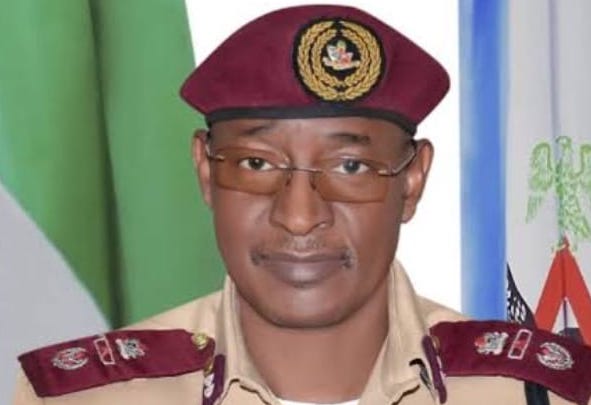
Representing President Bola Ahmed Tinubu, the Corps Marshal of the Federal Road Safety Corps, Shehu Mohammed, addressed world leaders and road safety experts. It was a clear signal that the country is no longer content to ride shotgun on global road safety. Nigeria is stepping up to the wheel.
In his address, the Corps Marshal said, “Guided by the Marrakesh Declaration, Nigeria remains resolute in accelerating the implementation of the Global Plan for the Decade of Action for Road Safety 2021–2030.
‘We are deeply concerned by the findings of the WHO Global Status Report on Road Safety, which identified Africa as the region with the highest road traffic fatality rate. In response, Nigeria has reinvigorated the implementation of the Nigeria Road Safety Strategy 2021–2030.
“This whole-of-government, multi-sectoral strategy enjoys the full support of the Federal Government and is coordinated through the National Road Safety Advisory Council, chaired by the Vice President of the Federal Republic of Nigeria.
“While Nigeria has recorded significant progress, important gaps remain, particularly in intelligent enforcement technologies, road infrastructure, safety assessment, and institutional capacity development.
“Nigeria therefore calls upon the international community to strengthen technical cooperation, facilitate technology transfer, and support sustainable capacity-building initiatives to accelerate the achievement of our shared road safety goals and vision.”
Nigeria lending its voice on road safety on the global stage did not happen by luck. It was the outcome of an institutional identity evolution. Under Shehu Mohammed, the FRSC has been pulling itself up by the bootstraps, moving far beyond roadside checks and traffic warden duties. The Corps has rebranded itself as a data-driven, tech-savvy public safety body whose work now cuts across public health, economic growth, and national security.
His address spotlighted homegrown initiatives that fit squarely into global frameworks. First is the Safe System Approach under NigeriaRAP, built with the International Road Assessment Programme, iRAP. The idea is simple: human error should not be a death sentence, so roads must be designed to protect people when mistakes happen.
Then there is the push to bake safety into Nigeria’s green transition. As the country rolls out the Presidential Initiative on Compressed Natural Gas and electric mobility, the FRSC is making sure the drive to decarbonise does not compromise vehicle integrity.
Finally, technology is doing the heavy lifting on enforcement. From automated biometric licensing to digital tracking and crash databases, the Corps is building a real-time intelligence network that turns guesswork into evidence.
What made Nigeria’s intervention stand out was that it spoke for more than one country. As host of the Secretariat for the African Association of Road Safety Lead Agencies, AARSLA, the FRSC is now the go-to hub for collaboration across the continent.
Africa still carries the heaviest load when it comes to road fatalities, and with the African Continental Free Trade Area, AfCFTA, opening up more cross-border trade corridors, the stakes are only getting higher.
To get ahead of the curve, Nigeria is pushing for harmonised standards — from vehicle roadworthiness to driver data registries — across West Africa and beyond. The goal is to ensure that as goods and people move more freely, they also move more safely. In short, Nigeria is trying to get all African nations on the same page, and the same road.
At the end of the day, declarations made in air-conditioned halls do not save lives. The rubber meets the road on highways, in rural communities, and at chaotic urban junctions.
Meeting the UN’s target to halve road deaths and injuries by 2030 will take more than lofty communiques. It will take pouring resources into infrastructure, holding the line on enforcement, strengthening post-crash emergency response, and getting federal, state, and local governments to pull in the same direction.
With the FRSC’s voice under Shehu Mohammed in New York, it is clear that our road safety story is going global. The next chapter — and the harder one — is making sure those global commitments trickle down and make the daily commute safer for every Nigerian.
