

Mark Fisher/Shutterstock
England is sweltering under an red heat health alert and could see its hottest June day on record. In North America, football fans and players are suffering, with a quarter of this summer’s World Cup matches forecast to be played in dangerous heat.
The public know to expect this in advance because the science of forecasting has become remarkably powerful. Scientists can run a million versions of the future before it arrives. But seeing the future in data is not the same as being ready for it. The gap between knowing and doing is not a gap in our technical capability. It is a gap in human imagination.
In September 2024, Storm Boris brought severe flooding across central Europe. Forecasts gave authorities time to act. Thousands of people were evacuated. The science helped people see into the future.
Three years earlier, in July 2021, forecasts for rivers in western Germany were predicting serious flooding several days ahead. Yet some people did not receive warnings. Others did not understand what the warnings meant. And some simply could not imagine that the flood would be worse than anything they had ever seen before. Villages were torn apart and 190 people died.
What happened differently? I was part of a team of researchers who spoke to people who had lived through the floods in the Ahr valley in Germany. One person said: “It was clear that a lot of rain was coming. I lacked the imagination of what that means.” People may possess information and still be unable to see the danger they are in. Previous experience can help people picture a flood, but often only up to the scale of their prior experience. As the climate changes further, the future has no template.
Making possibilities visible
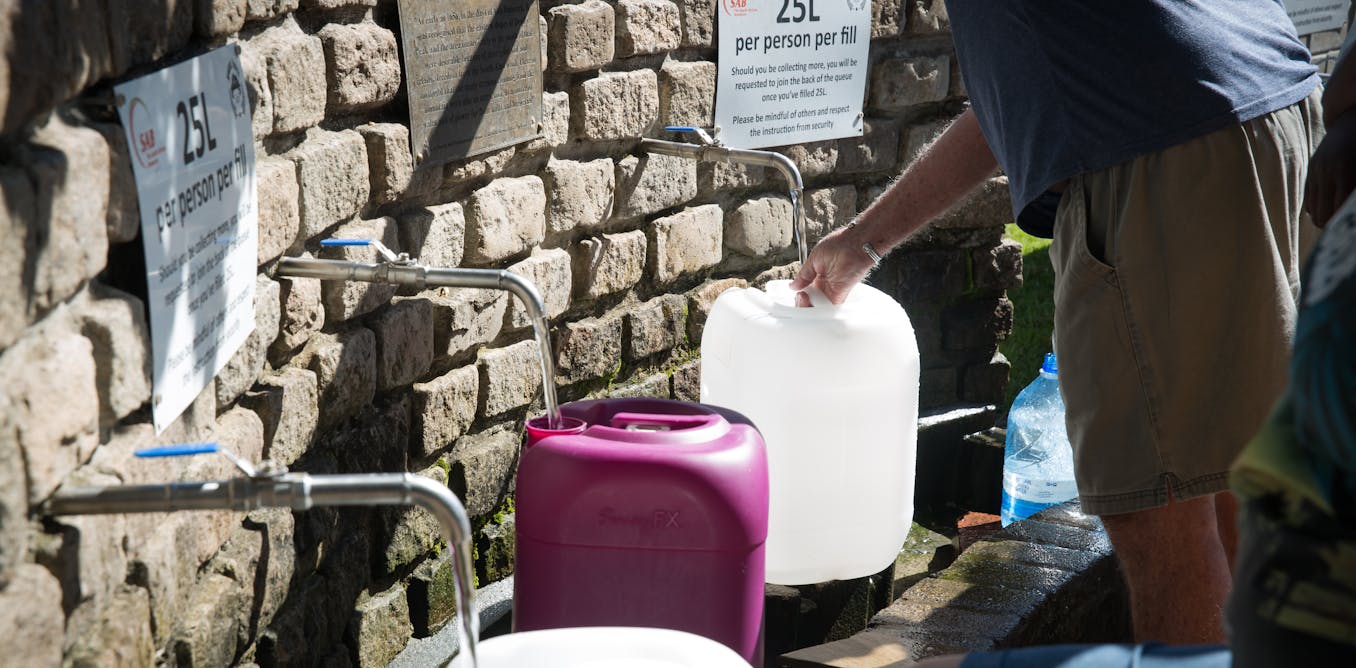
Between 2015 and 2018, Cape Town in South Africa experienced a severe drought. Reservoir levels fell sharply. The city began to approach what became known as day zero: the point at which household taps would be turned on, and no water would come.

Dewald Kirsten/Shutterstock
Research showed that this situation was made worse by inequality as much as climate change. Rich residents filled swimming pools while their poorer neighbours were left without running water to drink. But the crisis rose in prominence because of the way it was discussed. The idea of day zero turned an abstract risk into a timed countdown, making visible the possibility of an otherwise invisible but devastating future. Cape Town needed better water infrastructure, but the crisis did not become real until its residents created better imagination infrastructure.
Imagination infrastructure provides the building blocks of society’s shared understanding. To understand how the natural world will affect us, we need stories, forecasts, maps, conversations and shared spaces that allow us to rehearse a future in our minds before it arrives. A flood warning is a piece of imagination infrastructure. So is a photograph of water rushing through a familiar street, which can make an approaching danger suddenly real in a way that an abstract warning cannot.
The science will tell us what is likely to happen. The harder question is whether that knowledge reaches people in a form they can feel and act on.
Not only that, but imagination infrastructure can improve physical infrastructure. This is not an either/or trade-off. We cannot replace flood barriers and pumping stations with storytelling. We also need strong public institutions and political decisions that take future risk seriously. But physical infrastructure begins with a collective act of imagination. Before we build a flood barrier or redesign a street, we have to picture why that change matters.
Futures we can already see
The science of climate forecasting has already given us a range of possible futures: worlds with 1.5°C of warming above pre-industrial temperatures, 2°C, 3°C and beyond over the coming decades. Those numbers can often seem too abstract to grasp, or the timescales feel too far off to care about.
The challenge for science is not just to forecast the conditions that are ahead. It is to imagine the kind of society we want to be in the future, as conditions like this week’s heatwave in the UK grow more common.
The good news is that we don’t have to look very far to see ideas being put into action. Just a few steps from where I live and work in Reading, we have modern hydroelectric turbines on the River Thames generating renewable electricity. Electric buses carry passengers swiftly around the town. And the Reading School Streets programme (an initiative that ensures roads outside ten schools are closed to most vehicles during school arrival and departure times) brings cleaner air and safer surroundings to children and families on the daily trip to the school gates. These ideas all stem from someone deciding to imagine a different future and making that a reality.
When science predicts heatwaves or floods next week, or extreme conditions decades in the future, those futures are real. To avoid walking headlong into disasters we can already see, and to build different futures for ourselves, we need to learn to imagine and feel them too.
