

- In late May, Mongabay accompanied a group of conservationists and scientists to Taï National Park — a large rainforest in Côte d’Ivoire famous for its habituated western chimpanzees.
- Despite the presence of these charismatic apes, the park gets relatively few visitors, whose presence could help to support conservation efforts and deter poachers.
- Conservationists are now planning to promote niche tourism in the park and support work by the Ivorian Office of Parks and Reserves (OIPR) to protect Taï’s stunning biodiversity.
- Chimpanzee sightings are a major attraction for any visitor to the park, but other animals, including one of the world’s largest scorpions and Africa’s largest and rarest owl, could also prove to be a draw for those looking for an adventure-filled experience.
DJOUROUTOU, Côte d’Ivoire — After a night of heavy rain, the chimpanzees of Taï Forest, in southwestern Côte d’Ivoire, like to sleep in.
Early on a late May morning, chimpanzee guide Evariste Tere led a group of scientists and conservationists to a chimp group’s nesting site that he had marked with his GPS the previous evening.
The humans set off at 4:30 a.m., then spent an hour and a half waiting for the chimpanzees (Pan troglodytes ssp. verus) to wake up.
Eventually, one of them did. Moisture gathered in her nest from the night’s rain gushed down, and then the other trees began to bend and creak as their occupants — one male, four females and a baby — stirred.
One of the females, with the baby clinging to her belly, moved through the treetops to a bigger tree, then used the handholds and footholds of a strangler fig snaking its way up the trunk to reach the canopy. This didn’t seem to impress the male, who was already on the ground and, noticing the humans, wanted to get his group moving.
He screamed angrily and beat his hands on the buttress root of a large tree so that the sound echoed through the forest like a drum.
“He’s angry that they didn’t follow,” Tere said, adding that while Taï’s chimpanzees are used to seeing tourists, a group of five was bigger than normal, and the male did not want to linger. Instead, he would keep his charges moving until they reached the safety of a much bigger chimpanzee group that had spent the night several kilometers away.
Taï’s chimpanzees, which have been studied by primatologists for decades, may be the forest’s most iconic animals, and the most likely to attract visitors, but there is much more to see.
Recent camera trap images obtained by the Ivorian Office of Parks and Reserves (OIPR in French) and its partners as part of a program to monitor mammals, revealed, among others: leopards, forest buffalo, pygmy hippos, giant pangolins, large elusive antelopes known as bongos, golden cats and water chevrotains — the latter an antelope-like animal that hides from predators by diving into water and holding its breath beneath the surface until danger has passed.
Beyond these mammals, Taï’s rainforest has a host of unique amphibians, birds, reptiles and invertebrates that could prove equally big draws for adventurous nature lovers. Leadership for Conservation in Africa (LCA), a South African NGO, is working with OIPR and Eburny Biodiversity Conservation (EBURCO), an Ivorian conservation NGO, to develop specialized rainforest tourism on the back of this diversity.
“There’s a growing market for people who want to see specific reptiles and amphibians,” said Michele Menegon, a herpetologist and director of biodiversity conservation with LCA. “It’s basically [driven by] a combination of [fascination for] rare animals, photography and Instagram.”

Two notable photogenic frogs found in this 5,000-square-kilometer (1,930-square-mile) national park include the giant West African horned toad (Sclerophrys chevalieri), whose back resembles a dried leaf, and the Ivory Coast wart frog (Acanthixalus sonjae), a lumpy-skinned frog barred with green and black stripes that lays its eggs in small rain-filled tree cavities.
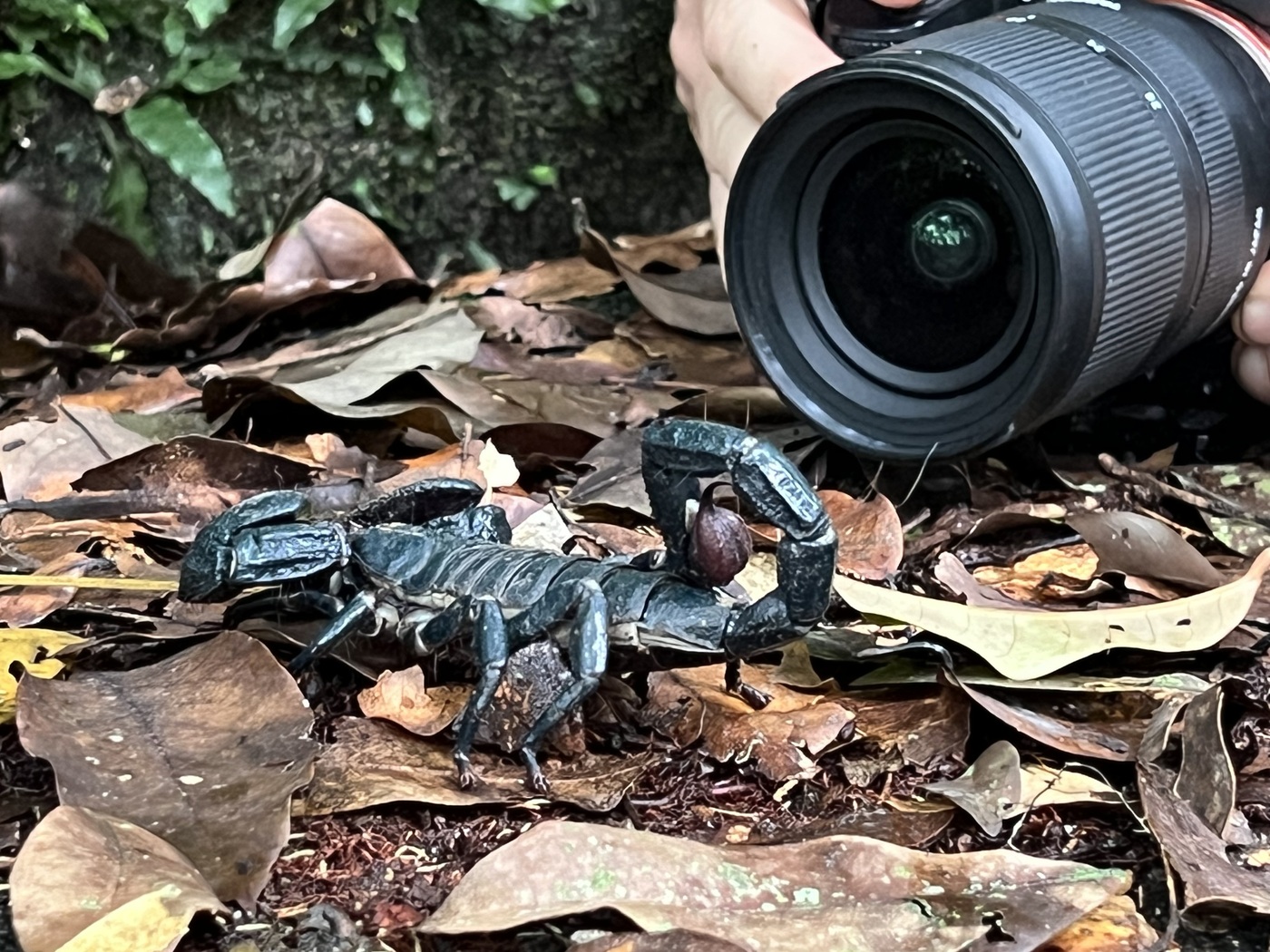
Invertebrates are equally intriguing. A Mongabay correspondent saw a West African tailless whipscorpion (Damon medius), a harmless species of arachnid, scuttling across the path at one point during a five-hour hike through the night to reach a campsite near the Hana River, in the south of the park. The correspondent also photographed one of the world’s largest scorpions — the emperor scorpion (Pandinus imperator) — sheltering beneath a pile of firewood near the campsite kitchen. Taï also has two resident species of Goliath beetles (Goliathus genus), palm-sized arthropods patterned like jewels that are attracted by the smell of fermenting bananas.
Critters like these are targets for the international pet trade, but Menegon said he believes that collectors’ curiosity will be satisfied by instead seeing them in their native habitat — in places like Taï.
Locals can reap dividends from such specialized tours, Menegon suggested, by gaining employment as cooks, guides, porters and assistants. “For communities that are subsistence-based, any extra income is welcome, so even though the park might be sustained by donors and the government, resources flow outwards.”
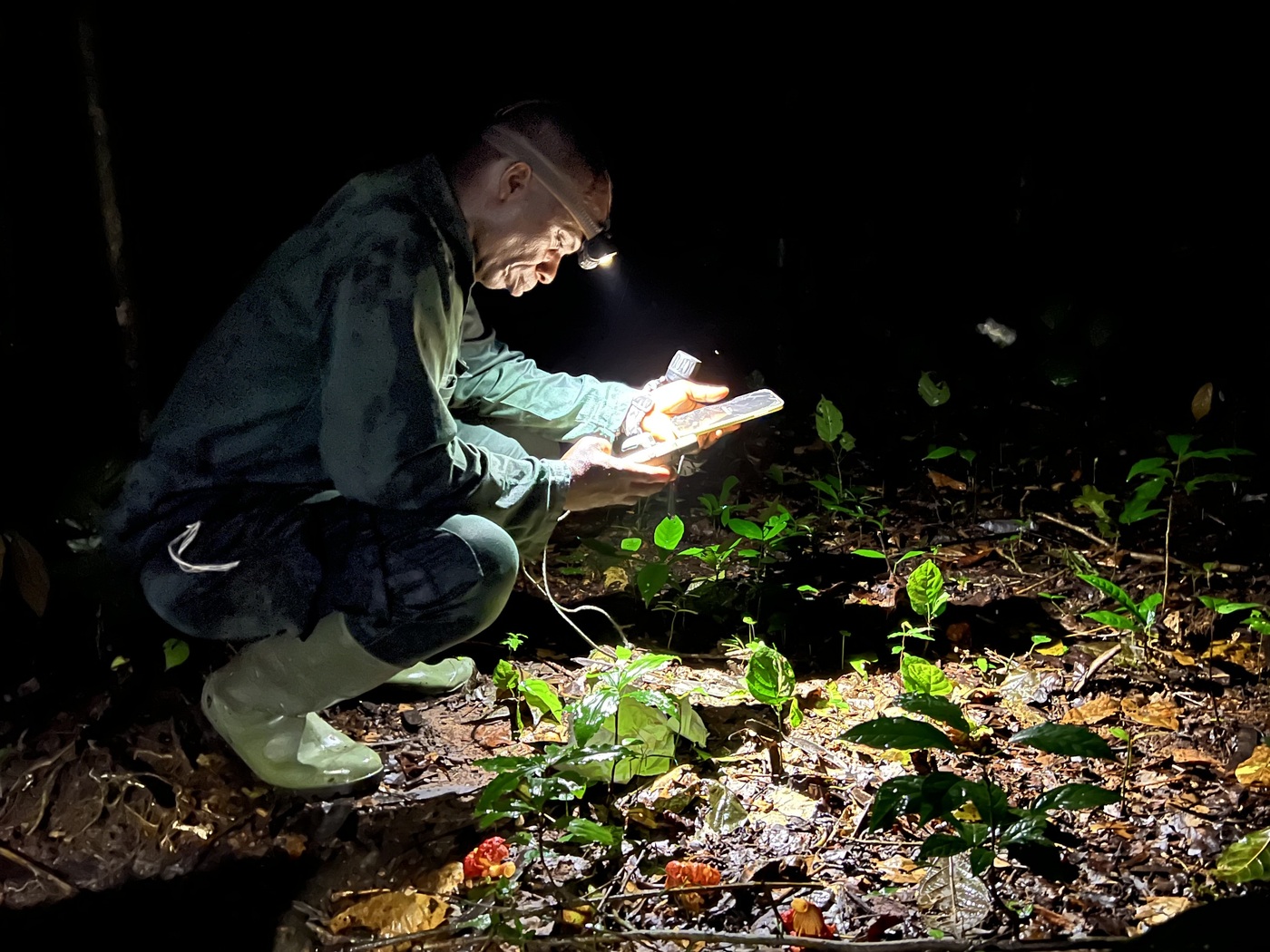
The conservation partners said they hope to identify individuals within local communities who can become knowledgeable guides — people like Tere, the chimpanzee guide, and Kevin Hino, a bird guide who works at the ecolodge near the village of Djouroutou, in the south of the park.
A few years ago, Hino led a U.S. wildlife photographer to capture images of a Shelley’s eagle-owl (Ketupa shelleyi), widely regarded as Africa’s largest owl and possibly its rarest. It was apparently only the second time in history the eagle-owl had been photographed.
“We looked for the bird many times before we saw it,” Hino told Mongabay. After the photos were published on the photographer’s website, Hino was contacted by bird guides from neighboring Ghana who came to Taï to try to see the owl for themselves.
On the first night that the Mongabay correspondent stepped into Taï, a male Shelley’s eagle-owl’s banshee-like call provided a dramatic introduction to the rainforest, along with the sight of lianas as thick as tree trunks, the sound of forest elephants splashing in a stream, and the feel of occasional swarms of driver ants, nipping ankles and crawling up shins.
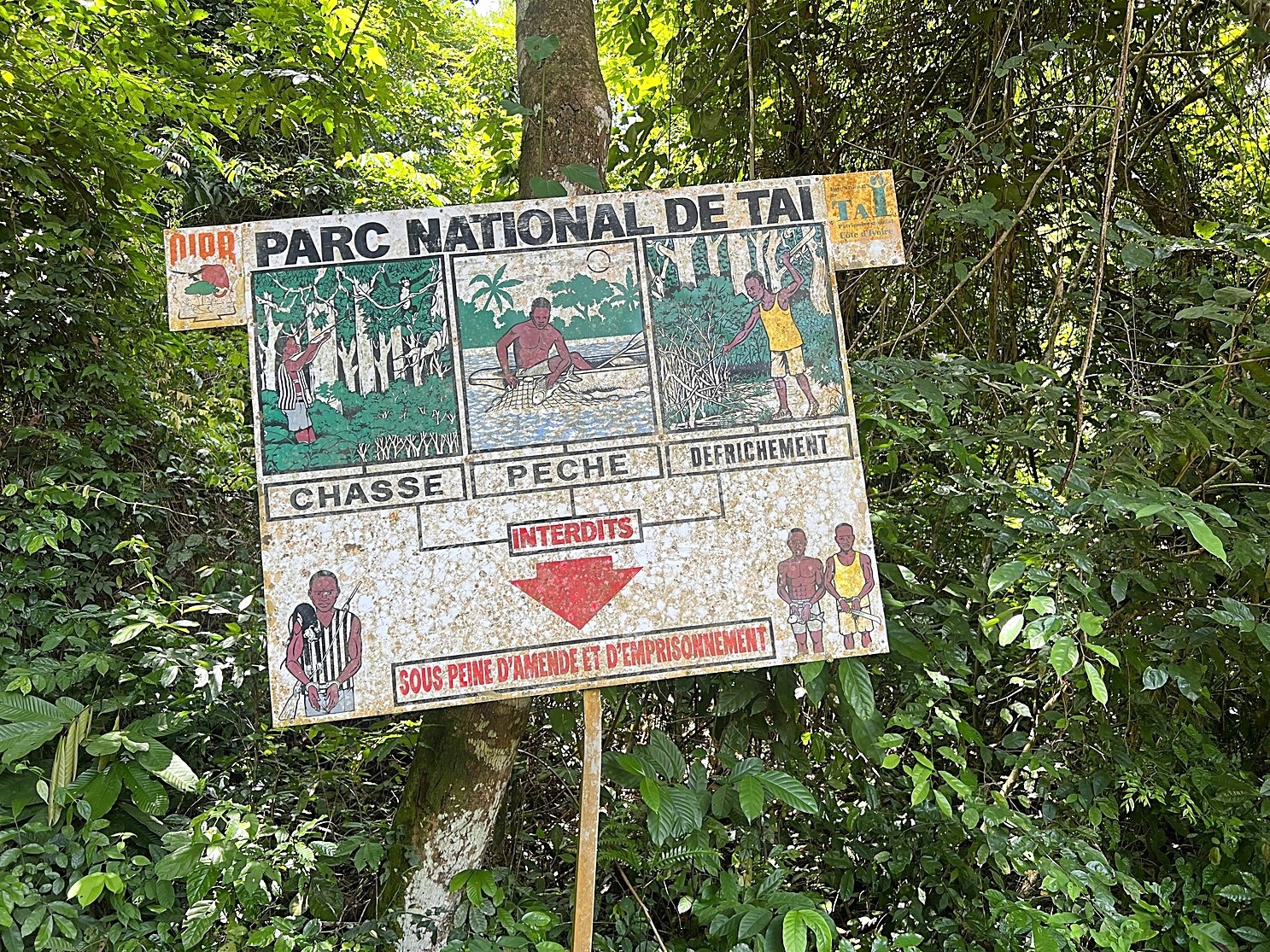
The main entrance to the northern section of Taï National Park, reached via several hours on a rough dirt road north of Djouroutou, is marked only by a forest path and a signpost warning visitors not to hunt, cut wood or fish.
Mongabay accompanied Menegon and a research team on a 10-kilometer (6-mile) hike from here to a forest campsite. Initially, the path meandered through secondary forest, dotted here and there with remnant oil palm trees, a crop responsible for the loss of much of Côte d’Ivoire’s rainforest, but around the campsite stood the tree giants of old growth primary forest, as tall and wide as cathedral columns.
Around 40-50 meters (130-165 feet) above, hornbills wailed and churned the air with heavy wingbeats, and lithe-limbed Diana monkeys (Cercopithecus diana), striking in their pelts of chestnut, black and white, capered along high branches. They are just one of nine species of monkey native to Taï.
In a damp spot, surrounded by Uapaca trees on their stilt-like roots, elephant footprints were visible in the soil and numerous middens of tiny duiker droppings showed that these small antelope were still abundant.
An adventurous spirit and a tolerance of minor discomforts may be prerequisites for any visitor to Taï, but a gradual increase in visitor numbers — including from English-speaking countries — would provide more income for the park and more eyes and ears along its forest trails, supporting the work of the park’s 100 rangers, who are already thinly-stretched across the rainforest’s 5,000 square-kilometer expanse.
Lorenzo Prendini, curator of arachnids and myriapods at the American Museum of Natural History in New York, said he doubts many of the hobbyists who collect live amphibians, reptiles and invertebrates could afford a trip to a place like Côte d’Ivoire, or would even consider going there. “The hobbyist who purchases live animals from a dealer is very different from the hobbyist — or professional — who collects dead critters for a scientific study,” Prendini told Mongabay.
But neither would they pose any direct threat to forest fauna. “Most of these hobbyists do not collect their own critters and wouldn’t know how.”
Menegon said he was heartened by a pilot safari he conducted in Tanzania earlier this year. A clutch of overseas visitors, many of them gecko and reptile keepers, were content to pay to travel from Europe all the way to East Africa to see the animals in their natural habitat. A similar pilot is planned for Taï later this year.
“I think the market [for specialist safaris] is there,” Menegon said.
At the heart of all these efforts is the need to protect Taï — the largest intact stand of Upper Guinean rainforest remaining in West Africa.
During Mongabay’s visit, gunshots echoed through the forest in the southern section of the park on at least two successive nights. They were likely fired by hunters illegally targeting animals to feed a market for bush meat.
Part of LCA’s agreement with OIPR includes paying rangers per diem, on top of their regular salaries, for each day that they’re out on patrol.
Menegon said he is confident that with more trained local guides, possibly including biologists from Ivorian universities working in the rainforest on a seasonal basis, Taï could attract several hundred visitors each year. He said he envisages an investor providing light-touch facilities — wooden decking above the forest floor to keep tourists’ feet dry at well-equipped campsites reached by foot via well-marked forest trails — as opposed to major infrastructure developments like lodges.
A trip to Taï could combine the chimpanzee experience with observing its reptiles, amphibians and numerous special bird species, like the Shelley’s eagle-owl and others unique to the Upper Guinean forest.
“Taï is super rich, super interesting,” Menegon said, “and filling the gap in terms of [providing] facilities and local knowledge could make it work.”
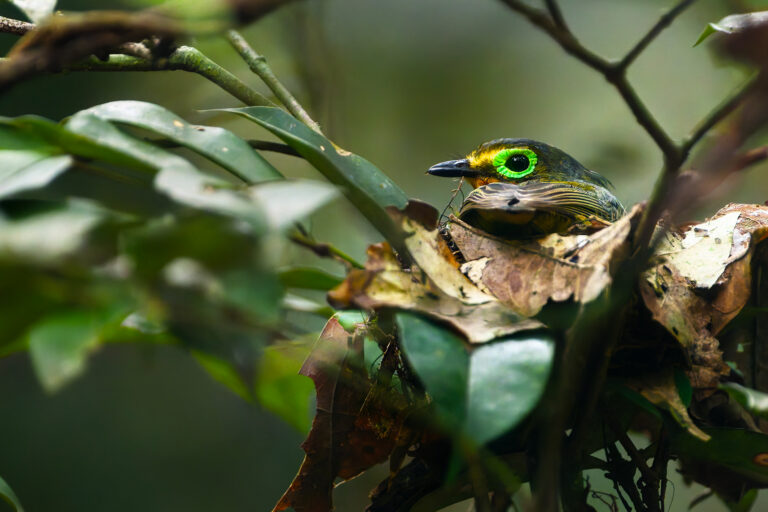
Banner image: A yellow-bellied wattle-eye (Platysteira concreta), a bird of the rainforest understorey, sits on its nest in the Tai National Park. Image courtesy of Michele Menegon.
What makes community ecotourism succeed? In Madagascar, location, location, location
Feedback: Use this form to send a message to the author of this post. If you want to post a public comment, you can do that at the bottom of the page.
Credits

