

Hot on the heels of a global heatwave, consumers are reaching for sunscreen like never before. The market is healthy, and brands are catering to an exacting set of demands. What was once an awkward part of holiday-makers’ beachside routines has become yet another step in year-round skincare, with modern SPF formulations incorporating everything from hyaluronic acid, niacinamide and vitamin C through to peptides, ceramides and antioxidants — all in service of hydration, brightening, skin barrier repair, anti-ageing and complexion enhancement.
In practice, this might mean tinted sunscreens, serum-based SPFs or formulas designed with dewy, matte or radiant finishes. Or, it could be an SPF suited to consumers with deeper skin tones. The most critical consideration might be the format. If a sunscreen feels good, people are more likely to consistently wear it, which is why a longstanding focus on texture — mousses, sticks and mists have all infiltrated the market — and a seamless blend of the broader beauty category and suncare has taken hold.
“Korean brands like Isntree and Beauty of Joseon showed that texture drives compliance,” notes Dr Asmi Berry, a board-certified dermatologist based in LA. For her, brands that can deliver truly invisible, cosmetically elegant broad-spectrum protection (effective against UVA and UVB rays) can tap into a substantial growth opportunity. And this is reflected on socials, too.
“We are seeing particular momentum around names like Beauty of Joseon, Garnier, Medicube, and SVR Laboratoire Dermatologique,” says Emily Caine, head of beauty at TikTok Shop UK. “Our buyers want wearability and added value with lightweight textures, no visible cast, skincare-led benefits, and clear guidance on everyday routines.”
Per Euromonitor, the global suncare category has shown year-on-year growth from 2022 to 2025, with a forecast of 7.5% for 2025 to 2026. The market in 2025 was valued at $18 billion, with a projected figure for 2026 of $19.4 billion. Still, regional differences apply. As new data from GWI reveals, certain territories are leading in reported use of SPF: 26% and 28.1% of people report using suncream in the last week in Australia and South Korea, respectively, versus only 9.8% and 6.3% in the US and UK. According to Circana, Australia — which has the highest rate of skin cancer in the world — has seen its suncare market grow by almost 60% in the past four summers, ascending from AUD 64.4 million ($46 million) in 2022 to AUD 102.7 million ($73.35 million) in 2026.
Across markets, the biggest variable is how ingrained the habit of SPF use is, notes Bia Bezamat, cultural insights expert at Kantar. “While in Asia, SPF can be seen as a daily non-negotiable, for the West, SPF can still be more situational or weather-dependent,” she explains.
Despite skewed demands, the market has potential across the board. Notably, Circana reported suncare sales of £445 million in the year leading up to 25 April 2026, a 10% climb year on year. And, in the year ended March 2026, US suncare reached $2.7 billion in value sales, a growth of 6% year on year.
Experts argue that much of the legwork is in educating consumers and adapting products into an already thriving beauty category. “Sun damage awareness and demand for convenient on-the-go formats is driving SPF-infused make-up innovation,” confirms Lisa Payne, head of beauty trends at Stylus. She cites a 2025 report from Spate that showed an 185.5% year-on-year spike in US Google and TikTok searches for “SPF-setting sprays”.
Tapping into this growing market isn’t easy. Aside from being highly saturated, it comes with international legal hurdles, constant scientific innovation and an expanding number of product categories to contend with. For broader lifestyle beauty brands wanting to diversify, it’s an easier win. For SPF-first brands, it’s a chance to extend their range and reach a consumer looking for both clinical protection and a premium product.
The beautification of suncare
So, what to keep in mind for success? “The most significant shift in SPF is that it has transitioned from a seasonal product to an everyday essential for most consumers,” says Larissa Jensen, SVP global beauty industry advisor at Circana. Importantly, this means SPF has become a core part of the beauty ritual, arriving in the form of, say, a primer, foundation or moisturizer. “Some emerging brands are even positioning themselves as ‘sun makeup’ brands, underscoring this convergence,” adds Jensen.
Founded in 2021, Naked Sundays — the self-dubbed “BeautyScreen” (a hybrid of sunscreen and skincare) brand — is exemplary, offering hero SKUs, such as a hydrating glow mist SPF, which allows users to protect their skin without disrupting the flow of their make-up routine. “Of course, most people simply won’t reapply [SPF] if it means ruining their makeup,” explains founder Samantha Brett. It’s a similar case for the brand’s PoutScreen, a peptide-infused lip treatment with SPF 50 protection, and the BeautyScreen foundation tint, which has been designed in 15 shades. Both offer beautifying effects in conjunction with sun protection, and it’s paying off. Brett reports a company growth of 700% since 2023, with the US taking the largest share of growth.
“At this point, people understand the need to reapply during the day, so the job for brands is to make this fit into people’s everyday behavior,” says Kantar’s Bia Bezamat, calling out smaller stick formats that fit a bag or pocket — a feature Shiseido, Ollie and Elf Beauty have already capitalized on. In this vein, Australian brand Ultra Violette recognized a gap for products that didn’t feel like traditional beach-bag fare. “I think the audience was ready for SPF that didn’t feel like a chore to apply — we all know psychologically it takes a lot more effort to do something you don’t want to do,” says co-founder Ava Matthews. The poster product is the Supreme Screen — a hydrating SPF primer and moisturizer that has grown 50% year on year. “We call it our one-and-done because it really does everything,” she says, noting that it’s been in the offering since the brand’s 2019 launch.

Ultra Violette’s Supreme Screen primer and moisturizer has grown 50% year on year.
Photo: Courtesy of Ultra Violette
Similarly, Californian brand Skylar has been savvy to the factors that entice consistent use, proving popular with Gen Z and younger millennials. Leah Kateb, chief creative officer, tells me this thinking is what inspired the brand’s Scent-Screen mist, a product somewhere between fragrance, suncare and beauty. “Our SPF mists continue to be standout performers because they solve a real consumer need around reapplication while being unique in the category by combining SPF and perfume,” she explains, reporting that the mists have sold out with every release. This adds up with cosmetics consumer trends at large. “Fragrance is a key selling point for beauty and personal care aimed at Gen Zalpha, and suncare is following suit,” says Payne.
The new standard
With a wider menu of products now available, consumers have also gotten increasingly demanding regarding the quality and tailoring of their SPF. This past year, according to Amna Abbas, senior consultant at Euromonitor International, the SPF market has increasingly favored higher-protection products, with SPF 50+ displaying the strongest growth as consumers prioritize protection against UV rays. Additionally, Abbas points to an uplift in consumer demand for mineral sunscreen — typically reliant on zinc oxide or titanium dioxide — spurred on by a growing interest in reef-conscious, sensitive-skin-friendly and “clean-label products” (i.e. no artificial nasties). This is interesting given that since at least a year ago, the mineral format had a bad rap for leaving a white cast. With time, it seems, tinted variants, non-greasy formulas and lightweight variations have handled this issue. “Mineral sunscreen has also advanced significantly,” explains Jensen. “Thanks to micronized zinc oxide technology, formulas are now far more sheer and wearable across a wide range of skin tones.”
Beyond simply making SPFs more effective and attuned to consumer ethics, it’s also about pairing personalisation with troubleshooting. Payne notes that in the UK, 51% of adult consumers believe SPF can cause skin irritation, such as redness, stinging or itching, highlighting an important gap in the market. Whitney Hovenic, the dermatologist and co-founder of Gen-Z-savvy US brand, Spooge, was well aware of this barrier to use. “When patients tell me they are ‘allergic’ to sunscreen, I always ask what they are using, and more often than not, it’s a chemical sunscreen,” she says. “While true sunscreen allergies are relatively uncommon, certain chemical UV filters can exacerbate underlying skin conditions such as eczema, rosacea or acne in sensitive individuals.”
Hovenic’s young brand is just entering its first full sunscreen season, having launched last July and has seen month-over-month growth of more than 450% for Ghosted, its sheer daily sunscreen. It’s also maintained its core Gen-Z audience while expanding its customer base, seeing strong engagement from women in their 30s, 40s and beyond — many increasingly focused on skin health and sun damage prevention — and repeat purchases amongst men aged 35 to 50. “We have also seen success in the ski market, which stemmed from a simple idea: create a sunscreen made for skiers by skiers,” says Hovenic. “Face Shots delivers the high-altitude protection mountain athletes need in a formula that feels nothing like the thick, greasy sunscreens they’ve come to expect.”
Likewise, Supergoop! has spent this year focusing on individual skin needs and preferences among its consumer base. “Across the portfolio, we’ve continued to evolve our offering through more hydrating and glow-driven textures, oil-controlling matte finishes, broader shade inclusivity within mineral SPF, and elevated sensorial experiences across categories like lips and body care,” says CEO Melis del Rey, also observing momentum within the mineral sunscreen category. “We still see significant whitespace opportunities within areas like lips, body care, and easy reapplication formats,” she adds. Within Supergoop!’s offering, the Unseen Sunscreen franchise remains a top performer thanks to its weightless, primer-like formula, with one product selling every 16 seconds according to Rey.

Supergoop! SPF Spray.
Photo: Courtesy of Supergoop!
The blending of product innovation with personalisation matters for all brands — even the veteran dermatological stalwarts. Consider CeraVe, which has just launched a new chemical suncare range reflecting this very appetite. The offering comprises five different invisible formulas for a range of skin types spanning acne-prone oily complexions through to dry skin, supporting the skin with essential ceramides — lipids responsible for skin resilience and sensitivity. “Most people think about sun damage in terms of what they can see — a burn, a tan line,” says brand president Vincent Chauvière. “But the real damage happens beneath the surface, at the barrier level. Just two hours of sun exposure can deplete up to a third of [the] skin’s ceramides, leaving the barrier weakened and less equipped to protect itself.”
Pain points
This change in consumer standards isn’t always easy to address, depending on the region. Stateside, sunscreens are classified as over-the-counter drugs, with only two UV filters (zinc oxide and titanium dioxide) recognised as “safe and effective”, a limited number of cosmetic claims they can make and extensive testing procedures restricting manufacturers. In the UK, EU and Korea, sunscreen products come under cosmetics. “Shifts in legislation could be instrumental in altering the course of the global suncare market,” says Payne. Currently, US brands are banking on the approval of bemotrizinol — currently under FDA review — which has been used elsewhere for years.
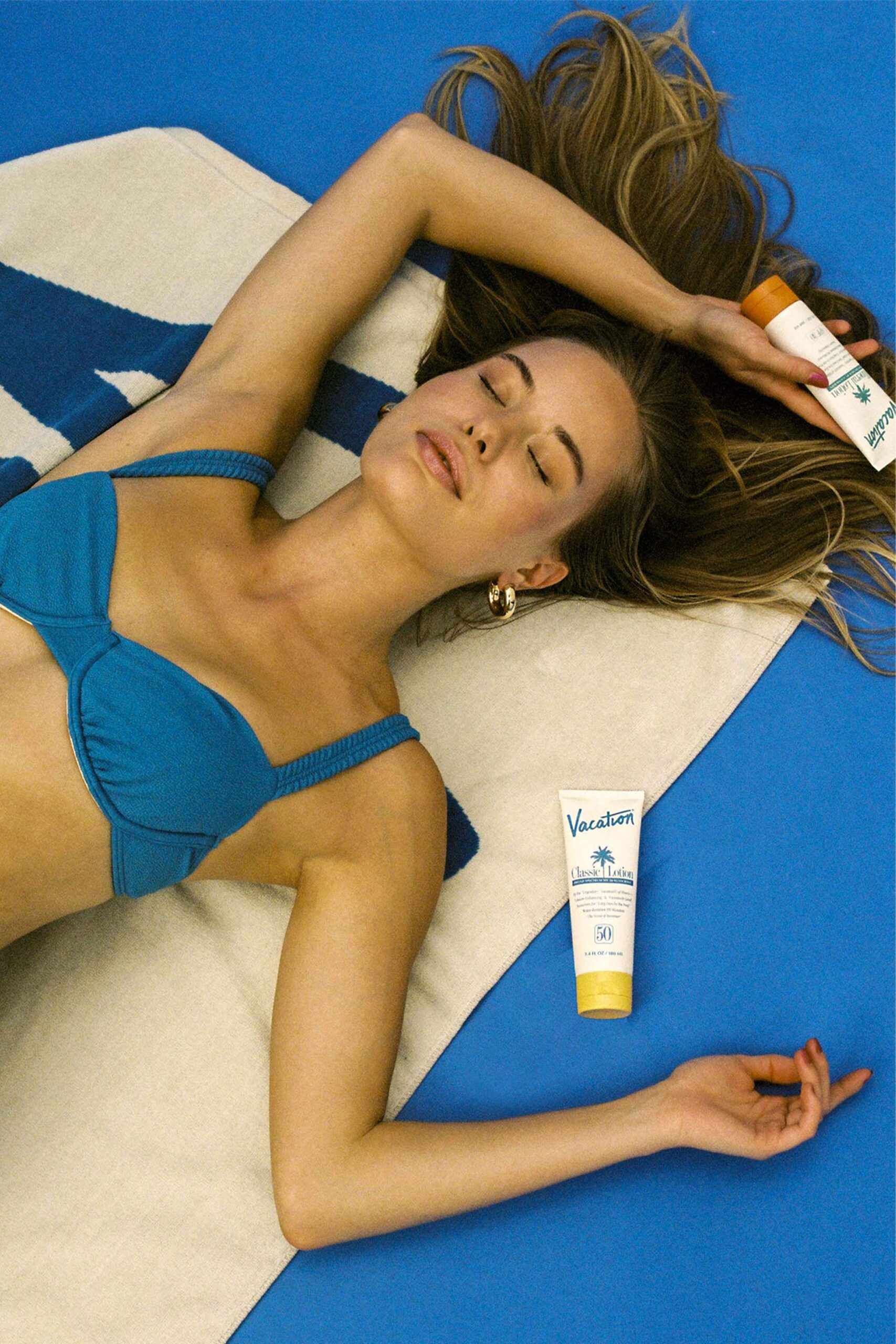
“The brands that you can tell are doing compliance well are those who are transparent with the consumer,” says Kamal Kaur, chief regulatory officer at The Cosmetic Regulator, noting that some brands publish results from SPF testing and have the product tested at two separate labs to ensure label accuracy. US-based brands Vacation and Supergoop! have both faced issues. In August 2025, the FDA issued warning letters to each.

Photo: Courtesy of Vacation
Supergoop! responded to Vogue Business for comment, pointing to a previously shared statement: “At Supergoop!, we remain committed to innovation in suncare and the highest standards of product efficacy and safety. The recent communication from the FDA regarding our PLAY SPF 50 Body Mousse is focused on product labeling and has nothing to do with its safety, effectiveness, or formula. We are working closely with the FDA to resolve this matter as we continue to uphold the high standards our consumers expect from us.”
Dakota Green, co-founder of Vacation, also responded, saying: “At Vacation, we take regulatory compliance seriously. We have full confidence in the safety, efficacy and integrity of our product. We are committed to working collaboratively with the FDA to satisfactorily resolve this matter.”
For this reason, brands often use different ingredients in different markets to ensure they comply and reap market rewards. Doing this, and addressing the gripes that have made SPF feel clinical and inelegant, while also doubling down on science-led, future-proofing formulations that nourish the skin, is the route to success. Anything less won’t survive in a rapidly evolving market.
