

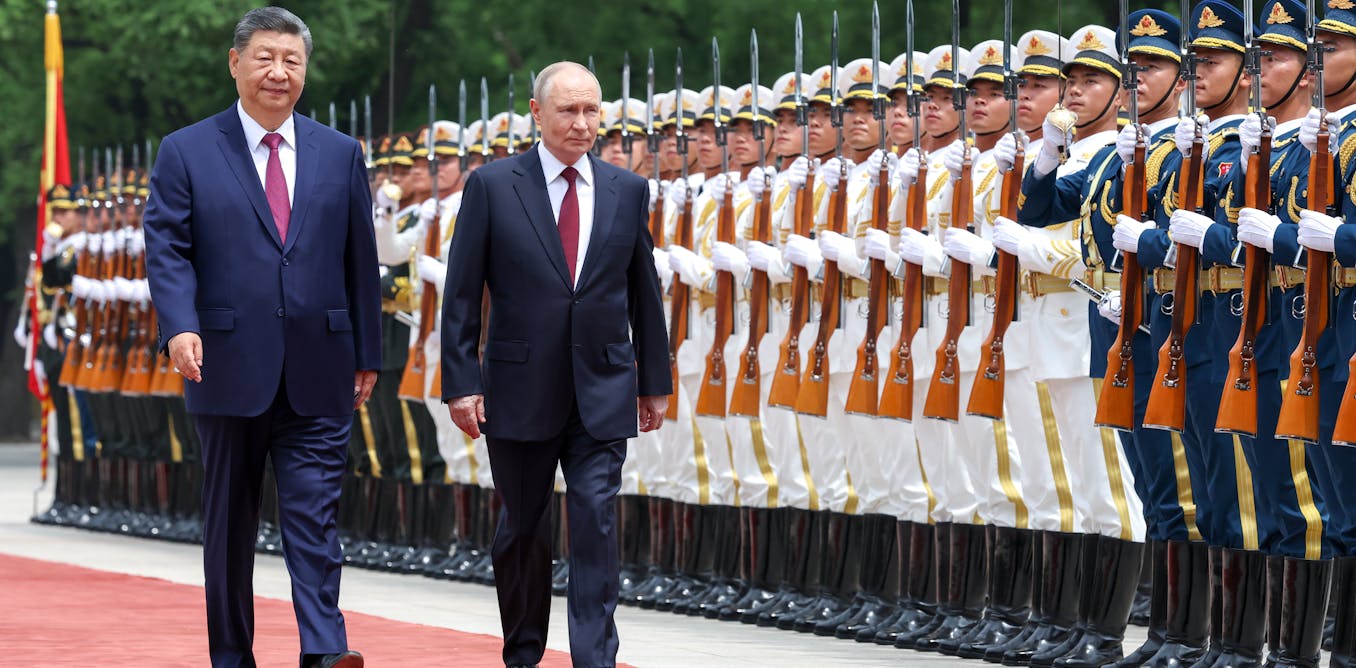
Less than a week after hosting Donald Trump, China’s leader Xi Jinping welcomed his Russian counterpart, Vladimir Putin, to Beijing. Unlike Trump’s visit, this was a routine meeting. The Chinese and Russian presidents have met more than 40 times since 2013, with the latest meeting marking Putin’s 25th visit to China.
The frequency of talks is itself a testimony to the expanding scope of shared interests between the two states. And, as is typical for Sino-Russian summits, Xi and Putin signed an array of documents following their meeting in areas ranging from energy to higher education and the media.
Xi and Putin may be close, but their promises of further cooperation hardly mean the friendship between them has “no limits”.
Opposition to US global primacy has formed the foundation of Sino-Russian cooperation since the end of the cold war. In a 1997 statement, the two nations condemned the “forcing of the international community to accept a uni-polar world pattern”. While not explicitly naming the US, they also added that no single country should monopolise international affairs.
Xi and Putin reiterated this message in Beijing. They adopted a statement in which they vowed to build a multipolar world order and a “new type” of international relations. However, putting this rhetoric into practice has consistently proved a complex undertaking.
Moscow and Beijing often choose the easiest and least expensive way of opposing the US. They have focused primarily on blocking US-backed initiatives and geopolitical strategies by vetoing UN Security Council resolutions.
But they have stopped short of launching any major joint effort to challenge US power. This was illustrated by the muted response of both countries to the ousting of Venezuelan leader Nicolás Maduro in January, as well as their limited support for Iran in its war with the US and Israel.
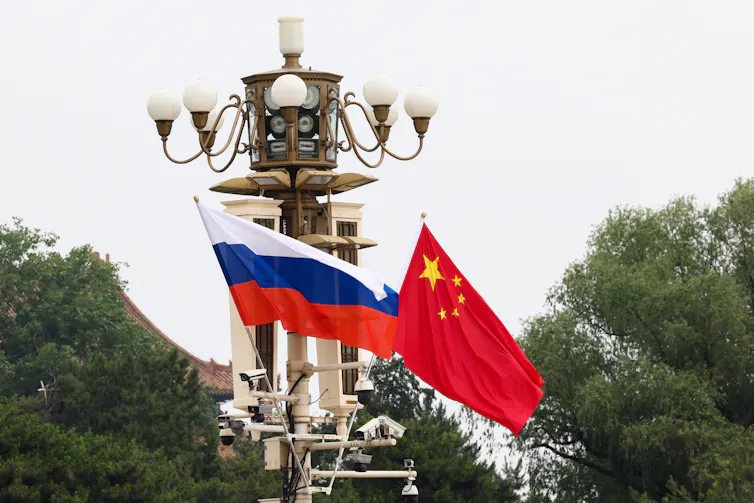
Wu Hao / EPA
One reason for this is the asymmetry in their capacity to help each other. Russia lacks the capacity to support China in the economic and technological domains, which are central to the Sino-American rivalry.
In terms of overcoming the US tariffs imposed on Chinese goods, Moscow can offer Beijing neither an alternative or much relief. The Russian market is not rich or attractive enough for Chinese companies, even before the possible fallout from secondary sanctions is considered.
Russia is also limited in its ability to help Beijing bypass US export controls designed to restrict China’s access to advanced technologies, from semiconductor manufacturing equipment to artificial intelligence hardware.
Western sanctions and recurrent failures to modernise the Russian economy have caused Russia to fall behind in the global technology race. And since 2022, Russia has been forced to rely on China for a number of technologies, from cars and laptops to 5G mobile networks.
China is in a different position. It has political, financial and economic means to support the Kremlin in its confrontation with the west. However, keen to preserve its own global interests, Beijing is highly selective in the support it provides to Moscow.
Chinese state propaganda mirrors Russian talking points and repeats Russia’s justification for its war in Ukraine, blaming the west and its “expansion” into former Soviet territories. China has also provided Russia with dual-use components like chips and fibre-optic cables without which the Kremlin could not sustain its war effort.
But, at the same time, China has refrained from providing lethal weapons to Russia. And Chinese armed forces that conduct regular exercises with their Russian counterparts and carry out joint air and naval patrols around Japan and South Korea, do not participate in similar activities in Europe.
China has also consistently delayed its final commitment to the proposed Power of Siberia-2 gas pipeline. The planned pipeline would transport additional natural gas from Siberia to China, partially compensating Russia’s loss of revenue from the European market.
The deepening asymmetry
Clearly, it is Beijing that dictates the pace of and areas for cooperation between the two countries. And Russia’s leadership seems ready to accept this “junior partner” status.
The Kremlin has sought to reconcile conflicting interests between Russia and China in recent years, particularly in central Asia, rather than challenge Beijing. For example, Moscow has remained silent on the presence of Chinese troops in Tajikistan, which was part of Russia’s former sphere of influence.
It helps that China treads carefully and puts substantial effort into creating the illusion of equality between itself and Russia. Despite the negative impact of Russia’s aggressive policy towards Ukraine on Chinese plans to work with Ukraine as part of the China-Europe railway transport corridor, for instance, Beijing has refrained from criticising Moscow’s conduct.
However, some Russians continue to see China as a threat. In recent years, several Russian scientists working on military programmes have been imprisoned following accusations of spying for China. The Russian government is itself also acutely aware of its deepening asymmetric dependence on Beijing.
It is nourishing ties with other Asian states, including countries like India and Vietnam that have historically had troubled relations with China. While China is an indispensable partner for Russia, Moscow looks to be wary of Beijing dominating east Asia and the Indo-Pacific.
