

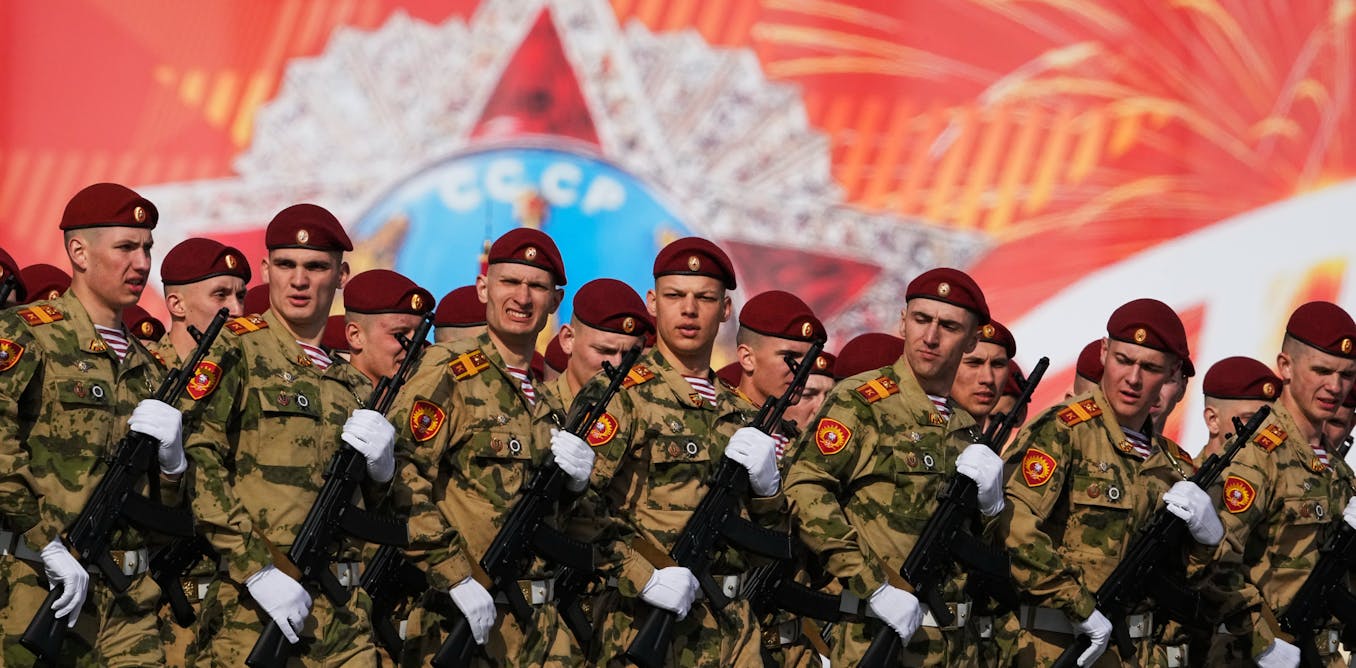
Russia has dramatically scaled back its annual Victory Day parade in Red Square on May 9, with no heavy military hardware for the first time in 20 years. There will also be fewer foreign or Russian dignitaries present.
In addition, the government has shut down airports and temporarily suspended mobile internet access ahead of the holiday.
The Kremlin says the security measures are intended to guard against Ukrainian “terrorism”. It has declared a unilateral “truce” for May 8-9, warning that any Ukrainian attacks during the celebrations could trigger a massive strike on Kyiv. Ukrainian President Volodymyr Zelensky has rejected the proposal, calling it a “theatrical performance”.
As the war grinds on in Ukraine, the Kremlin’s precautions at home are remarkable – a sign that Ukraine’s long-range strike capabilities have punctured one of Russian President Vladimir Putin’s most important political rituals, as well as the country’s seeming impregnability from the war.
Ukraine’s momentum
Under Putin’s rule, Victory Day has become more than just a commemoration of the Soviet defeat of Nazi Germany. The parade, a showcase of Russian military might, has been elevated into a core ritual of legitimising his regime.
The symbolism has taken on even greater meaning since Russia’s full-scale invasion of Ukraine in 2022. The defeat of Nazi Germany has been fused with Putin’s bogus claim that Russia needs to defeat fictitious Nazis in Ukraine.
Last year, Putin welcomed two dozen world leaders, including Xi Jinping of China, Luiz Inácio Lula da Silva of Brazil, Nicolás Maduro of Venezuela and Abdel Fattah el-Sisi of Egypt.
It was seen as an attempt to project Russia’s global power and show the West’s attempts to isolate Moscow were failing.

Alexander Zemlianichenko/AP
What a difference a year makes.
Ukraine has steadily expanded its ability to hit targets far inside Russia, including oil terminals, refineries, military infrastructure and defence industries. Some targets in the Baltic Sea near St. Petersburg and in the Ural Mountains are hundreds of kilometres from Ukraine.
The mere threat of drones has prompted dozens of airport closures and hundreds of flight delays in recent months, especially in Moscow.
At the same time, Ukraine has become much more adept at repelling Russian drone attacks on its own territory, reportedly shooting down 33,000 Russian drones in March of this year alone – a record for one month.
The expansion of its unmanned ground robotic systems and deep-strike capabilities – including its Flamingo missile, which hit a defence plant 1,500 kilometres from Ukraine on May 5 – have helped Ukraine offset its disadvantages in manpower (which remains a big constraint) and ammunition.
Ukraine’s defence industrial base is a big part of the story. Kyiv says its capacity has grown 50-fold since 2022, and now accounts for 70% of its weapons procurement.

Maria Senovilla/EPA
Its successes have won the admiration of its European partners and others around the world. In recent days, for example, it signed a 10-year defence export deal with Saudi Arabia, the United Arab Emirates and Qatar, all three of which were attacked by Iran.
And there are signs Ukraine is gaining momentum on the frontlines. Analysts say Ukrainian forces actually gained more territory than they lost in February, for the first month since 2023.
Estimates of Russian death tolls are difficult to come by, but NATO chief Mark Rutte said Russia is losing 30-35,000 soldiers per month, while Zelensky said 35,000 Russian troops were either killed or wounded in the month of March.
Cracks at home
Meanwhile, Putin has only grown more paranoid about a potential coup or assassination attempt with drones. He has reportedly sharply reduced his movements, spends more time in bunkers, and is surrounded by tighter security.
Domestic strains are growing, as well. Russia’s rate of recruitment has begun to fall short of its battlefield losses. The quality of recruits has plummeted, as well, with alcoholics reportedly being duped or pressured into signing up.
It is becoming harder to sustain recruitment without another politically risky mobilisation. That matters because Putin has long tried to convince Russians the war can be fought at a distance, without demanding too much from society at large.
Russia’s economy is suffering, too, from chronic labour shortages, negative growth, and high inflation and interest rates.
And there are increasing signs of discontent. One critic, Ilya Remeslo, a former Kremlin propagandist, for instance, publicly accused Putin of being a “war criminal”. He was arrested, but in a surprise move, was released after just 30 days and has vowed to continue his campaign against the Russian leader.
Gennady Zyuganov, the leader of Russia’s Communist Party (loyal to Putin), has warned the country’s faltering economy risks stoking a 1917-style revolution. And an anonymous former senior official wrote in The Economist that grumbling among the elite shows Putin is losing his grip on Russia.
Rising popular anger has also been triggered by the tightening of controls on the internet, including WhatsApp and Telegram, aimed at curbing dissent and criticism.
It’s too early to claim the war has turned decisively in Kyiv’s favour. The current stalemate may prevail for some time.
But the recent trends suggest Russia can no longer assume it can simply outlast Ukraine through attrition. This may well cause Putin to adjust his calculations about peace talks and his unwavering pursuit of maximalist goals.
Despite US President Donald Trump’s unfounded recent claim that Ukraine has been “militarily defeated”, Kyiv is more than holding its own. It continues to have Europe’s backing, as well, with the EU recently finalising a massive 90 billion euro (A$145 billion) loan.
As eminent strategic analyst Lawrence Freedman argues, Ukraine is succeeding by not losing. He argues Ukraine’s “Micawber strategy” – hoping that something will turn up, like the character Wilkins Micawber in Charles Dickens’ David Copperfield – could very well pay off.
