

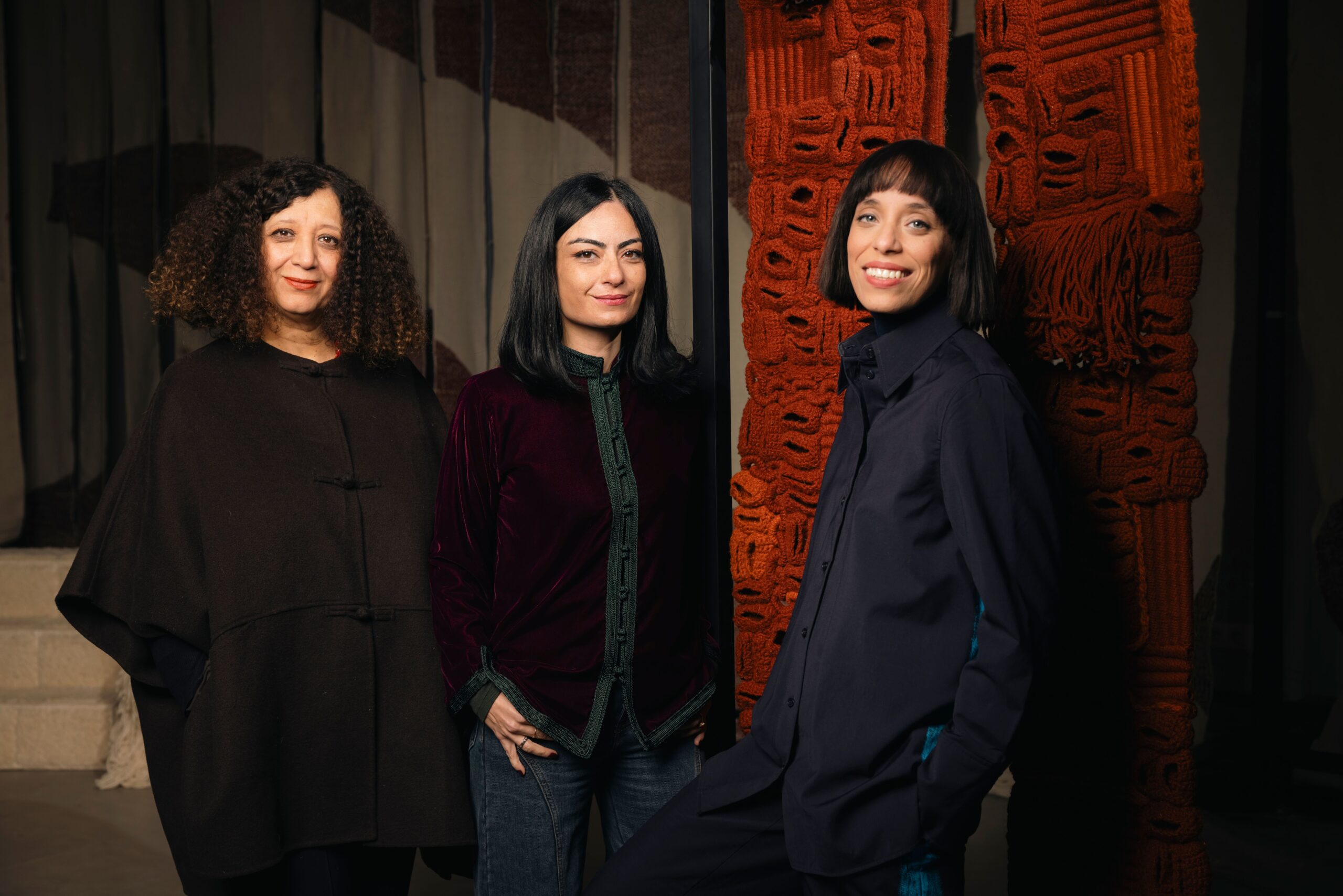
After a week of springtime rain in Marrakech, the sun had returned on the morning that I paid a visit to the artist Amina Agueznay, whose atelier and archives are located to the north of the city’s bustling core. From the upper terrace of a multi-unit building dripping with fuchsia bougainvillea and surrounded by leaning palms, she waved a small group of us up to meet her.
Upon climbing the outdoor tiled steps, we arrived at a selection of large, beautifully woven works staged en plein air. There was fibrous raffia that had been draped to highlight a subtle blocked pattern; long dyed raffia panels stitched with abstract organic motifs; complex layers of openwork repeated as zigzags or circles; and an off-white cubic ottoman as shaggy as a puli dog.
If textures were languages, Agueznay speaks in a polyglot of woven surfaces. Welcoming us with tea and almond cookies, she exclaimed, “We really want to make this first participation a success.”
There are, in fact, several firsts on Agueznay’s horizon. When la Biennale de Venezia unveils its 61st International Arte Exhibition on May 9, the Kingdom of Morocco will have its first official national pavilion within the Arsenale. (Morocco held a pavilion at last year’s Architecture Biennale and had presented smaller projects in 2005 and 2009.) Last summer, Agueznay was selected to represent her country, in tandem with curator Meriem Berrada. While they have worked together on museum and gallery shows since 2018, this is their first collaboration at this scale, and with so much visibility. They are supported by even more women, including Agueznay’s head artisan; her head of production, Miryam Alaoui Harroni; archive and research consultants, and head of communications.
“It’s important to see the dynamic of the team, because without them, there wouldn’t be a Biennale,” Agueznay said to our group, her voice breaking just a little, as she noted how the contributing craftspeople—some 166 of them from across Morocco’s regions and associated provinces—were just as essential. “I wish they could all come to Venice, but we will celebrate in Marrakech.”
After two days with Agueznay, 62, it was clear that she has been reveling in the ambitiousness of this project. She has been expending an immense amount of time and emotional energy, recognizing that the honor also carries a certain responsibility. She loves to speak about what she does and how she reached this moment—spanning her formative childhood as the daughter of a Moroccan artist mother and a urologist father; her training as an architect in the United States and pivot to jewelry design back in Morocco; and the start of her own artistic practice and “work in the field” with the artisans.
Especially in Marrakech, where dreamy destinations like the Jardin Majorelle and Yves Saint Laurent Museum, or else the exciting independent art scene (see: Comptoir des Mines Galerie and Loft Art Gallery), are a testament to the country’s wide-ranging cultural vibrancy, Agueznay is a wonderful standard bearer for advancing traditional craft into a contemporary artistic vernacular.
“To be an artist is a calling, but also a full-time job,” she told me during one of our meals together. She also refers to herself as an “artisan-creator,” especially when she is working with public institutions such as the Ministry of Tourism, Handicrafts and Social and Solidarity Economy or regional development agencies (we were visiting as guests of the Minister of Youth, Culture and Communication) on initiatives with the artisans.
The theme of this year’s Biennale, In Minor Keys, was conceived by esteemed contemporary art curator Koyo Kouoh, who died last May at the age of 57. It allows for broad interpretation, but generally invites an exploration of more nuanced narratives, which would seem to chime with the symbols and stories that are embedded throughout Agueznay’s visual poetry.
What does her pavilion entail? Titled “Asetta”—when written with the proper accents, the Amazigh word refers to ritual weaving—her concept uses weaving and other crafts as a giant, immersive metaphor for transmission. This encompasses ideas that are spatial (think architectural second skin membranes and thresholds), intangible (knowledge and shared memory), and skill-based (think basketweaving or silversmithing).

Asǝṭṭa, 2026. Detail. Created by artist Amina Agueznay. Courtesy Moroccan Ministry of Youth, Culture and Communication ©️ Ayoub El Bardii
Photo: Courtesy of Amina Agueznay
Due to an unlucky wrinkle in logistics, roughly 90% of the artwork’s components had departed for Venice the day before we met. Yet Agueznay made up for this with a show-and-tell of pavilion prototypes, previous works, and samples from the shelves of an anteroom stacked with containers of beads, silver pieces, and samples of fabric.
Agueznay may no longer practice architecture, but she remains attached to foundational principles of materiality and scale. As she describes it, the 300-square-meter space in Venice will mainly be filled with upwards of 200 bands (eight feet long in two widths, up to nearly a foot) suspended from the ceiling, all woven from naturally dyed, spun wool in the Tiflet region. Some of the bands will have tactile insertions, much like a low-relief frieze; other areas of the pavilion will be teeming with small beaded creatures—scorpions, lizards, lions—that connect back to Venice (the winged lion in the Piazzetta di San Marco is an enduring symbol of the city).
There will be a designated area to sit and reflect, but Agueznay realizes some visitors may simply wander through—though hopefully not before they notice the gold within the walls. When she moved from New York back to Morocco in 1997 to be closer to her family, she began making jewelry, which will also be integrated throughout the pavilion. “At a certain point, the piece leaves the bodies and enters the space,” she said, adding that in this way, “All [my] work has a talismanic or protective quality.”

Malika Benmoumen
Photo: Ayoub El Bardii
There are also recurring nods to sacred femininity, ranging from a panel bearing a womb-like shape in henna to a remarkable piece, crafted by head artisan Malika Benmoumen and other women, that appeared to be populated with mini cocoons—forms created by crocheting over, and then removing, rocks and stones that Agueznay had gathered. “This is the memory of the pebbles,” she said.
At one point, she unfolded a traditional veil covered with vibrant orange embroidery and showed us a smaller, scarf-like iteration that the artisans could take around to find new markets. “I am very aware of my impact in the field. I never impose a technique or a way of working. It must come from them,” she explained. “I won’t ask them to change their technique. Who am I to do that? There must be respect for their craft.”
According to the pavilion’s commissioner, Mohammed Benyaacoub, Morocco’s decision to participate in the Biennale—an initiative fully financed by the minister of culture, whose budget nearly doubled between 2019 and 2026—dates back two years. “Public decision-makers have finally understood that culture is a major asset, one that had more or less been overlooked before,” he told me. “We are now realizing that we have a culture that is extremely rich, very ancient, and highly diverse. There is a real creative force there and artists today are deeply engaged in it.”
Berrada, who is 40 and based in Marrakech, dresses with a cool confidence, one day in a summery suit, the next in a vibrant tunic of azure blue and chartreuse. She is the art director of MACAAL, the Museum of African Contemporary Art Al Maaden, a must-see institution in Marrakech that exhibits the private collection of the Lazraq family. Two works from Agueznay and one from her mother are on display in its permanent exhibition.
In fact, embroidered red raffia “guardians of the thresholds” interpreted from tiles of feminine symbols created by Agueznay’s mother, Malika Agueznay—a respected painter of the post-independence generation—will also be incorporated into the pavilion. “There is always the idea of strata in Amina’s life and practice, so she integrated that in the strata to reveal what the building could have been in a past life,” Berrada explained, adding that her role is to bring structure to Agueznay’s vision. She also joked that, for all the decorative and tactile elements, the result will not appear like a massive bazaar.

Asǝṭṭa, 2026. Detail. Created by artist Amina Agueznay. Courtesy Moroccan Ministry of Youth, Culture and Communication ©️ Ayoub El Bardii
Photo: Courtesy of Amina Agueznay
“I think her work embodies everything one could hope for; it’s a kind of perfect alchemy.” About the artisans, Berrada added, “Amina has long said, ‘I want to put them on the map.’ And in one way or another, that’s exactly what this is—showing these talents, these people.”
Agueznay, whose main home is in Casablanca, where she lives with her husband, doesn’t just exude an abundance of warmth and generosity toward humans; at the atelier, she also cares for at least 30 cats. Out of respect for any allergy sufferers, they were excluded from the visit; except for one who found its way to a table where I was speaking with Agueznay and Berrada. Also present was Benmounmen, a constant presence in Agueznay’s practice since 2018 as equal parts liaison and an extra set of highly capable hands. Here, she sat embroidering silver sequins along a panel, the result suggesting light glinting off the Venetian canals.
In 2009, local master artisans known as mâalmines in the south of Morocco showed Agueznay a type of bead that they described as a stone from the desert, only for the artist to recognize them as a kind of rosetta (a bead crafted using a colored glass technique that flourished in Murano during the 15th century). While the parallel is not proven, it aligns with the circulations, migrations and connections linking the Mediterranean across centuries. The exhibition will feature both forms.
Amid all these ancestral gestures and practices, one wonders whether younger women are joining their ancestors and carrying on the craft. “In the Souss-Massa region, you do have transmission. In the Middle Atlas [Mountains], yeah but, well…” Agueznay trailed off. “I’m a hopeless fool. And I think that’s why I do what I do. That’s why I’m out on the field. Because for me, maybe that’s my mission on this planet. At some point, you sit down and say, ‘Maybe this is my calling.’”
