

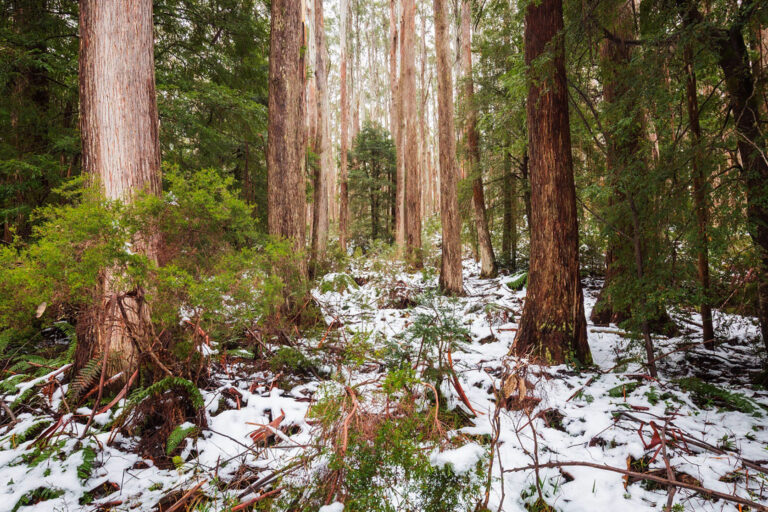
- Australia’s Alpine Ash forests have been listed as an endangered ecological community, with logging, repeated high-severity fires, and increased flammability in regenerating forests driving their decline.
- Conventional forestry practices such as mechanical thinning and prescribed burning are presented as solutions, but a growing body of evidence suggests they can increase fire risk and further destabilize these ecosystems.
- The evidence points toward a different path—halting logging, avoiding disturbance-based interventions, and investing in fire detection and recovery—argue David Lindenmayer, Phil Zylstra and Chris Taylor from the Fenner School of Environment and Society at The Australian National University.
- This article is a commentary. The views expressed are those of the authors, not necessarily of Mongabay.
In March, the Australian Government announced that the Alpine Ash forests of mainland Australia have been listed as an Endangered Ecological Community under national environmental law. The Australian Government made the decision based on the recommendations of the independent Threatened Species Scientific Committee, although it has been opposed by logging lobby interests such as the Australian Forest Products Association (AFPA).
Australian Alpine Ash forests are extraordinary places; they support trees up to 60 meters tall and provide habitat for a range of threatened species such as the critically endangered Leadbeater’s possum. Alpine Ash forests have been listed as an Endangered Ecological Community for several key reasons, the primary ones being widespread logging, recurrent high-severity wildfire, and the fact that logged and regenerated forests are more flammable than intact forests. Importantly, young Alpine Ash trees have a prolonged juvenile period during which they do not produce viable seeds. As a result, repeated fires at short intervals have the potential to eliminate stands of Alpine Ash altogether.

There is great urgency to protect Alpine Ash forests as an iconic and important ecosystem. Robust ecological science is needed to do this. An example that underscores this urgency is the Alpine Ash forests in the Central Highlands of Victoria, where only 0.47% of their extent remains as old-growth forest. Extensive logging practices have also resulted in the death of many Alpine Ash trees, which are becoming increasingly rare However, some foresters have suggested that conventional forestry methods should be used in Alpine Ash forests to reduce fire risks. That is, to save Alpine Ash forests, they must be thinned, and surrounding forests must be prescribed burned. Yet a growing body of evidence shows that traditional forestry methods—such as large-scale logging, extensive mechanical thinning, and widespread prescribed burning—have not only failed to protect forests but in many cases have significantly increased fire risks, contributing to ecosystems like Alpine Ash now being endangered. In other words, these methods are helping drive the problem by making forests more flammable. Perhaps this should not surprise us. Tools developed to maximize profit from forestry operations are unlikely to address the complexities of changing fire regimes.
The problems of mechanical thinning
Mechanical thinning is a forestry technique intended to accelerate the production of sawlogs. Forestry manuals have long warned that thinning in ash-type forests increases fire risk, but in 2015 an Australian Government initiative funded research into whether the technique could instead reduce that risk.
Thinning typically removes up to 50% of the trees in an Alpine Ash forest, with the goal of reducing competition so that the remaining trees grow faster. This can increase tree growth, but for fire management the details matter. Thinned forests may produce sawlogs more quickly, but large quantities of fuel are left on the ground. One study found up to 24 tonnes per hectare of debris left on the forest floor following thinning operations. Silvicultural manuals published by the Victorian Government note the increased fire risk posed by these fuels. A Tasmanian Government forestry manual on thinning in Alpine Ash forests warns:
Tree crowns (heads), bark, and other harvest residue make up the fuel load. The climate on the forest floor is altered by thinning, with higher wind speeds and air temperatures, lower humidity, and lower moisture content in the fuel. Understory vegetation also changes, especially with increased light. Bracken ferns and cutting grass may grow vigorously, both of which are more flammable than the species they replace.
Because Alpine Ash trees are killed if they are scorched, the high fuel loads left from thinning do not solve the fire problem. Mechanical thinning also encourages denser understories, which can lead to more intense fires and increase the risk of ecological collapse.

This suggests there is little reason to expect that thinning for sawlog production would reduce bushfire risk. What does the empirical evidence show? Studies indicate that, particularly under severe fire weather conditions, Alpine Ash forests that have been thinned are more likely to be scorched by bushfire. Modeling studies also indicate that thinning is likely to increase fire severity. The practical implication is straightforward: thinning increases the likelihood that Alpine Ash forests will be killed by the next fire.
Beyond fire risk, widespread mechanical thinning can have other environmental impacts that undermine ecological integrity. One is the construction of road networks to move heavy machinery. These roads can increase human-caused ignitions and facilitate the spread of weeds and feral animals such as foxes and cats.
The problems of prescribed burning
Prescribed burning is a forest management technique developed in the United States to prevent succession in pine forests. British colonizers had long burned Australian forests to clear land for livestock grazing. Major public inquiries following wildfires in the late 1930s found that this practice increased bushfire risk by promoting dense understory regrowth. In the 1960s, Australian foresters argued that prescribed burning could be used to reduce fire risk. The idea of fuel-reduction burning emerged from this thinking.
The theory holds that heavier fuel loads produce larger, faster fires. However, evidence shows that severe fires are driven less by fuel weight than by dense understory and the loss of a protective canopy. In many forests, prescribed burning can worsen these conditions—a process described as disturbance-stimulated flammability.

Can prescribed burning in surrounding forests protect Alpine Ash? The answer appears to be no. Lower-elevation forests often include Mountain Ash, which is also vulnerable to repeated fire. Higher elevations include Snow Gum woodlands, which have already experienced extensive wildfire over the past two decades. In subalpine New South Wales, climate change, fire, and wood-boring beetle outbreaks are killing millions of Snow Gums. Introducing additional fire into these stressed systems would likely accelerate their decline.
The most extensive study of fire in the Australian Alps National Parks examined 36 million instances of bushfire encountering forests with different fire histories. The pattern was consistent: burning creates a short period of reduced fuel, followed by decades of increased fire risk. Either very frequent burning of small patches or no burning at all reduces risk; anything in between increases it.
A better way forward
Although the outlook for Alpine Ash forests is poor, there are steps that can be taken to improve their chances. Burning and thinning are tools developed primarily for timber production. Evidence shows they are ineffective as fire management strategies and, in many cases, counterproductive.
First, logging in Alpine Ash forests should be halted. Evidence consistently shows that logged and regenerating forests are more flammable. Past logging has created large areas of young forest that are vulnerable to collapse if burned before they produce viable seed.

Second, forestry practices such as mechanical thinning and widespread prescribed burning should be avoided. These practices do more harm than good. There is a strong case for rethinking prescribed burning in remote environments, particularly near Alpine Ash systems, where it is likely to increase flammability rather than reduce it. Burning in remote areas also does little to protect people or property.
Third, large-scale seed banks should be expanded to support artificial regeneration in areas affected by repeated fire or failed regrowth after logging.
Finally, investment in fire detection and rapid response is essential. New drone and observation technologies offer opportunities for early detection. Increased availability of small aircraft capable of operating in mountainous terrain could help contain fires before they spread. Remote-area firefighting teams are effective but under-resourced. As climate risks grow, reliance on volunteer labor is no longer sufficient. A larger, well-funded professional workforce will be needed to respond to wildfire, floods, and other climate-related disasters.
Credits

