


We live in what has been called the “distraction economy”: an environment full of triggers that are engineered to demand our attention at every turn. The result is often fragmented attention, loss of focus and sometimes even increased rumination and anxiety.
Becoming fully absorbed in an activity is rare. Think of a time a film was so engrossing that you didn’t reach for your phone – the film-watching experience was no doubt the better for it. You can actively seek out this experience, which is known as “flow”. Hobbies are a great way to find a flow state and make outside distractions – work emails, unread messages, breaking news and chores – disappear.
The concept of flow was developed by Hungarian-American psychologist Mihaly Csíkszentmihályi. In his seminal 1990 book on the topic, he describes flow as: “A state in which people are so involved in an activity that nothing else seems to matter; the experience is so enjoyable that people will continue to do it even at great cost, for the sheer sake of doing it.”
Hobbies can bring joy, wellbeing, and focus to our busy lives, but so many of us don’t have one. If you’re ready to replace scrolling with stitching, or hustle with horticulture, The Hobby Starter Kit (a new series from Quarter Life) will help you get going.
Reviews of neuroscientific evidence show that being in a flow state reduces mind wandering by suppressing brain activity in the so-called default mode network. This set of brain regions covers much of the self-referential processing we do, including our inner critic. Being able to “go with with flow” is thus directly related to not having such reflective or ruminative thoughts.
The reduction of the mind-wandering brain activation means there can be more efficient activation of attention networks. During a simulated car-racing task, researchers showed that objective mental effort and gaze focus were highest during flow conditions, even though participants reported the experience as more effortless. Flow doesn’t mean less attention – it means that attention is so efficiently allocated to the task that self-monitoring and distraction fall away.
However, flow is not the same as “hyperfocus”. In fact, they can be negatively correlated with each other. In a study with 85 college students with and without attention deficit hyperactivity disorder (ADHD), students with clinically significant ADHD symptoms reported higher hyperfocus, but lower flow on many measures. The key difference seems to lie in control: flow is directed and intentional, whereas hyperfocus tends to happen to you. But that raw capacity for absorption may be an asset – with the right conditions, like clear goals and a well-matched challenge, it could be channelled into genuine flow.
How to find your flow
Hobbies are a great mechanism for finding a flow state. Sports have been extensively researched as a flow-inducing activity. In a study of 188 junior tennis players, concentration on the task and sense of control were the two aspects of flow that most strongly predicted whether a player won or lost their match. However, it is not just about winning. A study with 413 young athletes aged 12-16, found that participants who were focused on effort and improvement, rather than winning, reported more flow.
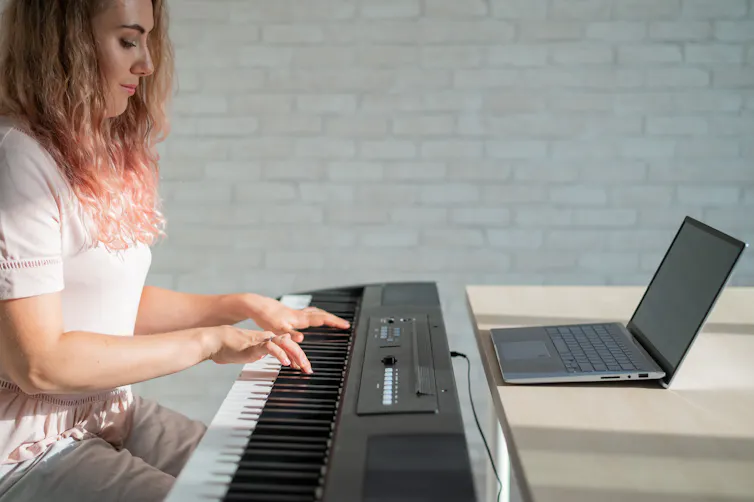
Music is another rich domain for flow. In a survey of daily practice, 35 music students aged 12-18 indicated that concentration, emotion and clear goals were central to achieving flow. Eighty percent of the teenagers reported that being able to choose their own repertoire was a highly significant motivational factor.
Another study found that the balance between the challenge of a musical passage and the musician’s perceived skill consistently predicted the flow experience. Flow might also buffer against performance anxiety: when 27 student musicians were tracked over the course of a semester, it was found that when flow was at its highest, performance anxiety was at its lowest, and vice versa.
Reshetnikov_art/Shutterstock
If neither sports nor music are your thing, you may want to consider games. In a project I recently ran with a student, we investigated flow during tabletop role-playing games such as Dungeons and Dragons, and compared it to video games. Being in a flow state was associated with greater satisfaction with social interactions with friends, in particular for those who played tabletop games.
For those who play video games, gaming was associated with high monotropic flow – being so absorbed it is difficult to quit playing. These findings align with other research showing that a flow state during gaming can be so absorbing it makes you go to bed later – something to consider before picking up a new hobby.
Another form of role-playing is theatre and drama. In my previous work, I found that acting students experience significantly more flow than psychology students when they imagine scenarios as fictional people (like Romeo and Juliet), but not when imagining scenarios as oneself or one’s best friend. This reflects the effects of developing a practised skill. And, staying in a flow state while acting might ultimately culminate in a high-level performance.
Committing to a hobby and finding your flow might not only help you reduce outside noise (work or social media distractions), but also your own internal noise, such as mind wandering or rumination. Becoming fully absorbed in an activity is rare in the world of distractions, but can pay off for your brain.
