

The Artemis II astronauts broke out of Earth orbit and headed for the moon Thursday, firing their main engine for nearly six minutes to boost the ship’s velocity to 24,500 mph, the speed required to escape Earth’s gravitational clasp.
Racing through the low point of a highly elliptical orbit, Artemis II commander Reid Wiseman, Victor Glover, Christina Koch and Canadian astronaut Jeremy Hansen closely monitored the make-or-break “trans-lunar injection,” or TLI, engine firing, which added 867 mph to their already high orbital velocity.
The shuttle-era Orbital Maneuvering System engine at the base of the Orion capsule’s service module fired at 7:49 p.m. EDT at an altitude of just 115 miles. When the engine shut down, the Orion capsule was departing Earth on a so-called free-return trajectory that will carry the astronauts around the far side of the moon Monday and then back toward Earth without any other major rocket firings.
“And Houston, (this is) Integrity,” Hansen radioed when the burn was complete. “Just wanted to share a little bit of the sentiment up here as we came around the planet and were zooming over just a hundred nautical miles above it, if you’ve got a moment.”
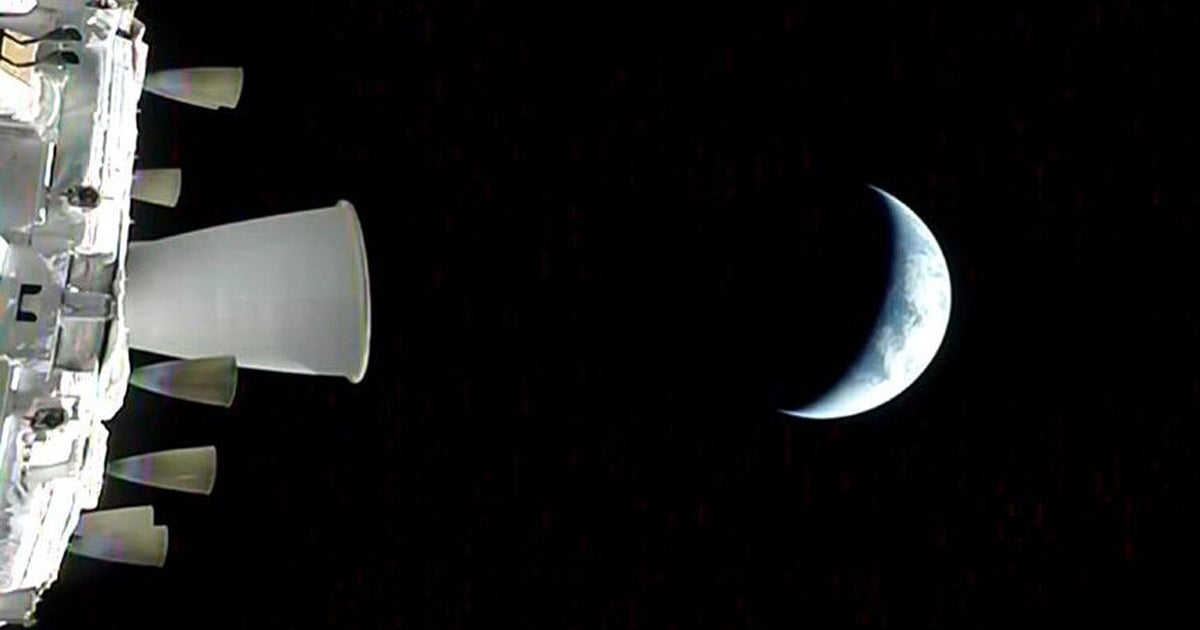
A spectacular view of the crescent Earth was beamed down by cameras on the Artemis II Orion capsule early April 2, 2026, as the spacecraft orbited Earth in a highly elliptical orbit at altitudes up to 40,000 miles or more. NASA 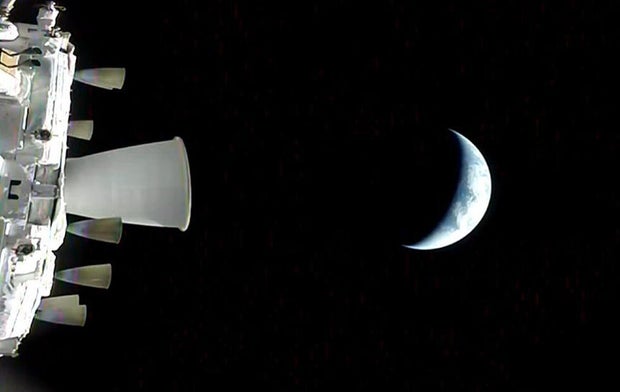
“Please, Jeremy, we’re all ears,” mission control replied.
“Well, with that successful TLI, the crew’s feeling pretty good up here on our way to the moon,” Hansen replied. “We just wanted to communicate to everyone around the planet who’s worked to make Artemis possible that we firmly felt the power of your perseverance during every second of that burn. Humanity has once again shown what we are capable of, and it’s your hopes for the future that carry us now on this journey around the moon.”
Looking on in mission control at the Johnson Space Center in Houston was NASA Administrator Jared Isaacman, a billionaire entrepreneur, space flight veteran and architect of a revamped moon program aimed at making moon flights a twice yearly occurrence on the way to building a U.S. base near the lunar south pole.
Watch: Artemis II astronauts take questions on their way toward the moon
21:23
A few moments after the TLI burn, now outbound from Earth, Hansen called down to say, “We are getting just a beautiful view of the dark side of the Earth lit by the moon. Phenomenal.”
“That sounds amazing,” the mission control spacecraft communicator replied. “We hope you’re taking some pictures for us.”
“Yeah, none of us can get to lunch because we’re glued to the window. We’re taking pictures. Reid says he just can’t take it anymore.”
“There was a moment, about an hour ago, where mission control Houston reoriented our spacecraft as the sun was setting behind the Earth…but you could see the entire globe from pole to pole, you could see Africa, Europe, and if you looked really close, you could see the Northern Lights, it was the most spectacular moment, and it paused all four of us in our tracks,” Wiseman later said when the astronauts fielded live questions from reporters late Thursday night.
“It was pretty tense moments there for a second,” Wiseman told reporters of the TLI experience. “And when we got done with that burn, we just kind of looked at each other as a crew. We have been to the moon before…It’s been a long time since we’ve been back, and I got to tell you, there is nothing normal about this. Sending four humans 250,000 miles away is a Herculean effort, and we are now just realizing the gravity of that.”
Launched from the Kennedy Space Center Wednesday, Wiseman and his crewmates spent their first “day” in space testing their Orion capsule’s myriad systems.
They also checked out the capsule’s maneuverability and adjusted its highly elliptical orbit to line them up for the free-return trajectory to a loop around the lunar far side Monday.
NASA’s Mission Management Team met Thursday and after reviewing the Orion’s near-flawless performance, cleared the spacecraft and its crew for the critical TLI burn.
“Hey just to make it clear in the open here, we are go for TLI after the MMT concluded their deliberations a few minutes ago, and we’re going to proceed down that path and get ready for the burn here,” radioed lead Flight Director Jeff Radigan.
Replied Hansen, “Alright, Jeff. We love those words. And we’re loving the view. We’re falling back to Earth real fast and looking forward to accelerating back to the moon.”
Wiseman and his crewmates are the first astronauts to fly aboard a Lockheed Martin-built Orion spacecraft and the first to head for the moon since the final Apollo mission in December 1972.
In the process, they’re expected to travel farther from Earth than anyone before them, reaching a distance of some 252,021 miles as they fly behind he moon, beating a record set by the crew of Apollo 13 in 1970 by an estimated 3,366 miles.
But the major goal of the flight, along with putting the Orion through its paces, is to test the planning, procedures and flight control protocols for managing upcoming moon landing missions after a half-century gap between the Artemis and Apollo programs.
The Artemis II flight is seen by NASA as a trail-blazer, demonstrating the Orion crew ferry ship can safely carry astronauts to the moon and back on a regular basis, setting the stage for one and possibly two landings near the moon’s south pole in 2028.
Amid planning for those flights, NASA Administrator Jared Isaacman says the agency will send up another Orion crew next year to rehearse rendezvous and docking procedures with moon landers being built by SpaceX and Blue Origin. That flight, Artemis III, will be carried out in low-Earth orbit.
Isaacman says NASA will spend $20 billion over the next seven years to speed up the launch rate to a moon landing every six months while building a base near the moon’s south pole.
In:
