

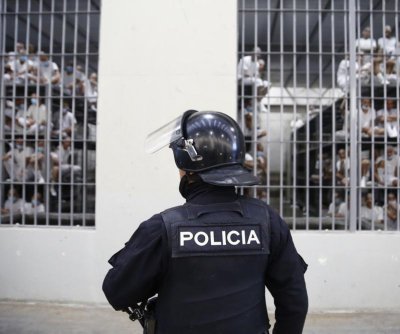
The U.N. Office of the High Commissioner for Human Rights wants authorities in El Salvador to reconsider constitutional and legal changes that allow life sentences for minors as young as 12. File Photo by Rodrigo Sura/EPA
April 2 (UPI) — The United Nations Office of the High Commissioner for Human Rights urged authorities in El Salvador to reconsider recent constitutional and legal changes that allow life sentences for minors as young as 12.
The agency warned Wednesday that the measure contradicts international human rights standards and obligations.
El Salvador’s Legislative Assembly approved the reform March 26, amending the country’s juvenile criminal law to permit life imprisonment for minors linked to criminal groups.
The change is part of broader constitutional changes promoted by President Nayib Bukele, and it expands the use of life sentences, previously authorized for adults, to include adolescents.
The reform accompanying a constitutional amendment promoted by the government of Nayib Bukele alters the juvenile justice system by removing previous maximum detention limits for crimes such as terrorism and organized crime, digital outlet Lexis reported.
The move is part of a broader tightening of criminal policy after ratification of a constitutional reform that authorizes life sentences for adults and now extends them to adolescents, with the stated goal of combating criminal networks and gangs.
Until now, Salvadoran law established that in severe cases, minors under 12 could face up to 10 years in detention, while those older than 16 could receive sentences of up to 15 years.
The new legal framework establishes life imprisonment as the only possible sentence for crimes such as homicide, femicide, rape and gang membership for those between ages 12 and 18, representing a major shift in the country’s juvenile justice model, Infobae reported.
The proposed measure was ratified with 57 votes in favor, marking a significant shift in the Central American country’s criminal policy.
In response to the U.N. statement, Bukele pointed to historical precedents. He recalled the implementation of the Juvenile Offender Law in 1994, adopted following U.N. recommendations, which he said contributed to conditions that enabled the growth of gangs in the country.
In a message on X, Bukele said past decisions, along with processes such as the deportation of Salvadorans during the administration of Bill Clinton, helped strengthen criminal structures that shaped decades of violence in El Salvador.
“So, no, thank you very much. Take your social experiments to other countries that have not suffered what we have suffered; maybe they will believe you (hopefully not). We are not going back to the past,” Bukele wrote.
¿Recuerdan el 27 de abril de 1994?
Tal vez ustedes no, pero nosotros sí.
El Salvador acababa de salir de una sangrienta guerra civil que dejó 85,000 muertos.
Luego, siguiendo sus recomendaciones, ese día se aprobó la Ley del Menor Infractor, bajo los mismos argumentos del… https://t.co/5zpwvbBqEw— Nayib Bukele (@nayibbukele) March 31, 2026
The office of high commissioner said the reform conflicts with the Convention on the Rights of the Child, which requires that children in conflict with the law be treated in a way that prioritizes rehabilitation and reintegration, and that detention be used only as a last resort and for the shortest possible time.
“Prolonged detention is deeply harmful to children, violates several of their rights and affects their development and well-being throughout life, reducing their chances of successful reintegration into society,” spokesperson Marta Hurtado said in a statement.
The agency added that improving prison conditions and ensuring full compliance with human rights standards for all detainees remain essential.
Salvadoran magistrates defended the reform, saying it is consistent with the Convention on the Rights of the Child because it does not impose a sentence without the possibility of release, the newspaper La Nación reported.
The government created a mechanism that allowed those sentenced to life imprisonment to seek a review of their sentence. Under certain criteria, this could allow them to regain their freedom in a controlled manner after 25 years in prison.
If a minor is convicted of more than one crime, the sentence review would take place after 35 years in prison. If the conviction involves an aggravated or extremely serious offense, the sentence may not be reviewed until 40 years have been served.
On March 27, El Salvador marked four years under a state of emergency aimed at combating gangs, which authorities blame for the majority of homicides in the country.
