

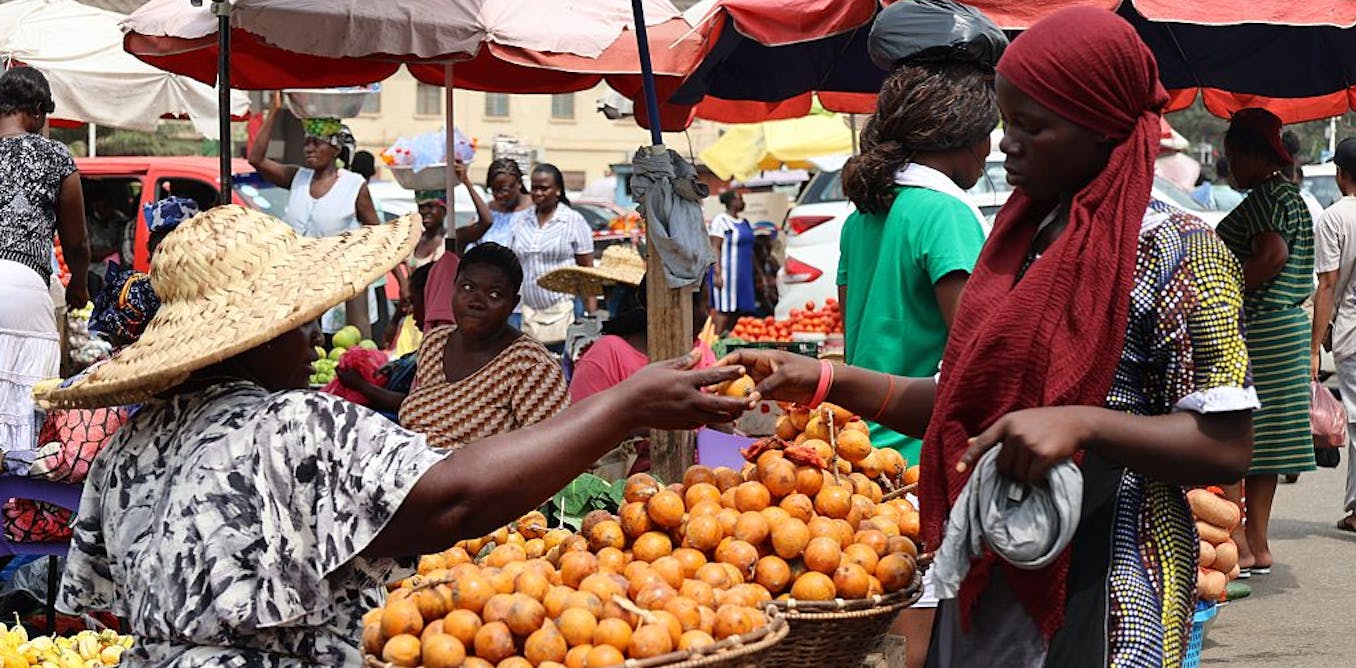
The informal economy is the basis of everyday economic life across sub-Saharan Africa. In Ghana, as in many low- and middle-income contexts, a lot of retail trade, food distribution, artisanal production and service provision happens outside formal regulatory frameworks.
Women occupy a prominent position in this world. They trade in open-air markets, process and sell foodstuffs, produce garments, provide hairdressing services and manage micro-enterprises that sustain households and anchor local economies.
Many do this work because they haven’t been able to get an education, a formal job or formal finance.
The informal economy is easier to enter – but also less secure. Enterprises tend to work without firm tenure, enforceable contractual protections or social insurance mechanisms. Income streams are volatile, exposure to risk is routine and it’s difficult to expand the business.
Despite these challenges, women’s informal enterprises play an important developmental role. They generate income where few alternatives exist, finance children’s education and contribute to local supply chains.
Public debates often portray them as vulnerable victims of poverty or as heroic symbols of resilience.
Both pictures oversimplify a far more complex reality.
We are researchers specialising in gendered entrepreneurship and informal economies. We conducted a study to explore how women in Ghana with low or no formal education sustain businesses where they are at a disadvantage, and how they deal with being portrayed as “weaker vessels”.
The research sheds light on what entrepreneurship looks like when resources are scarce, institutions are fragile and gender norms remain powerful. Our findings show resilience, as well as the hidden costs of survival in an economy where formal support systems are largely absent.
Our findings suggest that by supporting women in Ghana’s informal economy, policymakers can strengthen local markets, reduce economic precarity and enhance inclusive economic growth. Informal enterprises are deeply embedded in broader supply chains and community networks. Recognising and supporting them can increase productivity, stabilise livelihoods and create spillover benefits for the wider economy.
Life on the ground
We interviewed 21 women in southern Ghana and observed market spaces. The women were invited to share stories of actions they believed had enabled their businesses to survive despite limited resources.
These conversations highlighted the advantages associated with formal education, like access to networks, skilled labour and government programmes.
We also learned how informal women entrepreneurs kept ventures going without that kind of support. The findings pointed to informal-formal collaboration as an important, if often overlooked, linkage.
Participants described an environment marked by pervasive uncertainty:
-
threats of eviction
-
fluctuating input costs such as wholesale food prices, transport overheads and cooking fuel
-
ad hoc levies imposed by local market associations, informal gatekeepers and neighbourhood officials
-
harassment by municipal authorities.
This instability shaped how they operated.
As one trader explained:
Today you are selling peacefully. Tomorrow they can tell you to move.
The women also said they couldn’t get conventional bank finance because they didn’t have collateral, formal documentation or credit histories. Instead, they relied on rotating savings and credit associations (locally known as susu), kin-based financial support and reinvestment of modest profits.
The bank will ask for papers I don’t have. So we depend on our susu (rotating savings system).
Risk diversification was a key survival strategy. Some managed multiple activities. For example, they combined food vending with petty trading or seasonal commodity sales.
If one business is slow, the other one helps.
Equally critical were dense social networks. Fellow traders provided short-term loans, shared information about changes in prices and regulations, and offered psychosocial support.
Informal subcontracting relationships with formal enterprises sometimes provided extra income streams. This showed that informal entrepreneurship is embedded within broader economic circuits.
Participants also had to deal with people’s ideas about women as inherently fragile or dependent. Yet women’s survival depends on physical endurance, negotiation skills and financial acumen. One market trader put it this way:
If you are weak in this market, you cannot survive.
Rather than openly rejecting what people expected of women, some used those ideas to their advantage. They framed entrepreneurial activity as caregiving. This made income-generating work look more socially and morally acceptable.
I tell them I am doing this for my family. Then people accept it.
The women also spoke of the physical and psychological strains they worked under. They managed multiple income streams, absorbed market shocks and fulfilled unpaid care responsibilities.
Implications
Several recommendations emerge from our study.
First, informal women entrepreneurs should be formally recognised and supported. Simplified registration processes and flexible regulatory frameworks can help reduce barriers to formalisation. They can also give access to legal protection, institutional support and market opportunities.
With legitimised informal businesses, women would be able to operate more securely and plan for sustainable growth.
Second, access to context-sensitive finance is essential. This could include microfinance schemes, low-barrier credit products and support for community-based savings mechanisms.
Third, targeted capacity-building and social support programmes would help. This could include:
-
literacy and context-sensitive training in business management, financial literacy and digital skills
-
social protection measures like affordable childcare and healthcare access
-
time-saving interventions such as improved water and energy infrastructure.
Finally, links between informal and formal sectors need to be strengthened. Policies that encourage collaboration through subcontracting, supply chains or networking platforms can improve income stability, access to resources, and long-term business sustainability.
These measures can create an enabling environment where women’s informal enterprises don’t just survive, they thrive, and contribute to economic development.
