

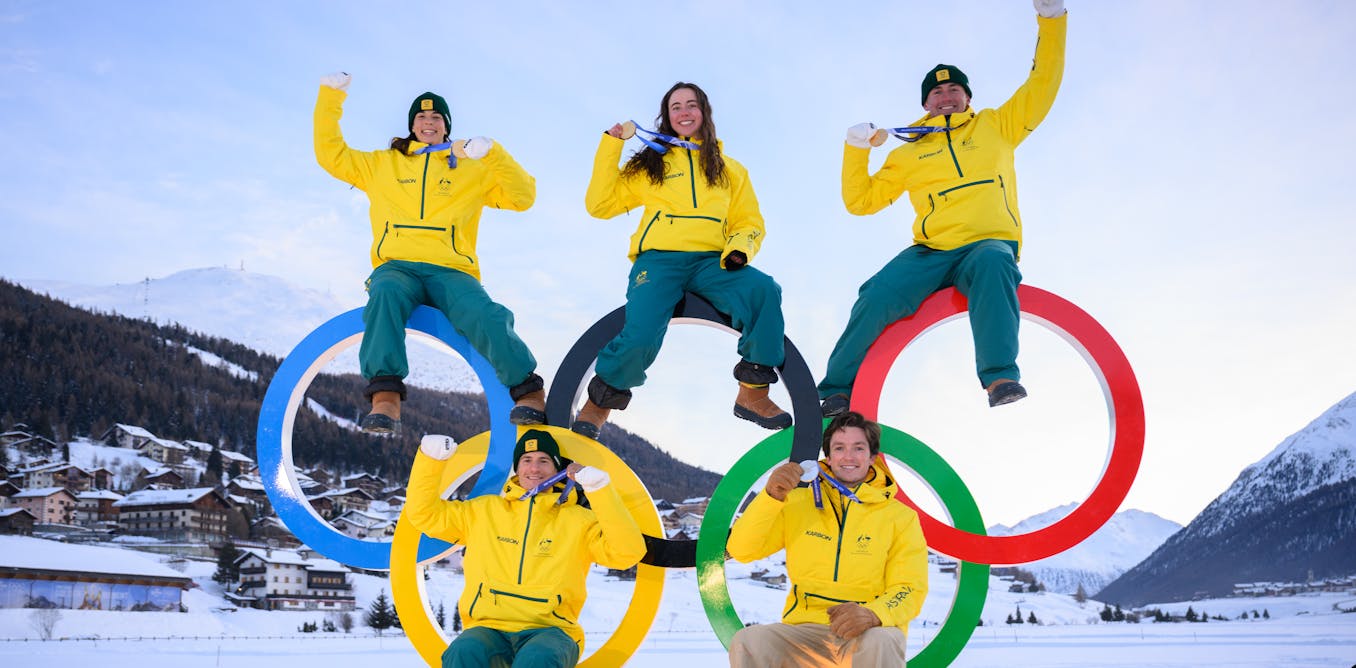
Milan Cortina 2026 was Australia’s most successful Winter Olympics.
From 1936-2022, Australia won 19 medals, including six golds.
This year, Australia has added another six medals, including three golds.
How has this happened and what may this success mean for the future of winter sports in Australia?
A medal rush in Italy
Jakara Anthony became our first two-time Winter Olympic gold medallist in the women’s dual moguls.
Cooper Woods (men’s individual moguls) and Josie Blaff (women’s snowboard cross) also won gold.
Scotty James became the first Australian to win three Winter Olympic medals with a silver in the men’s half-pipe, and Matt Graham added to his 2018 medal with a bronze in the men’s dual moguls.
Danielle Scott also won silver in the women’s aerials.
Other young members of the 53-strong team such as Valentino Guseli (snowboard half-pipe), Tess Coady (snowboard big air), Jackson Harvey (moguls) and Indra Brown (freeski half-pipe) also made finals and recorded top-ten results, indicating Australia should continue to be competitive in the future.
What are the reasons for this success?
Increased investment from the federal government has certainly helped.
In July 2024, the federal government announced A$489 million of funding for elite Olympic and Paralympic athletes, coaches and support staff for 2025-2026. This was 50% more than the previous government’s 2021- 2022 high performance funding.
This funding is focused on better support for training, wellbeing, event preparation and access to high-level international competitions.
In 2023 the federal government announced a specific winter sport funding boost of $1.1 million, while in November 2024, a $385 million package was announced for winter and summer sports, with the aim of ensuring Australians have world class pathways and support at all levels.
Investment in facilities has also been critical.
The Olympic Winter Institute of Australia was formed in 1998 to support the development of elite winter athletes.
It contributed to a world class moguls course at Perisher in New South Wales, where three of Australia’s 2026 medallists have trained.
Aerials and moguls skiers can now practise their jumps on the southern hemisphere’s first year-round ski jumping facility near Brisbane: the Geoff Henke Olympic Winter Training Centre which was completed in 2020.
It greatly reduces the need for these athletes to travel overseas to train.
Four of our 2026 medallists have trained here.
Read more:
How do Winter Olympians train compared to summer games athletes?
The National Snowsport Training Centre in Jindabyne, NSW, is also world class.
Winter athletes have benefited from Australia’s European Training Centre in northern Italy. This “home away from home” for Australian athletes greatly reduces the travel required to compete in many elite events.
So what happens now?
Australia’s success at these Olympics has pushed winter sport into the mainstream. The big question is what happens next – will more people try them, and will more funding follow?
Possibly – we have seen a similar pattern in Australia before.
After the 2003 Rugby World Cup, there was a spike in junior registrations.
Similarly, women’s and girls’ soccer registrations significantly increased following the Matildas’ performance in the 2023 Women’s World Cup.
However, this is not always the case.
For example, the 2000 Sydney Olympics did not significantly increase physical activity levels in Australia, despite our successful games.
Read more:
Does sports participation boom during (or before, or after) the Olympics?
Additionally, winter sport has tougher barriers than rugby and soccer because many are expensive, seasonal and coaches and facilities are often located far from where people live.
The Australian ski season doesn’t begin until June, meaning any surge in enthusiasm from the Winter Olympics must persist for months before people can access domestic snow fields.
The Australian Sports Commission estimates about 184,500 Australians (aged 15+) skied or snowboarded at least once in 2024.
So, there is real interest but those numbers are small compared to other popular sports.
Continued funding for athletes and facilities will help ensure greater opportunities for Australians to engage in snow sports.
Currently, non-elite athletes in Australia have limited access to year-round facilities, although some developments are being proposed in major cities.
While recent funding has contributed to our success in Milan Cortina, there are concerns about this funding continuing.
There are calls for further investment in winter sports, while Australian’s chef de mission Alisa Camplin-Warner hopes the winter games won’t be forgotten as Australia increases its focus on the Summer Olympics in Brisbane in 2032.
Australia’s success at the Winter Olympics could inspire other Australians to pursue snow sports. But if Australia wants a “Matildas effect” for winter sports, they must become easier to access for the general population.
This can happen through continued facility development, cheaper learn-to-ski/ride programs, more school links and more pathways through Snow Australia.
