


As Uno Minda sharpens its focus on technology-led products, premium feature adoption and electrification, the company remains confident of sustaining growth ahead of the broader auto industry, supported by a strong and expanding product pipeline and deeper engagement with original equipment manufacturer (OEM) customers across segments.
That confidence is underpinned by a steady financial performance. In the October-December quarter of 2025 (Q3 FY26), year-on-year, Uno Minda reported revenue growth of 20% at ₹5,018 crore (vs ₹4,184 crore), earnings before interest, taxes, depreciation and amortisation (EBITDA) up 21% at ₹554 crore (vs ₹457 crore) and an EBITDA margin of 11% (vs 10.9%).
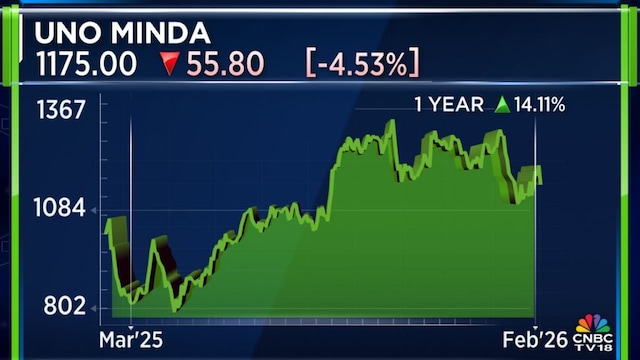
The Gurugram-based company has a market capitalisation of about ₹68,034.31 crore, and its shares have gained nearly 14% over the past year.
Below are the edited excerpts from the interview with Sunil Bohra, Group Chief Financial Officer, Uno Minda Group.
Q: India–US and India–EU, the free trade agreements (FTAs), in what way does this change things for the Indian auto component sector, and what are the tangible benefits that you see?
A: It definitely opens up a lot of opportunities for exports from India. We have been seeing that a lot of the auto component players like us have been exporting to the EU and the US. And now, with this stability in terms of tariffs and clarity, and also tariffs going down, definitely, it will open up a lot of opportunities. For example, we have also been in discussions with some of our customers. But because of some of these situations, things have not been progressing as one would have expected. Now that we have the clarity, things will speed up, and it will definitely open up a lot of opportunities for exports of auto and auto components.
Also Read: Bajaj Auto sees export run-rate holding above 2 lakh units a month
Q: When we look at the auto sales numbers, it looks like the entry-level cars have done better, and that impacts the value proposition for you — yours is a premiumisation play. What should we expect in terms of volume and value growth going forward?
A: In terms of vehicles being sold and with the current goods and services tax (GST), it was expected that it would trigger more entry-level two-wheelers and four-wheelers sales. And that’s what the data has been suggesting, because their kit value, obviously, is lesser in an entry-level car versus a premium car or a premium bike.
Having said that, there has been a change in terms of the adoption of a lot of these premium features. So as the cost goes down, as the volume increases, even these premium features — which, say, for example, used to be in entry-segment cars or 350cc bikes or 250cc bikes — have been coming down to D-segment and C-segment vehicles, etc. So, the adoption has been increasing. For example, airbags used to have very low penetration. Now, it has been consistently increasing. The same thing goes for alloy wheels and some of the lights.
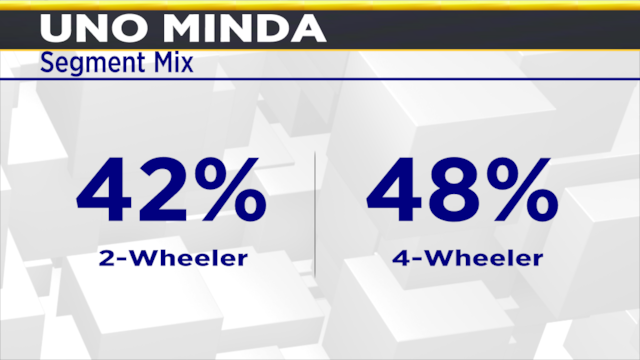
As we move forward, we do expect this premiumisation play even to get into some of these entry-level segments — maybe not in the base models, but definitely in terms of the upper models of those same segments. Moving forward, we do expect this momentum to continue.
Also Read: US duty relief could trigger fresh orders for Indian industrial and auto suppliers
We have been significantly expanding in terms of our product profile and in building our capacities in line with our customers. We are pretty confident that this growth momentum will continue. We are not going to give actual growth numbers because we do not normally talk about the OE one, but definitely our endeavour has consistently been, on an annual basis, whatever the industry grows, we consistently grow at least 1.5 times or more, and we are pretty confident that we should be able to deliver that.
Q: How do you see the business evolving from here on? If you tell us the content per vehicle that you’re dealing with currently — both two-wheelers as well as four-wheelers — and how you see that number scale up? Give us a broader time horizon, say, in the next 12 months, as well as 24 months. How do you see this improving, because you have been hinting about this in the past?
A: There are some products which are currently in the development phase and which will get into the production phase sometime in the next calendar year. For example, sunroofs will get into production next year. Some of the EV-play components for four-wheelers will get into production next year. Some of the two-wheeler components will get into production next fiscal year.
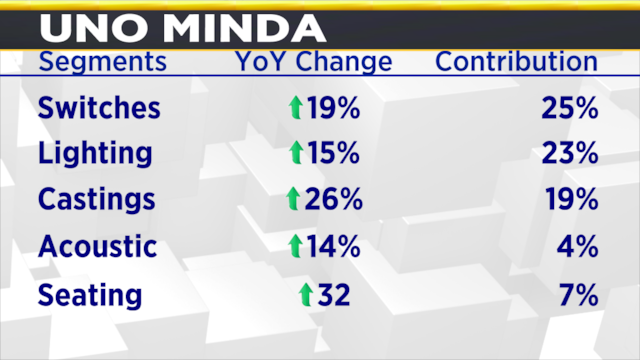
There are a lot of these products which will get into SOP at the end of 2026 and early 2027, so this consistently will help us improve our offering per vehicle, which will actually translate into the actual realisable. On top of it, some of the existing products are also seeing some switches getting into habit-based switches, or horns getting into electromechanical horns. Electrification for lamps has been a consistent journey for the last few years, and we have been seeing that sensor adoption is increasing. So, we are very optimistic.
Watch the interview in the accompanying video
Catch all the latest updates from the stock market here
