






The loudest parenting moments are rarely the ones children carry with them. More often, it’s the quiet ones — the parent who didn’t say what they were thinking, who sat down instead of standing over, who asked one question instead of ten.
These twelve parents each faced a moment that could have gone differently. They chose kindness when it was hardest to. Their children noticed.




- My daughter told me she didn’t get into any of the universities she’d applied to. Not a single one. I didn’t say everything happens for a reason. I didn’t say there are other options.
I just said, “I’m coming upstairs.” I sat with her on her bed and let her be devastated for as long as she needed to be. Later that week, quietly, I helped her research an application she hadn’t considered.
She starts there in September and last month told me it was the best thing that ever happened to her. I didn’t remind her I’d thought so too.
- My son told me at seventeen that he wanted to drop out of school and travel for a year. I disagreed completely. I thought it was avoidance dressed up as adventure. But I’d watched my own parents argue me out of things I later regretted, and I didn’t want to be like that.
So instead of saying no, I asked him to spend one month writing down exactly what he wanted from the year — what he’d learn, how he’d fund it, what he’d come back to. He worked on it seriously.
By the end of the month, he’d talked himself into deferring rather than dropping out. He went, came back, and finished his degree. He thinks it was his idea. It was.
- My daughter’s best friendship ended badly in her second year of high school — the kind of falling out that happens publicly, that the whole grade witnesses. She came home that first day destroyed.
I’d met that girl’s mother at school events for years. Part of me wanted to call. Part of me wanted to tell my daughter exactly what I thought about how she’d been treated.
I did neither. I just kept things at home as steady and warm as I could while she rebuilt. She found her people. It took time. But she found them herself, which I think mattered.


- My son got caught cheating on a school assignment when he was sixteen. Not plagiarism — he’d copied directly from a classmate. The school handled the consequences and I let them.
What I said at home was this: tell me why. Not accusatory. Just genuinely — tell me why. He talked for a long time. He’d been overwhelmed, too proud to ask for help, scared of falling behind.
We talked about all of it. I didn’t add punishment on top of the school’s. I think that surprised him more than any punishment would have.
- My daughter didn’t make the team she’d been working toward for two years. She’d trained hard, it meant everything to her, and she didn’t make it. I watched her in the car afterward — she stared out the window the whole drive home and didn’t say a single word.
I didn’t fill the silence. I didn’t tell her she’d done her best or that the coach had made a mistake. I just drove.
When we got home I made dinner. She came to the table. We talked about other things. The next morning she asked if we could go back to training. I said yes before she finished the sentence.
- My teenage son came home with a failing grade on an exam he’d told me he was prepared for. I’d helped him study. I was frustrated and he knew it. He was already humiliated without me adding to it.
I took a breath and asked one question — what do you think went wrong. He talked for twenty minutes. By the end he’d diagnosed the whole problem himself. I said almost nothing.
He came back three weeks later with the highest grade in the class on the retake. He taped it to the refrigerator himself.


- When my son was twelve he broke something in the house that I’d told him repeatedly to be careful around — something that had belonged to my father. He came to me holding the pieces, white-faced, clearly terrified of my reaction. I looked at what he was holding. I felt the loss of it, genuinely.
Then I looked at my son’s face and thought about what I was teaching him in that moment about whether it was safe to come to me with broken things. I said, “Thank you for telling me.” I put the pieces in a box. I still have them.
- My daughter asked me when she was fifteen if I’d ever done anything I was ashamed of. We were driving and she asked it quietly, looking out the window. I understood it was not a casual question.
I could have deflected. Instead I told her the truth about something I’d done in my twenties that I wasn’t proud of — not the details, but the shape of it, the why, the what I learned. She was quiet for a while.
Then she told me something she’d been carrying for weeks. I don’t think she would have if I’d pretended to be someone without a history. That conversation changed something between us.
- My son went through a period at sixteen of being genuinely unkind — to me, to his sister, dismissive and sharp in a way that hurt to be around.
I didn’t match it. I didn’t punish my way through it. I just kept showing up — kept asking about his day, kept making his favorite dinner on Fridays, kept being steady.
One evening he came downstairs and said, “I don’t know why you’re still nice to me.” I said, “Because you’re going through something hard and that’s what I’m here for.” He didn’t say much. But something shifted that week.


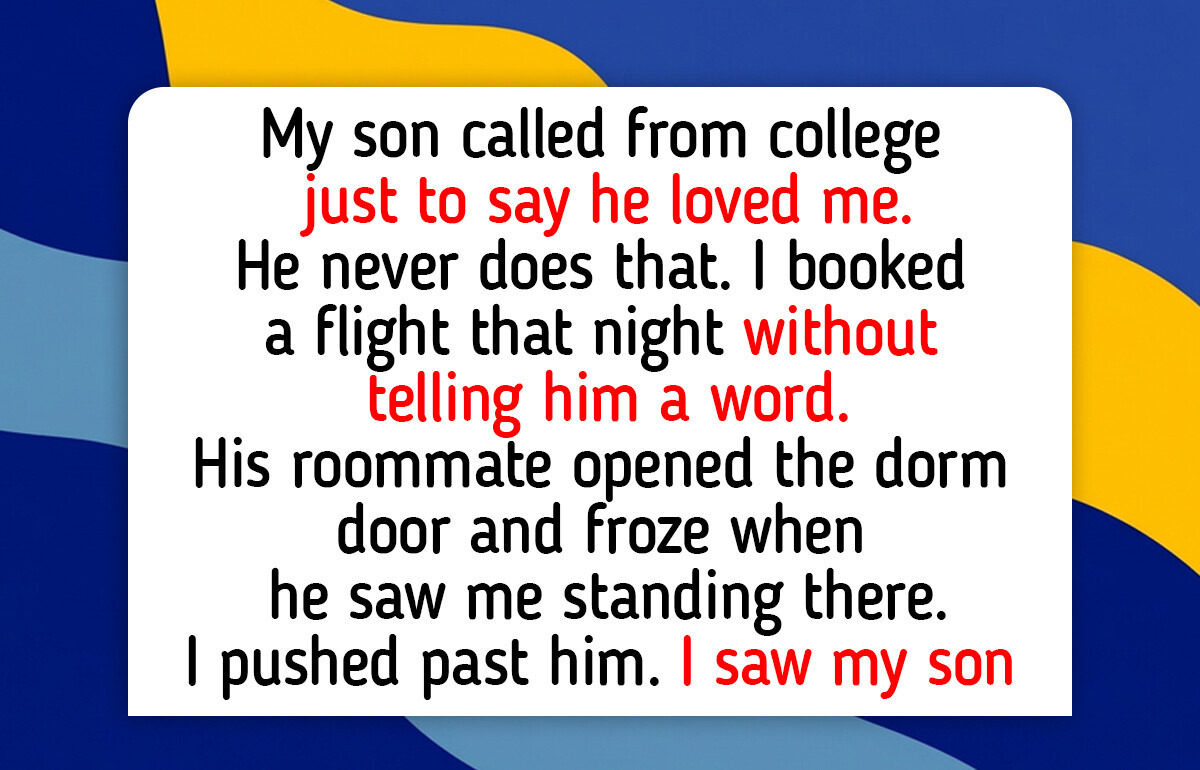
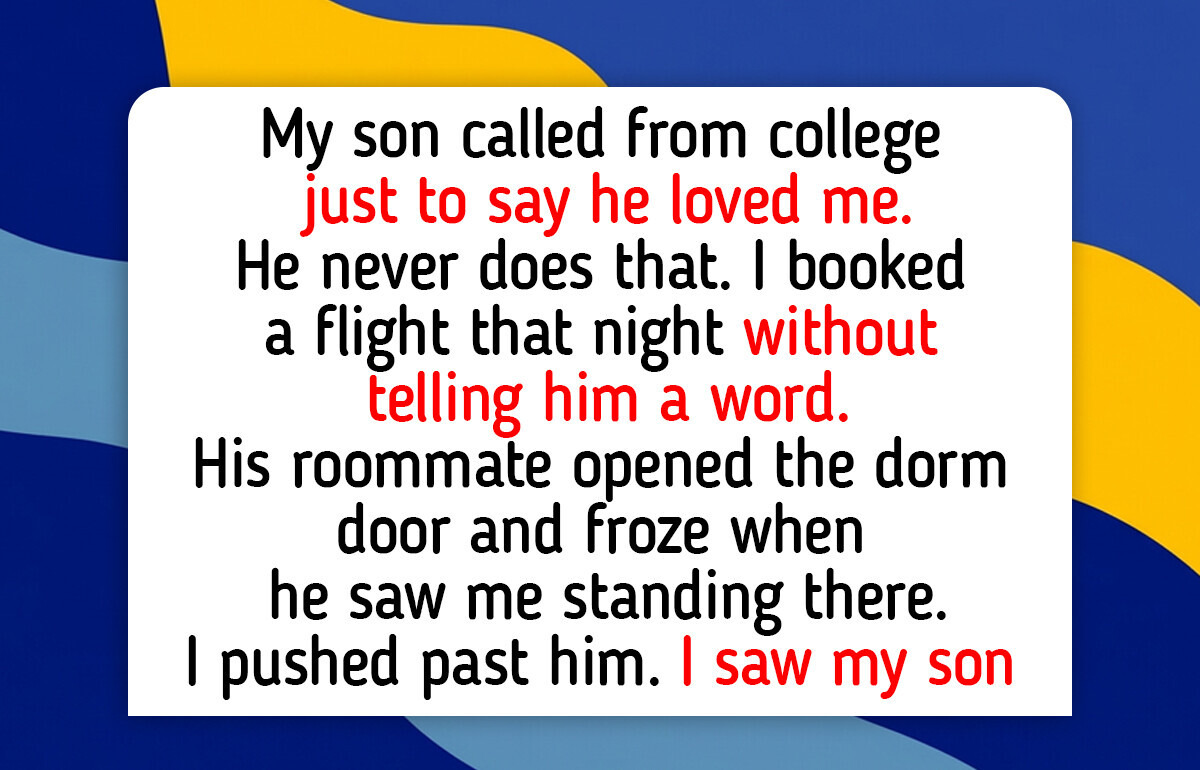
- My son called from college just to say he loved me. He never does that. I booked a flight that night without telling him a word.
His roommate opened the dorm door and froze when he saw me standing there. I pushed past him. I saw my son sitting on his bed surrounded by textbooks, dark circles under his eyes, quietly falling apart over two failing grades he hadn’t told me about.
He looked up and said, “What are you doing here?” I said, “You called me.” He didn’t say anything for a moment. Then he just put his head in his hands.
I didn’t lecture him. I ordered food, sat next to him, and we talked until two in the morning about pressure, about asking for help, about things neither of us had said in years. I flew home the next morning. He passed both classes.
- My son was twelve when his father and I separated. He stopped talking about feelings completely — just went quiet and held everything in. I didn’t push. I found a way to be near him without demanding anything.
I started watching whatever he wanted to watch in the evenings, sitting next to him on the couch without an agenda. Slowly, over months, he started narrating what was on screen, then commenting on things, then telling me about his day.
We never had a big conversation about the divorce. We had a hundred small ones, sideways, while watching television.
- My daughter told me she didn’t want to go to university at all. She was eighteen, and I had very different ideas about what her life should look like. She sat across from me at the kitchen table and said it plainly. I didn’t argue.
I asked her what she wanted instead. She talked for an hour — it was the most I’d heard from her in months. We made an agreement: one year to pursue what she’d described, with real structure and real goals.
Three years later, she has a business that supports her and two employees. I had almost argued her into a degree she would have resented.
Comments
Lucky you! This thread is empty,
which means you’ve got dibs on the first comment.
Go for it!


